
Welcome to the Soccer Tavern, where we’re discussing the history, philosophy, and culture of the beautiful game. My name is Dave and in this video, we’re talking about the history of Bayer Null Vier (04) Leverkusen Fußball Gesellschaft mit beschränkter Haftung better known as Bayer Leverkusen. Pull up a seat and let’s start the discussion.
Bayer Leverkusen is located in the Central, slightly southwestern part of city of Leverkusen. Leverkusen is located in the western part of Germany. The club currently play in the Bundesliga and its home ground is called the BayArena. The BayArena opened in 1958 and currently holds about 30,000 people.
Origin
The process of creating the club began in February of 1903 when Wilhelm Hausschild and August Kuhlmann collected signatures in support of starting a Gymnastics club in the area that would become the city of Leverkusen. The two men sent the petition of support to leaders of the Bayer works. The leaders of the company supported the idea and the club was officially founded on July 1, 1904 as a Gymnastics club for employees of the company.
Flash forward a few years to Friday May 31, 1907. On this date, a group of men met at the Wiesdorfer Hof restaurant and called for the creation of a soccer squad at the club. The club leaders accepted under the condition that the soccer players attend the weekly gymnastics events and on June 1, 1907, the soccer component of the club was officially created.
In the 1920s, the soccer portion of the club, separated to form its own distinct club. It then went through a couple name changes and a couple different mergers with other clubs over the decades including re-merging with the sporting club it first left in the 1920s.
The final changes came on April 1, 1999 when the soccer portion of the club, split off again to become its current name of Bayer 04 Leverkusen Fußball GmbH. The GmbH just means that it’s a private limited liability company. Also, it’s important to note here that the club’s official name does not end in e.V. like most other German clubs. Because of the club’s history of always being owned by the Bayer company, the club was given a pass on some of the Bundesliga requirements for ownership.
Nickname
The club is nicknamed Die Werkself. The nickname literally translates as the 11 workers, but can be more loosely translated as the Factory Workers’ team. This nickname comes from the club being created for employees at the Bayer AG pharmaceutcal company’s factory.
Crest
The club’s crest takes most of its inspiration from the Bayer company logo that started the club.
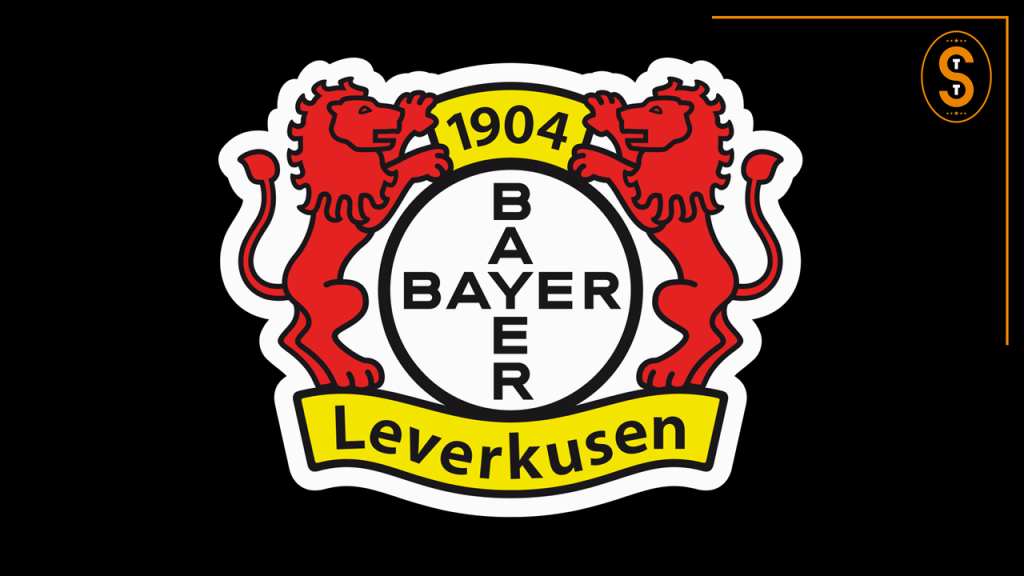
The center of the crest is a circle with the word Bayer written in capital letters vertically and horizontally to form a cross shape. It’s virtually the same logo used by the Bayer company today and is known as the Bayer cross. The Bayer cross was first patented in 1904 and its creation is a mystery with 2 separate Bayer employees claiming to have invented it in the late 19th and early 20th century.
On either side of the Bayer Cross are 2 red lions. I couldn’t find specifics on these lions, but the original Bayer company logo included a 2 tailed lion which came from the coat of arms of Elberfeld, where the company was headquartered at the time. Though the lions in the Leverkusen club crest aren’t two-tailed, I assume this is where they come from. If you have other information about the lions, please let us know in the comments section below the video.
And lastly, the scrolls with writing at the top and bottom of the crest should be self-explanatory. 1904 is the year the club was founded and Leverkusen is the city name where the club plays in addition to it being a part of the club’s official name.
Important Events
I’d like to highlight 3 great days in the club’s history plus touch on something not so great in this section.
First, on May 12, 1979, Bayer Leverkusen played Bayer 05 Uerdingen (now known as KFC Uerdingen 05). Leverkusen were leading the second division at the time and Uerdingen were in 2nd place. A win or draw for Leverkusen on the day meant that they’d be promoted to the Bundesliga for the first time since the league was created in 1963. Leverkusen trailed 3-0 at home after 62 minutes, but fought back to level the match. In the 85th minute, Matthias Brücken scored the equalizer that sent 15,000 fans into delirium. It was one of the greatest days in club history and the club has not been relegated from the Bundesliga since it joined in 1979.
The next event I’d like to highlight happened on May 18, 1988. Bayer had reached the final of the UEFA Cup, which is now known as the Europa League. At the time, it was a two legged final, and Bayer had already lost the first leg 3-0 on the road to Espanyol. May 18 was the return leg at Leverkusen’s home ground. After a scoreless first half, Leverkusen leveled the match through goals by Tita, Falko Götz, and Bum Kun Cha. The match went to penalties with Bayer prevailing in a dramatic shootout. It was the club’s first major title and the club’s only major European triumph to date.
The last positive event I’d like to highlight happened on June 12, 1993. On this date, die Werkself played the second team from Hertha Berlin in the final of the DFB Pokal otherwise known as the German Cup. Just to provide a little clarity, it wasn’t like Hertha just decided to play their second team against Leverkusen in the match. In Germany, often times clubs have second teams that function within the German pyramid, similar to the minor league system in American baseball if the minor league teams could compete against teams in the MLB. Back to the match on this day. Leverkusen were obvious favorites in the match. Although the match only finished 1-0 with a goal from Leverkusen striker Ulf Kirsten, Leverkusen dominated throughout. The club won its second major title and so far only, major domestic trophy on this date.
I do also want to mention the 2001-2002 season for Leverkusen. The club led the Bundesliga late in the season before a collapse saw them end up finishing in second place. This was the 4th time in 5 seasons, that the club finished second. This disappointment was compounded by die Werkself losing the DFB Pokal Final to Schalke after taking the lead early in the match. The pain wasn’t over yet for Leverkusen fans as the club met Real Madrid in the Champions League final on May 15, 2002. Yet again, the club failed to win, falling 2-1 to Madrid. Three heartbreaking 2nd place finishes for the club in the span of 11 days confirmed a cruel nickname: Neverkusen.
Supporters
Before every Leverkusen home match, songs from the Leverkusen band “Mavericks” are played in the stadium. The main club anthem is called “Leverkusen”. Some fans feel other songs are the official club anthem, but this song is the one played in the stadium before matches, so I wanted to highlight it here.
Noteworthy Players
Cha Bum Kun was one of the greatest Asian soccer players of his generation. He joined Bayer Leverkusen in 1983 and was one of the best forwards in the Bundesliga throughout his time with the club. He led Bayer to the 1988 UEFA Cup, scoring a clutch equalizing goal in the 81st minute to force extra time before Bayer won on penalties. Cha retired the next season and in 1999, he was voted Asian Player of the 20th Century. He is a Leverkusen and Bundesliga legend.
The next player I’d like to discuss is Ulf Kirsten. Kirsten is the club’s all-time record goalscorer and joined the club in 1990 after the reunification of East & West Germany. Kirsten had spent the early part of his career in the East German league. He played his entire Bundesliga career with Leverkusen, scoring 182 goals in the Bundesliga alone. His only title with the club was the 1993 DFB-Pokal, but he was a fantastic forward for the club until he retired in 2003.
Rüdiger Vollborn is Leverkusen’s all-time appearance leader and spent his entire 17-year career with the club. Vollborn was a keeper and was instrumental in Leverkusen’s penalty shootout victory in the 1988 UEFA Cup. His career spanned long enough that he was a long-time teammate of both Cha Bum Kun and Ulf Kirsten, who we just discussed.
The last player I want to mention here is Stefan Kießling. Kießling began his career at Nürnberg, but joined Leverkusen in 2006. That would be the only move in his professional career as he would make more than 440 appearances and score more than 160 goals for die Werkself. Along with Ulf Kirsten, Kießling is the only Leverkusen player to be the Bundesliga’s top scorer, which he achieved in the 2012-2013 season. Kießling is undoubtedly one of the best Leverkusen players ever.
Noteworthy Managers
The club really hasn’t had many legendary managers in its existence. No manager has lasted more than 7 years at the club and unfortunately, the club doesn’t have many trophies in its cabinet.
Rinus Michels is the most famous manager from the club’s history, but he was only with Leverkusen for 1 season. Michels is famous for his role in developing Total Football and building Ajax, as well as FC Barcelona, into two of the best clubs in the world in the 1970s. His time with Leverkusen was not very noteworthy beyond it being the last club side he ever managed.
I want to quickly mention Erich Ribbeck who managed the club on 2 occasions, once from 1985 to 1988 and once from 1995-1996. He was the manager as the club won its first major trophy, the 1988 UEFA Cup (which we now know as the Europa league).
And the final manager I’d like to highlight here is Christoph Daum. Daum took over a struggling Leverkusen side in 1996. He led die Werkself to 3 second place finishes in 4 years including a tragic collapse in the 1999-2000 season. That year, the club entered the final day 3 points ahead in the table, but still lost the title to Bayern Munich. Daum likely would have continued building his side and would have unquestionably been Leverkusen’s greatest manager, but a cocaine scandal in the summer of 2000 forced the club to terminate his contract. It was a disappointing ending to a very promising managerial career at the club.
Rivals
Leverkusen considers FC Köln (Cologne) its main rival. The city of Cologne is very near to the city of Leverkusen and the rivalry pretty much stems from geographical proximity. Cologne doesn’t really reciprocate the rivalry as Cologne’s main rivals are Borussia Mönchengladbach. Still, derby matches between Cologne and Leverkusen can get heated, with hooligan fighting often a problem.
Mönchengladbach and Fortuna Düsseldorf are also located in the Rheinland area of Germany and can could be considered loose rivals of Leverkusen.
The reality is Leverkusen is not really liked throughout German soccer. This comes from the club being backed by the company Bayer and not 50% owned by members of the club like most other German soccer clubs. Many opposition fans don’t like the club because of the ownership situation.
Stats & Records
The stats and records we’re about to discuss are as of October 2019, which is when we are recording this video.
Leverkusen has played 41 seasons in the top flight in its history.
The club has 2 major titles:
- UEFA Cup (Europa League) 1988
- DFB Pokal (German Cup) 1993
Die Werkself’s record first team appearance holder is Rüdiger Vollborn with 472 first team appearances.
The club’s record goal scorer is Ulf Kirsten with 237 first team goals.
Leverkusen’s record transfer purchase is Kerem Demirbay from Hoffenheim on May 9, 2019 for about €32M. The transfer officially processed on July 1, 2019 when the transfer window opened..
And the club’s record transfer sale was Son Heung-min to Tottenham Hotspur in England on August 28, 2015 for ~€30M.
And 1 last interesting fact about the club: in 1999, the Lindner Hotel BayArena opened in Leverkusen’s stadium. It became the first hotel in Germany to be built within a soccer stadium.
So there you have it… a bit of history on Bayer Null Vier (04) Leverkusen. Let’s continue the discussion in the comments section below the video.
Thanks for stopping by the Soccer Tavern. Hope to see you again soon. Prost!
 The Soccer Tavern