Welcome to the Soccer Tavern, where we’re discussing the history, philosophy, and culture of the beautiful game. My name is Dave and in this video, we’re talking about the history of Borussia Verein für Leibesübungen 1900 Mönchengladbach e.V., better known as Borussia Mönchengladbach. Pull up a seat and let’s start the discussion.
Borussia Mönchengladbach is located in the western part of city of Mönchengladbach. Mönchengladbach is located in the western part of Germany. The club currently play in the Bundesliga and its home ground is called Borussia Park. The stadium opened in 2004 and currently has a capacity of about 54K people.
Origin
On November 17, 1899, a group of players met at the Anton Schmitz pub in Mönchengladbach to break away from the Germania sports club and form their own club. The players called their new club FC Borussia. Borussia is the latin word for Prussia and Mönchengladbach was located in the area that was known as Prussia at that time.
Less than a year later, the club officially joined a league under the name of Borussia 1900. This is considered the club’s founding date, which was August 1, 1900, but the club’s history begins shortly before then as we just discussed.
The club would go through a couple minor name changes and mergers before finally becoming its current name of Borussia 1900 Mönchengladbach e.V. in 1921. Just a quick note, the official name of the city was München Gladbach until 1960. In 1960, the city’s name was changed to Mönchengladbach to avoid confusion with the city of Munich (which is pronounced München in german). The club officially changed their name to coincide with the city name change in 1960.
Also, the club basically follows the same naming convention as Bayern Munich with the region first, city name second.
Nicknames
The club has 2 main nicknames: Die Fohlen (The Foals) & ‘Gladbach. You might also see the nickname of Die Borussen, but that isn’t used as often.
In the 1960s and 70s, the club was well-known for having young, energetic, attacking players. This led to the nickname of Die Fohlen, which translates as the foals or young horses. Foals are known to have a ton of energy and the nickname was first written by Wilhelm August Hurtmanns. Hurtmanns was the team’s main reporter at that time. Other reporters began using this nickname and it has stuck over the years.
The clubs other main nickname of ‘Gladbach, is just the shortened version of the city’s name where the club plays. Pretty straightforward.
And the final nickname of Die Borussen, just means the Prussians and comes from the first word of the club’s official name.
Crest
Mönchengladbach has a very simple crest.
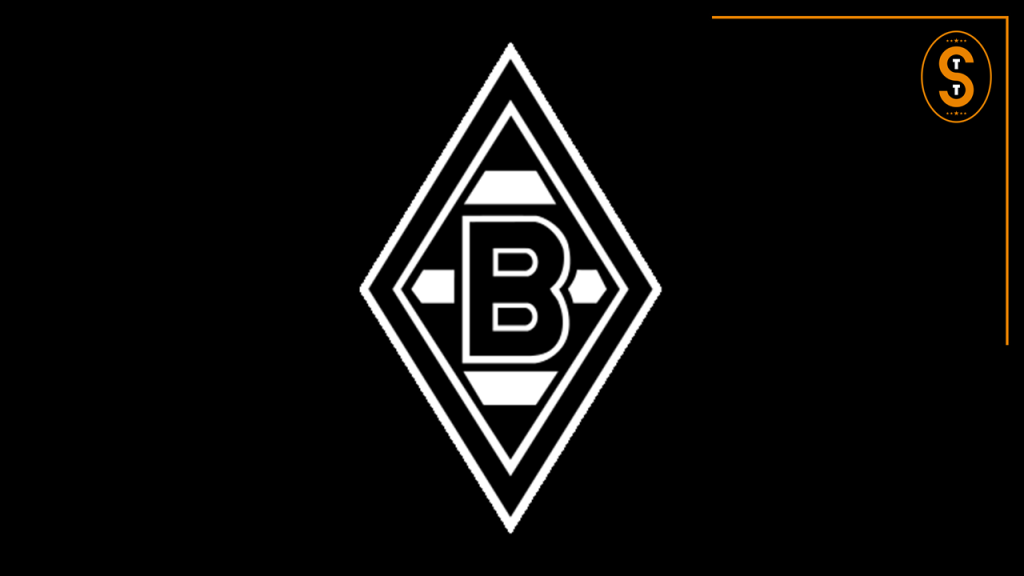
Versions of this crest have been used dating back to 1906, but really 1961 is when the club officially adopted its current design of a diamond crest with horizontal stripes & a B in the middle of it. Unfortunately, I wasn’t able to find why the diamond shape and horizontal lines were used in the design. If you know, please let us know in the comments section of the video.
The large B is a reference to the word Borussia in the club’s name. The black and white crest used today was the original color scheme for ‘Gladbach crests. The club used another version of the diamond crest with the colors of green & white in the 1960s, which came from Rhineland’s flag & crest. Mönchengladbach is located in the Rhineland region of Germany.
The current crest has been used since 1999.
Important Events
I want to highlight 4 important events in the club’s history in this secion.
The first event happened on October 5, 1960. Gladbach met Karlsruher SC in the final of the DFB Pokal. It was a back and forth match with Gladbach taking a 1-0 lead before Karlsruher equalized. Again, Gladbach took a lead, at 2-1 but Karlsruher equalized to make it 2-2. Finally, Albert Brülls scored the decisive goal for Gladbach and they held on for the 3-2 victory. The title was the club’s first ever major national title and it qualified the club for the European Cup Winner’s Cup, which would be the club’s first European competition.
The next event I’d like to highlight happened on June 5, 1971. On this date, Gladbach beat Eintracht Frankfurt 4-1 while Bayern Munich lost 2-0 to MSV Duisburg. The results meant Gladbach were Bundesliga champions for the 2nd consecutive year, making the club the first ever team to become back to back Bundesliga champions.
The 3rd event I’d like to mention happened on May 21, 1975. This was the second leg of the UEFA Cup Final (now known as the Europa League). At the time, the finals were played over 2 legs and 2 weeks earlier, Gladbach had drawn their opponent FC Twente from the Netherlands at home. So, on May 21, the Gladbach travelled to the Netherlands where it demolished the home side 5-1. Jupp Heynckes who was injured and forced to miss the first leg, returned in the second leg and put in a man of the match performance. Heynckes scored 3 goals and won Gladbach its first European title. It was also the first time a German team won the UEFA Cup/Europa League.
And the final event I’d like to highlight came on February 14, 2011. On this date, Borussia Mönchengladbach appointed Lucien Favre as its manager. The club was in the relegation zone, had 16 points from 22 games, and had allowed 56 goals at the time of Favre appointment. As the transfer window was already shut, Favre worked with the players he had to earn 20 points from the final 12 matches and helped the club avoid relegation. Remarkably, the club only allowed 9 goals in the final 12 matches. Favre’s appointment was a huge turning point for the club and definitely worthy of mention here.
Supporters
After a goal, the club plays a Torhymne, which translates as a goal song. The song is a techno song called Maria by Scooter where the fans chant “Doop Doop doop do do doop doop doop.” It happens to be the same song that my hometown club, the Philadelphia Union and its supporters group the Sons of Ben, adopted from Gladbach when the Union began play in MLS in 2010.
Gladbach was the origin of this goal song and it is widely considered the best in all of the Bundesliga, regularly winning online polls for best Torhymne.
Noteworthy Players
I want to discuss 5 players in this section and briefly highlight 1 more player at the end.
The first player I want to highlight is Günter Netzer. Netzer signed his first professional contract with the club in 1963 when he was 19 years old and Gladbach was still playing in the Regional League. Netzer was a creative attacking midfielder that could dominate matches. He is considered one of the greatest passers in soccer’s history. During his time with Gladbach, he helped the club become one of the 2 dominant Bundesliga clubs in the 1970s and he scored more than 80 goals in 230 Bundesliga appearances. Netzer won 3 major titles with Gladbach before departing for Real Madrid in 1973.
The next player I’d like to highlight is Jupp Heynckes. Heynckes was born in Mönchengladbach and began his professional career in 1964 with Gladbach when it was still in Germany’s second tier. He led the club to promotion that season and was a huge part of the Foals team that dominated German soccer in the 1970s. By the end of his career, he scored a then record 220 Bundesliga goals, won 6 major club titles with Gladbach, and had also won a World Cup & a European Championship with West Germany.
The third player I want to discuss is Berti Vogts. Vogts joined the Foals 1 year after Heynckes but unlike Heynckes, Vogts never played a senior match for any other team other than Gladbach. He is the club’s all-time appearance record holder and won 5 Bundesliga titles, 1 DFB Pokal, & 2 UEFA Cups with Gladbach. Like Heynckes, he also won a World Cup & European Championship with West Germany while playing club soccer at Gladbach.
A teammate of Heynckes & Vogts and the 4th player I’d like to highlight is Allan Simonsen. Simonsen joined Gladbach in 1972 and had a tough time adjusting to the Bundesliga as he came from Denmark. By 1974 he was breaking into the lineup and his performances were impressive. He continued to grow in the team and was one of the critical players in the dominant 1970s team before he left for FC Barcelona in 1979. Before he left though, he won the European Footballer of the Year award in 1977 as a Gladbach player. He was the first and so far only player to win the Ballon d’Or award while playing for Borussia Mönchengladbach.
Moving to our 5th player, Lothar Matthäus is one of the greatest German players in history. Matthäus join Gladbach from his boyhood club in 1979 and quickly earned a starting midfield spot at 18-years-old. Though he unfortunately didn’t win any trophies with Gladbach, he made an incredible impression at the club before moving to Bayern in 1984. Matthäus would play in 5 World Cups, including captaining the German national team that won the 1990 World Cup. He holds the record for most World Cup matches played after playing in 25 games. He also is the only German to ever win the FIFA World Player of the Year, which he won in 1991. Though most of these accomplishments came after his time with Gladbach he definitely deserves mention.
And before we wrap up this section, I wanted to briefly mention Marco Reus who is currently a standout player in the Bundesliga for Borussia Dortmund and the German national team. Reus had his career breakout while playing with Borussia Mönchengladbach in 2012 before he was transferred to Dortmund. Just wanted to note that.
Noteworthy Managers
I want to highlight 4 managers in this section and the first 3 managers were actually consecutive managers for the club.
First, was Hennes Weisweiler. Weisweiler joined Mönchengladbach in 1964 and was an incredibly innovative coach at the time. He developed an extremely effective counter-attacking style and was one of the leaders in a new school of managing. He communicated his tactics with players and involved the players in the discussions/decisions. He won 3 Bundesliga titles, a DFB Pokal and a UEFA Cup before departing for FC Barcelona in 1975. He established the foundations for the club to be dominant in the 1970s.
Udo Lattek then took over for Weiseiler in 1975. Lattek had already made a name for himself at Bayern Munich where he won the DFB Pokal and 3 straight Bundesliga titles. His time at Bayern ended on a negative note in the 1974/75 season, but Gladbach were happy to hire him. In his 4 seasons with the Gladbach, he won 2 Bundesliga’s and a UEFA Cup. He would move on to Dortmund in 1979 and by the time he retired, he was the most successful manager in the Bundesliga’s history. Lattek won 15 major club titles in his managerial career, 13 of which came while he managed Bundesliga clubs.
Once Lattek left in 1979, the recently retired Jupp Heynckes assumed managerial duties at the age of 34. He would manage Mönchengladbach for 8 seasons, but unfortunately couldn’t lead them to any major titles. Why am I mentioning him here then? In 1987, he left Gladbach for Bayern Munich and would have a legendary managerial career. He is one of the greatest managers in the history of the sport and won FIFA World Manager of the year in 2013.
And the last manager I want to highlight is Lucien Favre. We mentioned him in our Important Events section and he has been really critical to Gladbach reestablishing themselves in the upper echelon of the Bundesliga. Though he didn’t win any silverware with Gladbach, he helped them avoid relegation in 2011 and led them to qualify for the Champions League in 2012. He led the club to top half finishes in each of his 3 full seasons before he left in 2015 after a disastrous start. He has gone on to manage Nice in France and Borussia Dortmund and many view Favre as one of the best 20 managers in the world right now.
Rivals
The Foals have 3 main rivals, which we’ll talk about in increasing levels of modern intensity to the rivalries.
The first rival I’d like to discuss is Bayern Munich. Both clubs began the 1960s outside of the Bundesliga and joined the league together in 1965. The rivalry really heated up in the 1970s as one of the two clubs won the Bundesliga for 9 straight seasons between 1969 and 1977. Mönchengladbach then went through a down period relatively speaking in the 1980s and 90s, while Bayern rose to become the most successful Germany club. The rivalry is nowhere near its peak, but Bayern does deserve mention here as a historic rival.
The next rival I’d like to discuss is Borussia Dortmund. Matches between the two sides are unsurprisingly called the Borussen Derby because both clubs begin their name with Borussia. Quite frankly, there isn’t much to this rivalry beyond the naming convention used by each club. The two aren’t regional rivals and there is a bit of animosity stemming from some historical incidents, but each club has another main rival. I wanted to mention Dortmund here, but let’s talk about Gladbach’s main rival.
FC Köln or FC Cologne in English is Gladbach’s fiercest rival. The two clubs are each located in the Rheinland region of Germany and matches between the sides are called the rheinische Derby in German or Rhine Derby in English. The two first met in 1962 and Cologne was the stronger side in the early days. Like the Bayern rivalry, the Rhine Derby really heated up in the 1970s as both Cologne and Gladbach competed for trophies. One of the most notable incidents came in 1978 when the two weren’t even playing. It was the last day of the Bundesliga season and the two were tied on top of the table, but Cologne held a 10 goal difference lead. Gladbach proceeded to beat Dortmund 12-0, only to find out that Cologne won its match 5-0 and won the title that season. Both clubs have gone through ups and downs since the 1970s, but unlike the Bayern rivalry, this derby has remained heated. The proximity of the two clubs has likely been the main contributing factor to that.
Stats & Records
The stats and records we’re about to discuss are as of October 2019, which is when we are recording this video.
Gladbach has played 52 seasons in the top flight in its history.
The club has 10 major trophies including:
- 5 Bundesliga titles
- 3 DFB-Pokals or German Cups
- 2 UEFA Cups (now called Europa League)
The Foals record first team appearance holder is Berti Vogts with 528 first team appearances.
The club’s record goal scorer is Jupp Heynckes with 292 first team goals.
Gladbach’s record transfer purchase was Alassane Pléa from OGC Nice in France on July 13, 2018 for ~€23M.
And the club’s record transfer sale was Granit Xhaka to Arsenal FC in England on July 1, 2016 for ~€45M.
And 2 last interesting facts about the club:
1 – Gladbach were the victors in each of the 3 largest winning margin Bundesliga matches in history. The club beat Dortmund 12-0 in 1978, Schalke 11-0 in 1967, and is tied with 2 other clubs for a 10 goal margin of victory after Gladbach beat Eintracht Braunschweig 10-0 in 1984.
2 – On matchday 27 of the 1970-1971 season, Gladbach striker Herbert Laumen ran into the net as he tried to get on the end of a free kick. He hit the net so hard that it forced the left-hand post to break. At the time, wooden goalposts were used and the match had to be abandoned. From then on, wooden goalposts were no longer allowed to be used in the professional game. Nowadays, the broken post is on display at the Borussia Mönchengladbach club museum.
So there you have it… a bit of history on Borussia Verein für Leibesübungen 1900 Mönchengladbach e.V.. Let’s continue the discussion in the comments section below the video.
Thanks for stopping by the Soccer Tavern. Hope to see you again soon. Prost!
 The Soccer Tavern