Welcome to the Soccer Tavern, where we’re discussing the history, philosophy, and culture of the beautiful game. My name is Dave and in this video, we’re talking about the history of Eintracht Frankfurt e.V. Pull up a seat and let’s start the discussion.
Eintracht Frankfurt is located in the southwestern part of the city of Frankfurt. Frankfurt is located in the central, slightly western part of Germany. The club currently play in the Bundesliga and its home ground is called the Commerzbank-Arena. The stadium opened in 2005 and holds around 52K people.
Origin
Eintracht Frankfurt’s official founding date is considered March 8, 1899. On this day, Frankfurter Fußball-Club Victoria was formed. In the same year, another club called Frankfurter Fußball-Club 1899 Kickers was formed. The two would operate as separate clubs until merging on May 13, 1911 to become Frankfurter Fußballverein (Kickers-Victoria).
In 1920, the club merged with Turn- und Sportgemeinde Eintracht Frankfurt von 1861, which included a bunch of other sports beyond just soccer. This merger was the first time the name Eintracht was connected to the club. “Eintracht” basically means “United” in English.
By 1927, the two clubs that merged in 1920 split into a gymnastics club and a sports club with each keeping Eintracht as a part of its official name.
Finally, in 1969, the two clubs that split in 1927 merged yet again to form the current club of Eintracht Frankfurt e.V.
Nicknames
The club has 3 nicknames: Die Adler (The Eagles), S.G.E. (SGE), and Launische Diva (Moody Diva).
The Eagles nickname is straightforward as it comes from the club’s crest which has an eagle on it. We’ll talk more about the crest in the next section. This is the club’s main nickname.
Two less used nicknames are (Ess-Ga-Aye) or S.G.E. and Launische Diva, which means moody diva.
S.G.E. is the acronymn associated with the club’s old name before the merger in 1969. It stands for Sportgemeinde Eintracht.
And the moody diva nickname came about in the 1970s and 80s as the club earned a reputation for playing well in big time matches, but then underperforming against weaker opposition.
Crest
Eintracht Frankfurt’s crest draws most of its inspiration from the city of Frankfurt’s coat of arms.
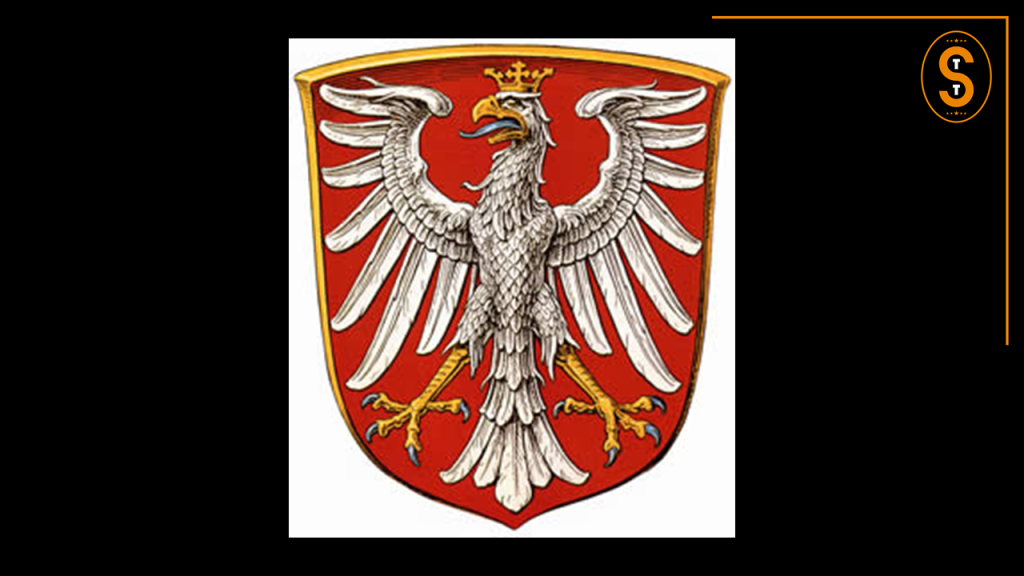
The eagle features prominently on the Frankfurt city coat of arms. Frankfurt was crowned an Imperial City of the Holy Roman Empire in 1245 and the eagle was a symbol of the empire. The city’s colors were not originally white and red, but red & white were adopted sometime around 1400. Around this time as well, the crown was added to the top of the eagle’s head. Since then, the city’s coat of arms has remained relatively unchanged.
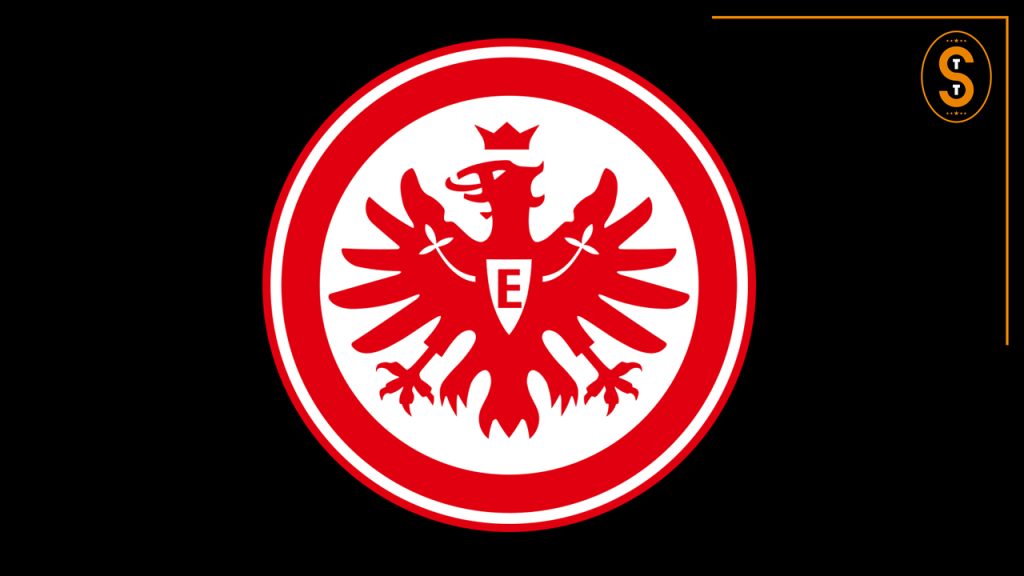
Versions of the Eintracht Frankfurt crest have more or less looked the same throughout the club’s history with the Eagle being a main feature of every crest and a combination of red, white and black utilized. These are the official colors of the club and come from a combination of the city’s official colors of red & white and the official Prussian colors of black and white.
The club’s most recent crest modifications came in 1999 as the club celebrated its 100th year of existence. We’ve already talked about the eagle and the E in the middle of the eagle refers to the Eintracht part of the club’s name.
Important Events
On June 28, 1959, Eintracht Frankfurt faced local rivals Kickers Offenbach in the German National Championship before the Bundesliga was created. The match was a back and forth affair, ending 2-2 after regulation. Frankfurt took the lead in extra time through a disputed penalty before going up 4-2. The Kickers brought it back to 4-3 with 10 minutes to go, but Eintracht scored the title clinching goal in the 119th minute to finish the match 5-3. It is the club’s only league title in its history and was the club’s first major trophy.
The next event I’d like to discuss happened on May 21, 1980. On this date, Eintracht Frankfurt faced Borussia Mönchengladbach in the second leg of the UEFA Cup Final. This competition is now known as the Europa league and this was the first time a European Competition had 2 German clubs in the final. Gladbach won the first leg 3-2 at home. On May 21, Fred Schaub scored the only goal of the match around the 80th minute as Frankfurt won 1-0, winning the Final on away goals. It is the club’s first and only major European title. It’s also likely the club’s greatest victory.
The third event I’d like to discuss is one of the most disappointing days in the club’s history. On May 16, 1992, Frankfurt played FC Hansa Rostock on the last match day of the season. Frankfurt was in a close title race with Stuttgart and Dortmund, while Rostock were fighting relegation. With the match tied 1-1 in the 76th minute, Frankfurt player Ralf Weber was clearly taken down in the penalty area. The referee did not call a penalty and admitted after the match that he made a mistake. Rostock would score and Frankfurt would lose 2-1, losing the title to VfB Stuttgart. This game is still talked about as one of the most disappointing in the club’s history.
The 4th event I want to discuss happened on July 17, 2002. Frankfurt had been relegated to the 2nd division a season earlier and lost some key owners and sponsors as a result. In June of 2002, after the team secured new owners, it made a mistake with filing its licensing paperwork to the DFL. The DFL is the German organization responsible for professional soccer. The DFL denied Eintracht their license and another club, SpVgg Unterhaching, who had been relegated, attempted to take Frankfurt’s place in the upcoming season. That would have meant Frankfurt would be relegated to amateur levels of soccer and would have been incredibly difficult for the club to recover from. Fortunately, on July 17, 2002, the court’s officially ruled in Frankfurt’s favor, meaning it retained its place as a fully professional 2nd division club.
And the final event I’d like to highlight came on May 20, 2018 Eintracht Frankfurt played Bayern Munich in the DFB Pokal final. Frankfurt prevailed in the match 3-1 with a brace by Ante Rebić and another goal by Mijat Gaćinović. This was Frankfurt’s first major trophy since May 28, 1988 – almost exactly 30 years to the day.
Supporters
Since 2006, Attila the golden eagle has been at every Eintracht Frankfurt home match. In 2006, the club was looking for a good luck charm and found Norbert Lawitschka who is a falconer who owns Attila. The bird is one of only 2 live animal mascots in the Bundesliga.
Noteworthy Players
Alfred ‘Don Alfredo’ Pfaff was one of the greatest players in Frankfurt’s early post WWII years. He led the club to their first and only national championship in 1959, which we’ve already discussed. Don Alfredo was an attacker and became world famous after a great display in the 1960 European Cup Final (now known as the Champions League). Though Frankfurt lost that match 7-3, it is considered one of the greatest European Finals ever.
The next player I’d like to highlight is Jürgen Grabowski. Grabowski is widely considered the best player in Eintracht’s history. He joined the club in 1965 and it would be the only club Grabowski would play for in his senior, professional career. Grabowski made 441 Bundesliga appearances for the club, never being substituted, and scored more than 100 goals. He led the club to 2 DFB Pokal titles and the 1980 UEFA Cup (though an injury ended his career shortly before and he wasn’t able to play in that 1980 UEFA Cup Final). For West Germany, Grabowski also won a World Cup and a European Championship. He is an Eintracht Frankfurt legend.
The next player I’d like to highlight is Bernd Hölzenbein. Hölzenbein was with the club for its most successful period in the 1970s and early 1980s. He joined the club in 1966 and would play for the Eagles for 15 years. Hölzenbein is the club’s all-time top scorer and won 3 DFB Pokals and 1 UEFA Cup with the club.
The 4th player I’d like to highlight is Karl-Heinz (Charly) Körbel. Charly is the club’s all-time record appearance holder and made the most appearances of any player in the history of the Bundesliga. He made 602 Bundesliga appearances over nearly 20 years, all of which came while playing for Eintracht Frankfurt, his only senior professional club. Körbel won 4 DFB Pokals and the UEFA Cup with Eintracht.
The 5th and second to last player I want to discuss is Anthony (Tony) Yeboah. Tony joined the Eagles in 1990 and though he was only with the club for 5 years, he was incredibly influential in the club’s history. Yeboah was the first black player the team had ever signed and he would become the first African player to captain a Bundesliga club. Yeboah was part of the 1991-1992 Eintracht side that nearly won the Bundesliga and that side is considered one of the greatest Frankfurt team’s ever. He would leave in 1995 for Leeds United, but he is a legend for the club and his name is still sometimes sung at Frankfurt matches.
And the final player I want to mention is Augustine Azuka Okocha, better known as “Jay-Jay” Okocha. Jay-Jay is widely considered one of the most skillful and talented dribblers in soccer history. He gained international recognition for his performances with Eintracht Frankfurt in the early stages of his professional career. Jay-Jay joined the club in the middle of the 1991-1992 season and nearly won the Bundesliga. He would make more than 90 appearances and score 18 goals before moving to Turkish club Fenerbahçe in 1996. While with Frankfurt, he won an African Cup of Nations title with Nigeria in 1994. And shortly after leaving Frankfurt, Okocha won a Gold Medal with Nigeria at the 1996 Olympics.
Noteworthy Managers
For a club that has had a decent amount of success, Eintracht surprisingly doesn’t really have a legendary manager in its history.
The closest manager to a legend would be Paul Oßwald. Oßwald was the longest tenured manager across 3 separate stints with the club beginning in 1929 and ending in 1964. He was manager as the club won its first and only National Championship in 1959. Oßwald was also in charge for the 1960 European Cup Final against Real Madrid in Hampden Park, Glasgow. As we already mentioned this is recognized as one of the greatest European Finals in history.
2 other managers I briefly want to mention are Dietrich Weise & Jupp Heynckes
Weise won 2 DFB Pokals with Eintracht Frankfurt in his first 2 seasons at the club in the 1970s. He left the club as manager in 1976, but returned in 1983. He’d leave again in 1986 and managed more than 230 matches across his 2 stints at Eintracht.
And Jupp Heynckes is widely considered one of the greatest German managers in history. He is more famous for his time at other clubs and many in Frankfurt see him as the reason why the club took a huge downturn in form in the mid-1990s. Heynckes took over in the summer of 1994. After the team underperformed throughout the season and Heynckes made numerous errors in dealing with the press and his players, he left the club on April 2, 1995. Eintracht finished mid-table that season, but were relegated the following season and many blame Heynckes for derailing the club and setting them up for relegation. Even though Heynckes was a total failure at Eintracht Frankfurt, he is worthy of a mention here because he is one of the most accomplished German managers in history.
Rivals
Eintracht’s primary rival is without question Kickers Offenbach. The clubs play in stadiums about 10 miles apart and matches are called Main Derbies in reference to the river that flows near both cities. The rivalry stretches back to the early 20th century, but it really took the next step in 1959. Offenbach and Frankfurt made the final of the German championship, which was the national competition that preceded the Bundesliga. An epic back and forth match followed with Frankfurt ultimately prevailing. A few years later, when the Bundesliga began play in 1963, Frankfurt was selected ahead of Offenbach to be initial participants. Offenbach had been the more successful side since WWII, but the Bundesliga weighed recent success more heavily in their selection criteria, which allowed Frankfurt initial entry. These critical events, coupled with the sides playing so close to each other sealed this as a fierce rivalry that continues to today.
Other, less-intense rivals are SV Darmstadt 98 and FSV Frankfurt.
SV Darmstadt 98 is a rival of Eintracht mainly due to the club’s location. The clubs are located about 20 miles from each other and both clubs are located in the Hesse state in Germany. For this reason, matches between the sides are called Hessen Derbies. Though Frankfurt is a much larger club, these two fanbases do not like each other. In 2015, fans in Frankfurt burned Darmstadt scarves and flags, which resulted in stadium bans for the Frankfurt fans. The rivalry sees increased police presence in both cities when these two sides meet.
And finally, matches between Eintracht Frankfurt and FSV Frankfurt are creatively named Frankfurt Derbies. There’s not much to this rivalry beyond the 2 clubs sharing the same city. Eintracht has historically been a much larger & successful club while FSV Frankfurt hasn’t enjoyed nearly the same success. The two haven’t played in official competitions much against each other since the Bundesliga began in 1963. It’s not much of a rivalry, but deserves mention here.
Stats & Records
The stats and records we’re about to discuss are as of October 2019, which is when we are recording this video.
The Eagles have played 51 seasons in the top flight in their history.
The club has 7 major trophies including:
- 5 DFB-Pokals or German Cups
- 1 UEFA Cup (now known as Europa League)
- 1 German national titles before the Bundesliga was created
Eintracht’s record first team appearance holder is Charly Körbel with 685 first team appearances.
The club’s record goal scorer is Bernd Hölzenbein with 191 first team goals.
Frankfurt’s record transfer purchase was Martin Hinteregger from FC Augsburg on August 1, 2019 for ~€9M.
And the club’s record transfer sale was Luka Jovic to Real Madrid in Spain on June 4, 2019 for ~€60M. The transfer officially processed on July 1, 2019 when the transfer window opened
And 2 last interesting facts about the club:
1 – Eintracht Frankfurt was the first German club to reach a European Cup Final. It came in 1960, when the club lost 7-3 to Real Madrid in Glasgow.
2 – The first 3 World Cup victories for Germany (1954, 1974, & 1990) all featured an Eintracht Frankfurt player on the roster.
So there you have it… a bit of history on Eintracht Frankfurt. Let’s continue the discussion in the comments section below the video.
Thanks for stopping by the Soccer Tavern. Hope to see you again soon. Prost!
 The Soccer Tavern