
Welcome to the Soccer Tavern, where we’re discussing the history, culture, and philosophy of the beautiful game. My name is Dave and in this video, we’re talking about the FIFA Men’s World Cup. Specifically, we’re going to go through a pretty comprehensive explanation of how the Men’s World Cup works including qualification. Pull up a seat & let’s start the discussion.
NOTE: this video was recorded in April 2018
FIFA is the international governing body of soccer and the FIFA Men’s World Cup is the premier international tournament for the world’s most popular sport. It’s estimated that 3.2 billion people, which is more than 40% of the World’s population, watched at least a portion of the 2014 World Cup, with more than 1 billion people watching at least a minute of the 2014 Final between Argentina & Germany.
Most people know the World Cup as the soccer tournament that runs from the middle of June to the middle of July. But that is actually formally known as the World Cup Finals.
Technically, every single active country in FIFA participates in the World Cup, but only 32 nations (the 31 nations who qualify plus the host country) make it to the World Cup Finals. We say active country because there may be countries who are officially in FIFA but are suspended. Those countries would obviously not partake in the World Cup.
In 2026, the World Cup is expanding to 48 teams, and there may be multiple host countries at that point, so what we’re about to discuss will be applicable for the 2018 and hopefully the 2022 World Cups.
The World Cup starts with World Cup Qualification in each of the 6 FIFA sanctioned confederations. These 6 confederations are basically the 6 main inhabited continents in the world.
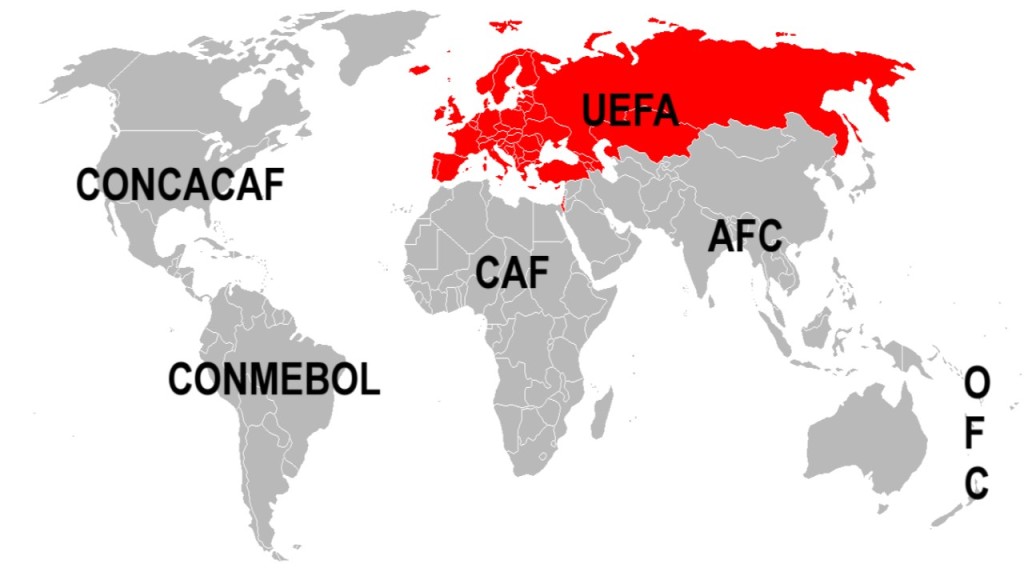
Europe’s confederation is called UEFA and has 55 countries
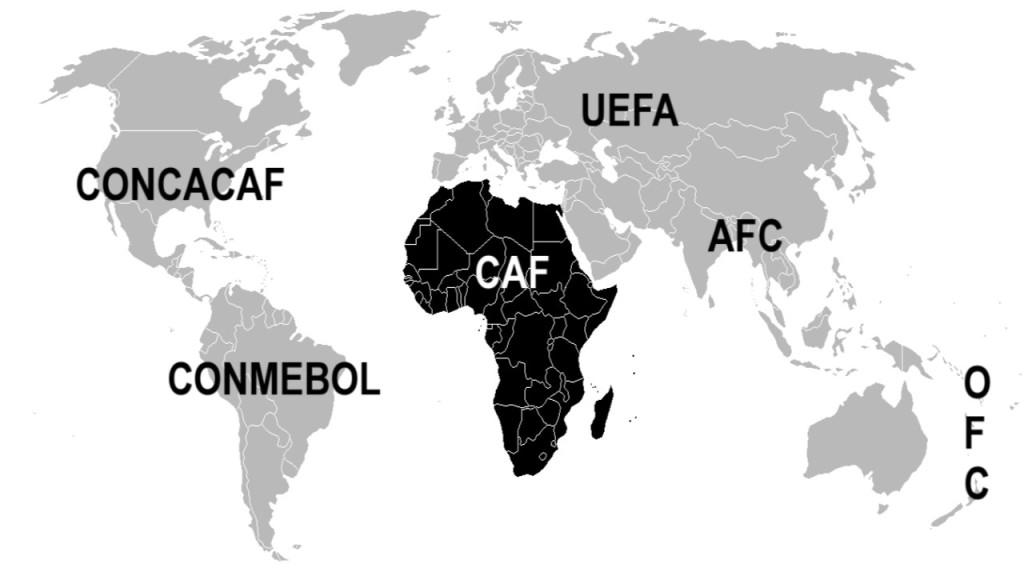
Africa’s confederation is called CAF and has 54 countries
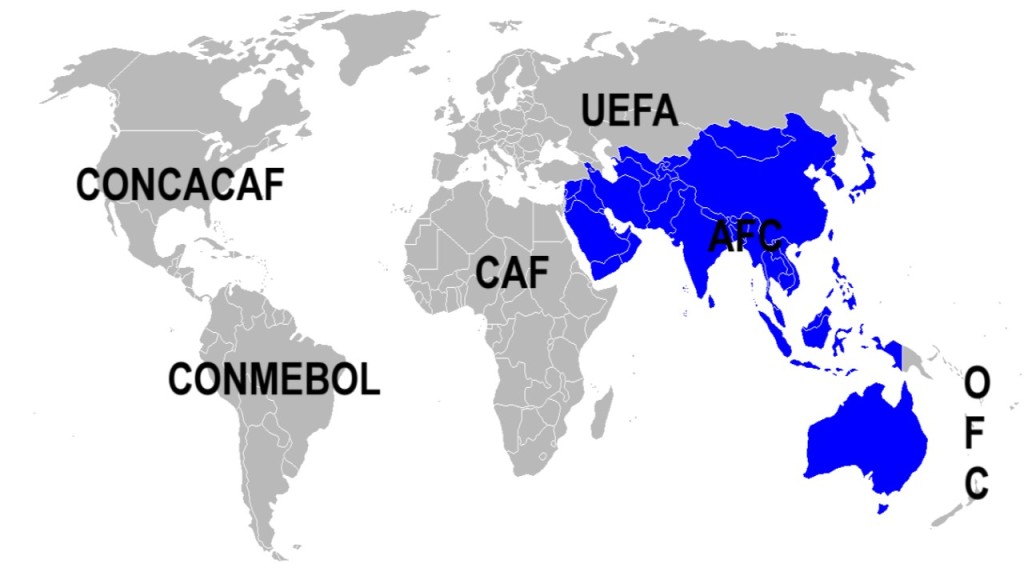
Asia’s confederation, which also includes some Pacific islands, is called AFC and has 46 countries – quick note – though Australia is its own continent, it joined the Asian confederation in 2006. This is the only major geographic wrinkle in the confederation system
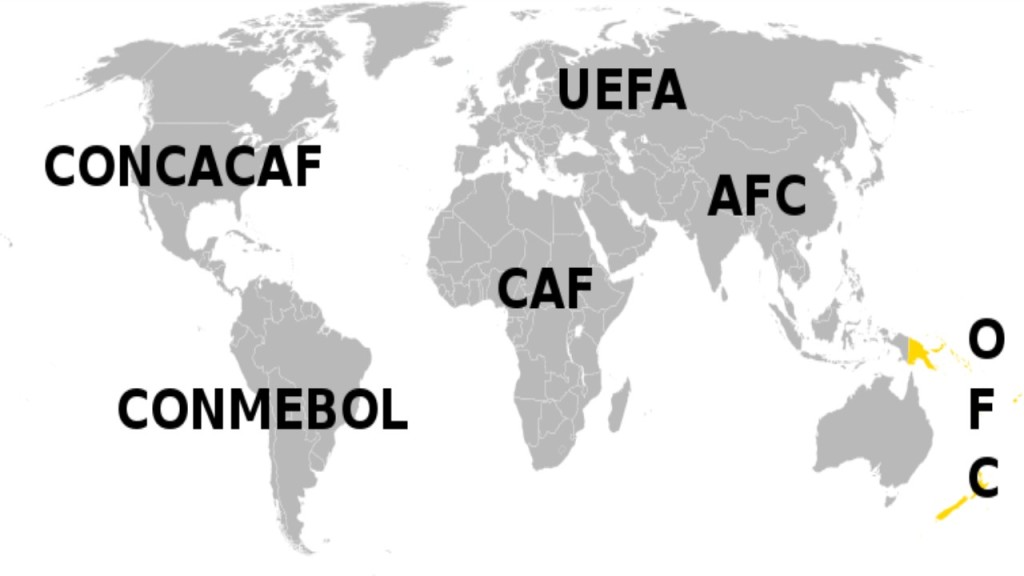
Oceania’s confederation, which includes the remaining Pacific islands not in the AFC, is called OFC and has 11 countries (with the aforementioned Australia moving to the Asian confederation in 2006).
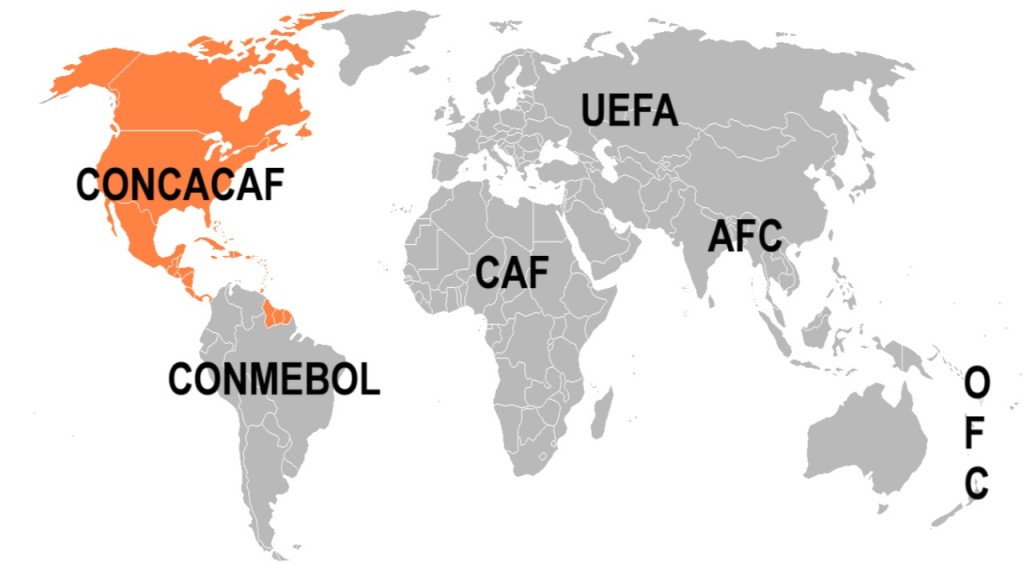
North & Central America’s confederation, which also includes the Caribbean islands and a small handful of South American countries, is called CONCACAF and has 35 countries.
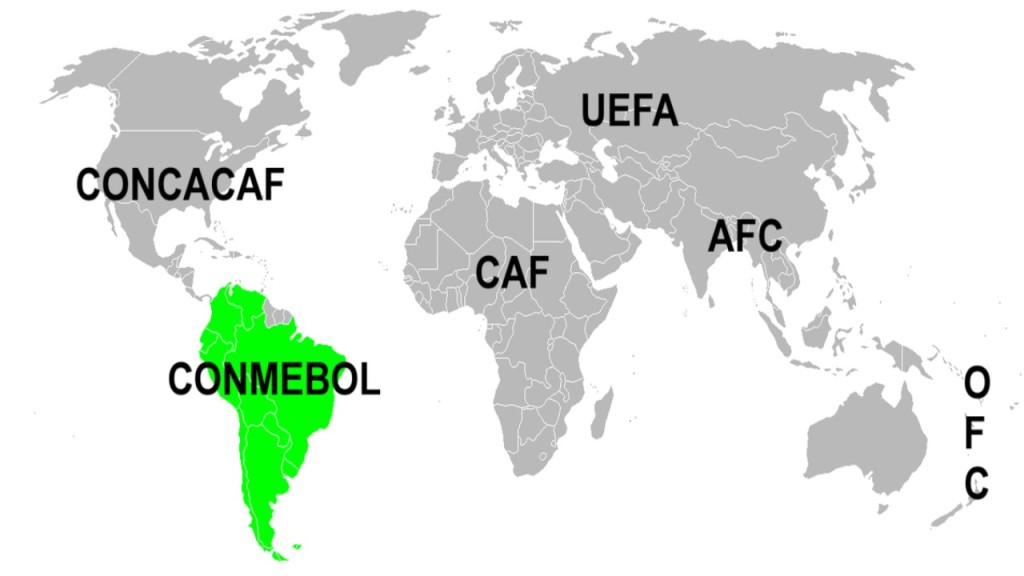
And finally South America’s confederation is called CONMEBOL and has 10 countries.
Each confederation is allotted a number of spots at the World Cup, and the confederations with better national teams are granted more qualification spots.
On May 30, 2015, FIFA set the World Cup allocations for the 2018 and 2022 World Cups:
- UEFA was allocated 13 spots
- Africa was allocated 5 spots
- South America and Asia were both allocated 4.5 spots
- CONCACAF was allocated 3.5 spots
- And Oceania was allocated half a spot
Now, the half spots represent a two-legged inter-confederation playoff match. That means each team will play 1 match at home and 1 match on the road in a two-match series between teams from different confederations.
The confederation playoff matchups for the 2018 World Cup were decided with a blind draw on July 25, 2015. AFC and CONCACAF were pitted against each other, and OFC was selected to take on CONMEBOL.
The draw for the 2022 World Cup Playoffs will take place in July of 2019.
Back to World Cup qualification. Every confederation has its own process for determining who fills their allocated spots.
Qualification games are played during international breaks from club soccer. These breaks last about two weeks, with 2 national team games played during that time.
Some are straight forward, while others are complicated. Let’s talk about them now.
UEFA
Because the 2018 World Cup is in Russia and that country automatically qualifies for the World Cup, only 54 UEFA nations entered World Cup qualifying this cycle.
The countries were broken into 9 groups of 6 teams each. Each nation played 1 match home and 1 match away against the other teams in their group between September 2016 and October 2017.
The 9 group winners automatically qualified for the World Cup.
The 8 group runners up with the best records against teams in spots 1-5 in their group qualified for a playoff against other European teams to determine the last 4 spots.
I wanted to highlight that the rules specified performance against teams 1-5 for group runners up, meaning countries couldn’t beat up on the weakest opposition in the group to get an advantage.
UEFA playoff matches happened in November 2017 and the unlucky runner up in this qualification cycle was Slovakia from Group F.
The European countries that qualified for the 2018 World Cup were:
- France
- Portugal
- Germany
- Serbia
- Poland
- England
- Spain
- Belgium
- Iceland
- Sweden
- Switzerland
- Denmark
- Croatia
CAF
Africa had 53 of its 54 member associations involved in 2018 World Cup Qualification. Zimbabwe was forbidden by FIFA from taking part due to outstanding debts from its federation.
The CAF qualification cycle was broken into 3 rounds stretching from October 2015 to November 2017.
In the first round, the 26 lowest-FIFA-ranked participating nations as of July 2015 were drawn into a 2 legged playoff. The top 13 teams were in one pot and the lower 13 teams were in another pot, so best teams were separated and couldn’t face each other in round 1. The winners of those 13 playoffs advanced to round 2. There, they were joined by the remaining 27 teams in CAF.
Similar to round 1, the 40 teams were drawn into a 2-legged playoff with the 20 winning teams advancing to round 3.
In round 3, the remaining 20 teams were broken into 5 groups of 4, where they played home & away matches against each of their 3 group opponents.
The top team in each group qualified for Russia 2018.
The African countries that qualified for the 2018 World Cup were:
- Tunisia
- Nigeria
- Morocco
- Senegal
- Egypt
CONMEBOL
CONMEBOL has the simplest World Cup qualification process of any confederation.
All 10 teams were placed into 1 group where the nations played each other once home & away from October 2015 to October 2017.
Because Argentina and Brazil are two of the strongest countries in world soccer, other CONMEBOL countries were spared from playing both of them during the same international break.
The top 4 teams automatically qualified for Russia, while the 5th place team entered into a playoff against the top Oceania team.
The South American countries that qualified for the 2018 World Cup were:
- Brazil
- Uruguay
- Argentina
- Colombia
- And Peru, who won their playoff match against New Zealand in Oceania
AFC
45 of the 46 AFC member nations participated in 2018 World Cup Qualification. Indonesia was excluded by FIFA due to government interference in the soccer federation, which is forbidden by FIFA statutes.
The qualification was broken into 4 rounds. The AFC had the longest qualification cycle, stretching more than 2 and a half years from March 2015 to October 2017.
The very first qualification match for the 2018 World Cup took place on March 12, 2015 between Sri Lanka and Bhutan in the AFC. Bhutan won 1-0 for those curious.
In round 1 of AFC qualification, the 12 lowest-FIFA-ranked participating nations as of January 2015 were drawn into a 2 legged playoff. The winners of those 6 playoff series advanced to round 2. There, they were joined by the remaining 34 teams in the AFC.
At the time, Indonesia wasn’t suspended yet, so they were technically involved in Round 2, but all of their matches were counted as forfeits. The 40 teams were broken into 8 groups of 5 where they played home and away matches against their group opponents. The 8 group winners, along with the 4 top 2nd place teams advanced to the 3rd round of qualifying.
The 12 remaining teams were broken into 2 groups of 6 where they played home and away matches against each opponent. The top 2 teams from each group qualified for the 2018 World Cup.
The 3rd place teams in each group entered into a home and away series against each other in the 4th round. The 4th round of qualification was simply the playoff between the 2 3rd-placed teams from round 3.
The winner of that series entered into the intercontinental playoff against CONCACAF.
The Asian countries that qualified for the 2018 World Cup were:
- Iran
- Japan
- South Korea
- Saudi Arabia
- And Australia via a playoff against Honduras from CONCACAF
CONCACAF
CONCACAF probably has the most complicated qualification system of any confederation. It is 5 rounds long and, similar to AFC qualification, lasted more than 2 1/2 years.
In round 1 of CONCACAF qualification, the 14 lowest-FIFA-ranked countries as of August 2014 were drawn into a 2 legged series. The winners of those 7 playoff series advanced to round 2.
In round 2, the next 13 ranked nations entered qualification. These 20 teams were drawn into head-to-head matches over 2 legs like the previous round. The 10 winners from those series’ advanced to round 3.
In round 3, the next 2 ranked nations entered qualification. Just like rounds 1 and 2, these 12 countries were drawn to play in home & away matches against 1 other country with the winners from the 6 series’ advancing to round 4.
In Round 4, the last 6 remaining countries entered qualification along with the 6 series winners from the previous round. The countries were then broken into 3 groups of 4 with the best countries being separated from playing each other. The teams then played everyone in their group once home and away. After 6 matches, the top 2 teams in each group enter the 5th and final round of qualification.
In the 5th round, the 6 teams were placed in 1 group and played each team home and away. At the end, the top 3 teams automatically qualified for the World Cup with the 4th place team entering the inter-confederation playoff. This World Cup it was against AFC.
The CONCACAF countries that qualified for the 2018 World Cup were:
- Mexico
- Costa Rica
- And Panama
- Honduras finished 4th and lost their playoff against Australia
OFC
CONCACAF may have the most complicated qualification cycle but Oceania takes the cake for weirdest. The OFC World Cup qualification starts with a 4-team round robin group played in one country. It featured the 4 lowest FIFA-ranked teams as of July 2015.
They play each other 1 time and the group winner advances to round 2. That’s seemingly simple. It’s slightly different than other confederations with not having a home and away series but not crazy.
Round 2 is where it gets weird, because it doubles as the OFC Nations Cup. The remaining 7 countries enter the tournament. The 8 teams are drawn into 2 groups of 4, with the best teams being separated from playing each other at this stage. The teams then play their other group members one time. The top 3 countries in each group qualify for the 3rd and final round of qualification.
But, because this is a tournament unto itself, the top 2 members in each group advance to the semifinals of the tournament where they play a single elimination match before the winners play in a single final match. These semifinals and finals have no bearing on World Cup qualification, which makes this Round 2 so odd.
And finally, in round 3, the 6 qualifying countries are placed into two groups of 3. The nations play each of their group opponents once at home and once away. The top country from each group then plays the other top country from the other group in a 2 legged home and away playoff.
That winner then advances to the inter-confederation playoff.
For the 2018 cycle, New Zealand advanced from OFC and played Peru in the playoff, where they lost over 2 legs.
I’m sure all of that is crystal clear, right?
World Cup Finals
Once all 31 qualified teams are determined, FIFA holds a World Cup draw to determine the 8 groups of 4 for the World Cup Finals tournament. The draw for the 2018 World Cup was held on December 1, 2017 in Russia.
The host country and the top 7 FIFA-ranked teams are put into pot A.
The remaining pots of B, C, and D contain the qualified countries in order or rank with a small twist.
No two countries from the same confederation can be drawn together with the exception of European countries. There can be a max of 2 countries from Europe in a group.
The draw then proceeds with 1 country being picked from each pot until the groups are filled.
The host country is always drawn first & placed in Group A, so Russia was in Group A for the 2018 World Cup and Qatar will be in Group A for the 2022 World Cup.
Once the draw is complete and the groups are set, the tournament proceeds with the countries in each group playing each other 1 time. There’s generally a 4-6 day break in between group matches.
The first match for the 2018 World Cup is on Thursday, June 14 between Russia and Saudi Arabia
At the end of the group stage, the top 2 teams from each group advance to a bracket-style, single-elimination knockout round.
Determination of the top 2 teams is based on the following factors:
- Teams are given 3 points for a win, 1 point for a draw, and 0 points for a loss
- The 2 teams with the most points advance
- In the event of a tie, the first two tiebreakers are used in this order:
- Highest positive goal difference in the group stage
- Most goals scored in the group stage
- If the teams are still tied after that, there are other tiebreakers. If you’re interested, you can check them out in Section 32, subsection 5 (Page 43) of this document.
Once the 2 teams who’re advancing from each group are determined, they are placed on opposite sides of the bracket, so they can’t meet again until the Final.
Knockout round matches are then played until a champion is crowned. In 2018, the World Cup Final will be on July 15.
And that’s how the FIFA men’s World Cup works.
Things are going to get a bit weird for the 2022 World Cup in Qatar, but most of what we’ve just discussed will still be applicable.
The World Cup Finals tournament will be held from November to December in 2022 due to Qatar’s unbearably hot summers.
Also, Qatar will be the third country (after Uruguay and Italy) to make its World Cup Finals debut because of its host country status.
Because of the expansion to 48 teams in 2026, the qualification, structure, and timing of the tournament are likely to be very different for the 2026 World Cup. Until then, you should now know more than you ever wanted to know about the Men’s World Cup.
If you have anything else to add to our discussion, please let us know in the comments section below the video.
Thanks for stopping by The Soccer Tavern. Hope to see you again soon. Cheers.
 The Soccer Tavern