Welcome to the Soccer Tavern, where we’re discussing the history, philosophy, and culture of the beautiful game. My name is Dave and in this video, we’re talking about the history of Düsseldorfer Turn- und Sportverein Fortuna 1895 e.V., better known as Fortuna Düsseldorf. Pull up a seat and let’s start the discussion.
Fortuna is located in the northern, slightly western part of the city of Düsseldorf. Düsseldorf is located in the western part of Germany. The club currently play in the Bundesliga and its home ground is called the MERKUR SPIEL-ARENA (formerly ESPRIT) Arena. The stadium opened in 2004 and holds a little less than 55,00 people.
Origin
The club was officially founded as a gymnastics only club on May 5, 1895 in a town called Flingern, which is now a part of the city of Düsseldorf. The club’s original name was Turnverein Flingern 1895.
Completely separate from this club, 2 other clubs were formed in the Düsseldorf area in the early part of the 1900s. Düsseldorfer Fußballklub Spielverein was created on May 1, 1908 and Fußballclub Alemania 1911 was created in May 1911. Fußballclub Alemania 1911 would rename itself to Fußballklub Fortuna 1911 in 1912. The name Fortuna came from a local bakery in the neighborhood of Flingern.
These 2 soccer clubs would merge in 1913 to become Düsseldorfer Fußballclub Fortuna 1911.
Finally, on November 15, 1919, the Turnverein Flingern 1895 merged with the Düsseldorfer Fußballclub Fortuna 1911 and became the club’s current name of Düsseldorfer Turn- und Sportverein Fortuna 1895.
Though Fortuna can rightly claim it has existed since 1895 as a club, the soccer portion of the club has “only” been playing since 1908.
Nicknames
The club has 2 straightforward nicknames.
The first is F95. It’s an abbreviation for the club with the F standing for Fortuna and 95 standing for the club’s founding year.
The other nickname of Die Flingeraner means people from Flingern, which, we’ve already discussed, is the neighborhood where the club was founded. Though its home stadium is no longer located in this neighborhood, the club still maintains this nickname.
Crest
Like most German soccer crests, Düsseldorf’s crest is very simple but it has evolved a bit over the years.
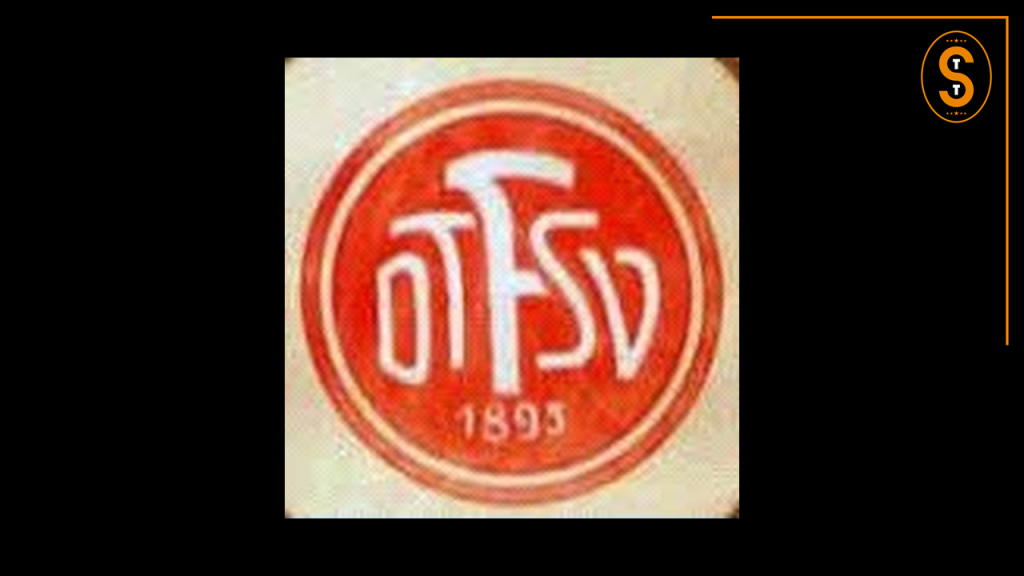
The first time a logo resembling the current logo was used was noted to be December 11, 1920. This logo had the letters “DTFSV” for Düsseldorfer Turn- und Sportverein Fortuna with the F large & in the middle and the club’s founding year of 1895. The colors of red & white for the club can be traced back to the two original soccer clubs of “FK Spielverein” and “FK Alemania” who both played in red & white striped kits.
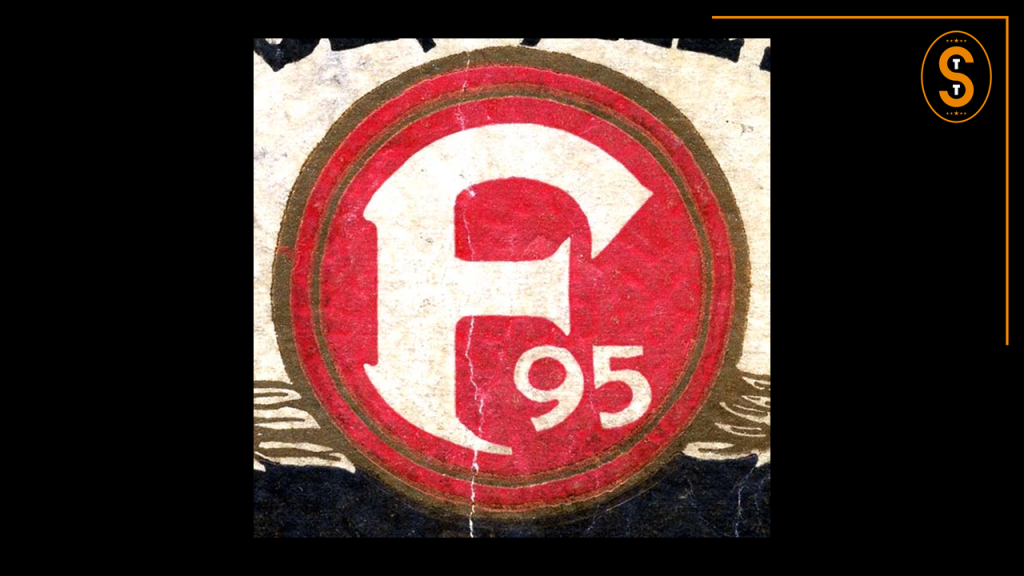
No one knows exactly who changed it or when the logo was updated but for the 1924-1925 season, the club was using this logo. You can see the large white F representing the Fortuna part of the club’s name. The 95 comes from the club being founded in 1895.
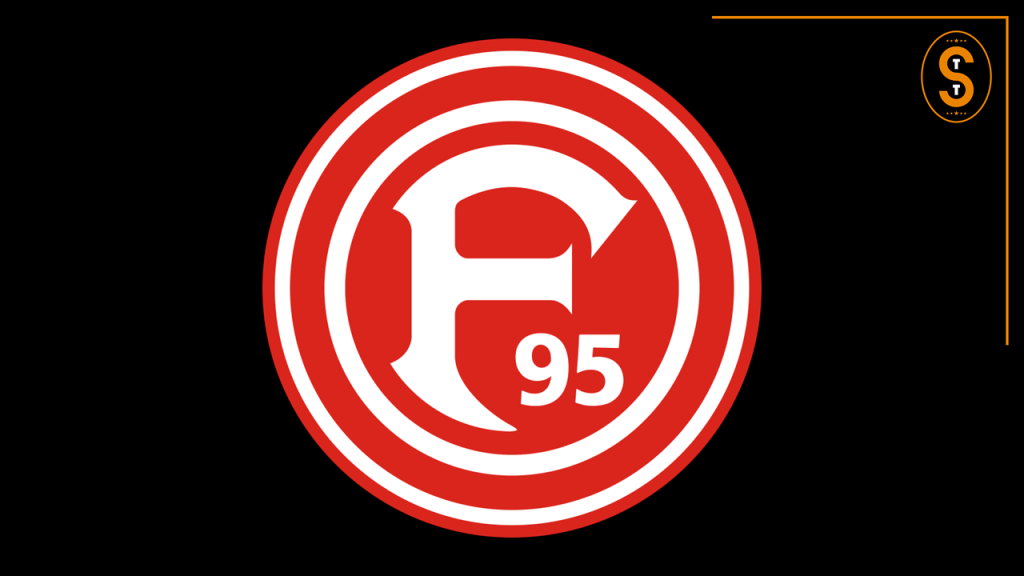
This is the same basic design as the current logo which has simply been updated with modern technology.
Important Events
I’d like to discuss 5 events here.
On June 11, 1933, Fortuna Düsseldorf played FC Schalke in the German National Championship Final. At the time, there was no Bundesliga and the German league champion was decided by a knockout tournament. Fortuna went unbeaten in 21 matches that season and on this date defeated FC Schalke 3-0 in the final in Cologne in front of 60,000 people. It was the club’s first and so far only league title.
The next event I’d like to discuss happened more than 45 years later. On May 16, 1979, Fortuna played FC Barcelona in the final of the European Cup Winner’s Cup in Basel, Switzerland. At the time, FC Barcelona weren’t the dominant FC Barcelona that we think of today, but the club was still one of the most famous clubs in the world. Fortuna went behind 1-0 5 minutes into the match. Fortuna levelled before Barca took the lead again. Fortuna equalized and the match went to extra time 2-2. Barca scored 2 goals in extra time to go up 4-2. Fortuna fought back to make it 4-3 but couldn’t get a late tying goal. Even though Fortuna lost the match, this is considered one of the best performances in the club’s history.
These next 2 events are happier from a Düsseldorf perspective. The first happened about a month after that loss to Barca that we just discussed. On June 23, 1979, Fortuna Düsseldorf beat Hertha Berlin 1-0 in the final of the DFB Pokal to win its first German cup in the club’s 6th appearance in the final. Up until that point, Fortuna had a reputation for being a great cup team until it got to the final. In this match, the club finally got over the hump and won the DFB Pokal for the first time. The club followed it up by winning their second consecutive Pokal final 1 year later on June 4, 1980. Fortuna beat FC Cologne 2-1 in the final. This is the club’s last major trophy victory.
And the last event I want to mention happened on April 28, 2018. The club beat Dynamo Dresden 2-1 in the 3rd to last match of that season. The victory secured the club’s promotion back to the Bundesliga for the 5th time in its history.
Supporters
The club hasn’t had much top flight success or even experience playing in the top flight, but the city of Düsseldorf is one of the largest in Germany. That enables the club to nowadays regularly fill its almost 55,000 seater stadium, even whilst it played in the lower divisions. That wasn’t always the case and support for the club ironically greatly increased when it dropped to the 4th division in 2002.
That motivated local fans to support the team and around the same time a famous local band named Die Toten Hosen sponsored the team’s kits. That sponsorship made Fortuna a cool team to follow for people outside of Dusseldorf.
So, since the early 2000s, the club has had fantastic support, which creates an amazing gameday atmosphere and has earned the Fortuna supporters a great reputation.
Noteworthy Players
Paul Janes played for Fortuna Düsseldorf from 1930 to 1951 with a break from 1941-1947 due to WWII. He was a standout defender for both Fortuna and the German National Team during his career. He won the 1933 German National Championship with Fortuna and was the record appearance holder for West Germany for almost 30 years until his record of 71 appearances was broken in 1970. Düsseldorf’s 2nd team stadium is named after Paul Janes.
Klaus Allofs was a talented striker who played for Fortuna from 1975 to 1981. He was the Bundesliga’s top scorer in 1979 while playing for Fortuna and is one of the best strikers in the club’s history. He was a key member of the Fortuna sides that won the only 2 DFB Pokals in the clubs history. Those came in 1979 & 1980, which we’ve already mentioned. Allofs would have a very successful career playing for other Bundesliga clubs and 2 clubs in France. He is still among the top 10 all-time scorers in Bundesliga history with 177 Bundesliga goals in 424 matches.
And the last player I’d like to discuss is Gerd Zewe. Zewe was a teammate of Allofs, but unlike Allofs he spent his entire professional career with Fortuna. He is the club’s all-time appearance leader and was a key member as the club made 3 straight DFB Pokal finals from 1978-1980, winning 2 of them. In the summer of 2016, Zewe became the 2nd ever player in the club’s more than 100 year history to be named honorary club captain.
Noteworthy Managers
Heinz Körner was the first noted manager in the clubs history, starting in June 1924. He managed until May 1928, then came back in 1931 and managed until 1934. Körner was the manager in charge of the club for its first and only national championship, which came in 1933. He’d have a couple other short stints with the club in the late 30s, early 40s, and early 50s, but his greatest achievement was the 1933 championship.
It’s tough to find other great managers in the club’s history. Hans-Dieter Tippenhauer deserves mention as he was in charge of the club for the 1979 European Cup Winner’s Cup Final loss to Barca and then the 1979 DFB Pokal victory over Hertha that we’ve already discussed.
But he left the club after a short stint and Otto Rehhagel was in charge of Fortuna when they won the 1980 DFB Pokal. Both deserve mention but aren’t exactly legendary managers at the club.
The last 2 managers I’d like to quickly mention are Kuno Klötzer and Aleksandar Ristic. Each had 2 separate stints with the club and each managed the club for about 8 years in total. Neither won anything exceptionally notable, but based on simply length of time in charge of the club, they deserve mention.
Rivals
Fortuna’s main historic rival is likely Rot Weiß Essen and the club’s main current rival is FC Köln (Cologne).
The Fortuna vs Rot Weiß Essen rivalry stretches back to the 1970s, when the two clubs regularly met in the Bundesliga. The two clubs are located about 20 miles apart and this rivalry really stems from geographic location. Rot Weiß Essen has fallen down the divisions in German soccer, so matches between the sides don’t happen as frequently. That has led to a cooling of this rivalry and why I highlighted it as a historic rival.
Fortuna’s main current rival is FC Köln. The cities of Cologne and Düsseldorf have a natural rivalry and are two of the biggest cities in Germany. They are located about a 30-minute train ride from one-another on the Rhine River. In the 1970s and early 1980s, Fortuna became a Bundesliga mainstay and competed for trophies along with places at the top of the Bundesliga table. Köln was also a successful club at this time, which helped develop this rivalry. Unfortunately, Köln’s main rival is Borussia Mönchengladbach, which dissipates this rivalry a bit, but Köln is Fortuna’s main rival from the Fortuna perspective.
Stats & Records
The stats and records we’re about to discuss are as of October 2019, which is when we are recording this video.
Fortuna Düsseldorf has played 25 seasons in the top flight in its history.
The club has 3 major trophies including:
- 1 German national championship (1933)
- 2 DFB-Pokals (German Cups) (1979 & 1980)
Fortuna’s record first team appearance holder is Gerd Zewe with 529 first team appearances in competitive matches. He made an additional 31 appearances in a tournament called the Intertoto Cup, which was a summer club tournament and some people don’t consider these to be official appearances. He made 560 appearances for Fortuna if you include these Intertoto games. I’ll leave it up to you what you consider Zewe’s appearance record to be.
The club’s record goal scorer is Peter Meyer with 98 first team goals.
Fortuna’s record transfer purchase was Dawid Kownacki from Sampdoria in Italy for a fee of €7.5M. Kownacki was on loan at Fortuna Düsseldorf and as part of the loan agreement, if he made 4 appearances, he would be permanently transferred. This happened on September 22, 2019. The deal will officially become permanent on January 1, 2020
And the club’s record transfer sale was Benito Raman to FC Schalke on July 5, 2019 for ~€6.5M.
And 1 last interesting fact about the club: Fortuna consecutively lost its first six cup final appearances across the DFB Pokal & European Cup Winners’ Cup. Five of those six matches were defeats by only a single goal. Though Fortuna is in the club’s name, it hasn’t always had the greatest luck. Hopefully things change as the club looks to re-establish itself in the Bundesliga.
So there you have it… a bit of history on Fortuna Düsseldorf. Let’s continue the discussion in the comments section below the video.
Thanks for stopping by the Soccer Tavern. Hope to see you again soon. Prost!
 The Soccer Tavern