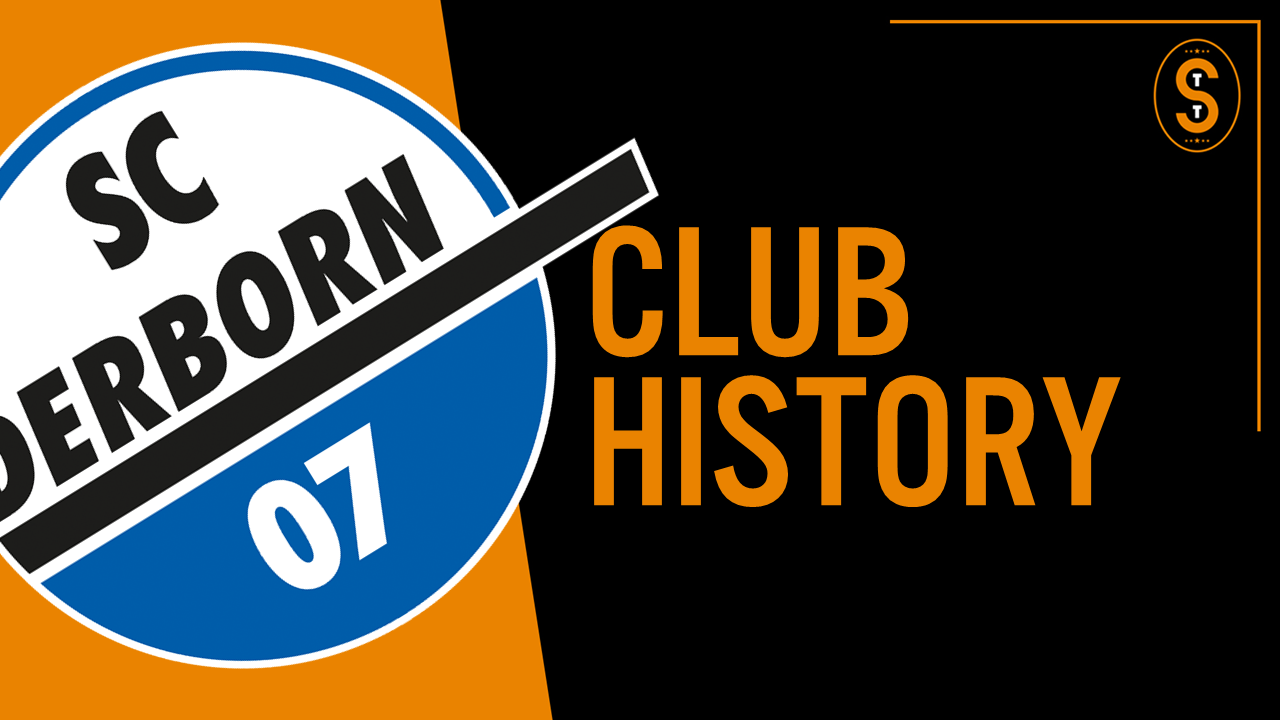
Welcome to the Soccer Tavern, where we’re discussing the history, philosophy, and culture of the beautiful game. My name is Dave and in this video, we’re talking about the history of Sport-Club Paderborn 07, also known as SC Paderborn. Pull up a seat and let’s start the discussion.
SC Paderborn is located in the northwestern part of the city of Paderborn. Paderborn is located in the central, slightly western part of Germany. The club currently play in the Bundesliga and its home ground is called the Benteler-Arena, which opened in 2008 and holds about 15,000 people.
Origin
SC Paderborn was officially created on June 1, 1985 when the rival clubs of SV 07/10 Schloß Neuhaus and FC Paderborn merged. The origins of these clubs began in the early 1900s, so let’s talk about their beginnings.
On August 14, 1907, 20 soccer fans formed a soccer club called Arminia Neuhaus that was located in the northern part of Paderborn. Three years later, a club called VfB Senne was founded on September 17, 1910 in the neighboring village of Sennelager. Each of these 2 clubs would go through some name changes over their 60 year independent existence.
On June 8, 1973, the two clubs, which were now named SV 07 Neuhaus & TuS Sennelager merged to form TuS 07/10 Schloß Neuhaus. So that’s the history of 1 out of the 2 of the clubs that merged in 1985. Still with me? Great.
The other club of FC Paderborn traces its roots back to 1908. In 1908, 4 people founded FC Prussia Paderborn. This club merged with another club called VfB Paderborn in 1912, but it could not survive and shut down in 1913. Former players of the Prussia club then formed SV 13 Paderborn on October 12, 1913. In 1915, former members of the VfB club then reformed a club that would eventually become VfJ 08 in 1920. The 08 referred to the club’s original founding year of 1908 before it shut down in 1913.
These 2 clubs existed as rivals until 1969. In 1969, the clubs merged to form 1. FC Paderborn 08/13. So that was the history of the other club that merged in 1985.
Each of FC Paderborn and TuS Schloß Neuhaus had middling success and realized that if they wanted to reach higher levels of German soccer, they’d need to merge. The merger happened on June 1, 1985 and the club became TuS 07/10 Paderborn-Neuhaus.
Finally, in 1997, the club rebranded to its current name of Sport-Club Paderborn 07. Sport-Club means sports club. Paderborn is the city where the club plays. And 07 refers to 1907 when the first club that would eventually become the current club was formed.
Nickname(s)
Surprisingly, the club is one of only a few clubs in the world that doesn’t really have a nickname.
The TuS Schloß Neuhaus club was nicknamed the Lords of the Castle because there is a castle in the northwestern part of Paderborn where the club played. But, that nickname went away after the merger in 1985.
I’d love to hear your thoughts and/or suggestions for current or future nicknames for Paderborn. Let us know in the comments section.
Crest
Let’s take a look at the club’s crest now, which was last updated in 2010.

Unfortunately, I was not able to find any details explaining the club’s crest. It seems to be straightforward with the club’s name of SC Paderborn 07 e. V. written and a circular shape to the crest with the club’s colors of blue, black, and white used.
The circular shape is used by many clubs in Germany for their crests, but Paderborn has an interesting design with portions of the crest existing outside the circle. I’m not sure why the word Paderborn begins outside the circle and why the thick black line dividing the circle in half extends out to the right.
With the club rebranding in 1997, it’s likely these were just design elements to make the logo look interesting without really a deeper meaning. All of this is conjecture on my part, so if you have additional details, please let us know in the comments section.
Important Events
Many of the club’s important historical events were related to mergers covered in our Origin section, so I’m going to discuss 4 events in this section and they are all from relatively recent years.
The first event I’d like to highlight happened on August 21, 2004. In the first round of the DFB Pokal, 3rd division Paderborn met Bundesliga club Hamburg SV on this date. After Hamburg took a 2-0 lead, Paderborn were awarded a pair of dubious penalties and Hamburg had a player sent off. Paderborn won the match 4-2, but it was later proven that the match official, Robert Hoyzer, was involved in fixing matches for a Croatian gambling syndicate. This match was one of the nine that Hoyzer helped fix. Paderborn didn’t do anything wrong in this situation, but it’s a famous event that involved the club and I wanted to mention it here.
The second event happened on June 4, 2005, when Paderborn beat VfL Wolfsburg’s 2nd team 4-0 in the last match of the Regionalliga Nord season. The win meant Paderborn finished in 2nd place and secured promotion to the 2. Bundesliga. It was the first time that the club clinched promotion to a professional division since the merger in 1985 and was a great day for Paderborn and its supporters. The return to professional soccer allowed the club to construct a new stadium and professionalize a lot of the club’s infrastructure.
The club would go through a handful of up and down seasons over the next few years, so let’s jump to May 11, 2014. This was the final matchday of the 2. Bundesliga season and Paderborn played VfR Aalen. In a tight match that finished 2-1, Paderborn prevailed and secured 2nd place in the 2. Bundesliga. That meant the club achieved automatic promotion to the Bundesliga. It was the first time in the club’s history that it would be playing in Germany’s top division.
That promotion kickstarted a wild 6 years for the club that I’d like to highlight as my last event here. After being promoted to the Bundesliga in 2014, the club immediately suffered back to back relegations, finishing dead last in the respective divisions in 2015 & 2016. In the 2016-2017 season, Paderborn finished 18th in the 3. Liga. That meant the club should have been relegated to the amateur 4th-division Regionaliga, but 1860 Munich, who was relegated from the 2. Bundesliga that season, decided not to pay the €10 million 3. Liga entry fee. That meant 1860 Munich would go down to the amateur Regionaliga and Paderborn were safe in the 3. Liga. Paderborn then miraculously achieved consecutive promotions in 2018 & 2019 by finishing 2nd in the 3. Liga and the 2. Bundesliga to return back to the Bundesliga for the 2019-2020 season. Neither of the recent promotions would have been possible without 1860 refusing to pay the 3. Liga license fee. Like I said, it’s been a wild ride for Paderborn supporters in recent years.
Supporters
Before every SC Paderborn home match, the song Das Paderborn-Lied from the band Madison-Band is played. The song was written in 1999 and is a song about love for the city of Paderborn.
Additionally, fans will sing an SC Paderborn specific song called “Helden geben nie auf!” meaning heroes never give up. These are two of the well-known songs associated with SC Paderborn & its supporters, which is why I wanted to highlight them here.
Noteworthy Players
For SC Paderborn’s 100-year anniversary in 2007, readers of the Westfälischen Volksblattes voted on a team of the century for the club. Most of the players only had short stints with the club so I’m going to quickly mention their names.
Goalkeeper was Stephan Loboué.
Defenders were Friedhelm Lüning, Markus Bollmann, & Günter Kutowski.
Midfielders were Peter Hobday, Thomas von Heesen, & Christian Schreier
And strikers were Antonio Di Salvo, René Müller, & Dieter Hecking.
For those math whiz viewers, you’ll have counted 10 players. That’s because the 11th player, defender Markus Krösche, is a club legend worthy of more time. Krösche joined the club in the summer of 2001 while the club was in the 3rd division. He’d remain at the club for 13 years as it fluctuated between the 2nd and 3rd divisions before retiring in 2014 after helping the club gain promotion to the Bundesliga for the first time in its history. Krösche was a long-time captain at the club and is a legendary player in SC Paderborn’s history.
Noteworthy Managers
Pavel Dotchev managed SC Paderborn for more than 140 matches across 2 stints at the club. In his first stint, he successfully led the club out of the 3rd division and into the 2. Bundesliga in 2005, which we discussed in our Important Events section. He did not stay on as manager that season, but returned in February 2008. Dotchev suffered relegation to the 3. Liga that season, but immediately led Paderborn back to the 2. Bundesliga in 2009 before departing again. He’s one of the longest tenured managers in Paderborn’s tumultuous history.
And the other manager I’d like to highlight here is Steffen Baumgart. Baumgart became manager of Paderborn in April 2017, which was one of the club’s lowest points since its merger in 1985. As we previously mentioned, Paderborn finished the 3. Liga season in 18th place that year, but were saved from relegation by 1860 Munich. Baumgart has since stabilized the club and led them to consecutive promotions that sees Paderborn currently playing in the Bundesliga. He’s been manager for 110 matches at time of recording and has a contract through June 2021. If Paderborn can survive in the Bundesliga or, simply not completely bottom out like after their last relegation, Baumgart could go on to become the greatest manager in club history. No matter what happens in the future, Baumgart has earned his place in the SC Paderborn history books.
Rivals
Because of Paderborn’s unusual club history, it doesn’t have a true rival. Germans are very traditional when it comes to soccer, and the fact that Paderborn was formed in 1985 as a merger of 2 clubs, then rebranded in 1997, has hurt their rivalry credentials so to speak.
Still, I’d like to highlight Arminia Bielefeld in this section. Bielefeld fans consider other clubs to be bigger rivals, but there is a rivalry with SC Paderborn, especially from the SC Paderborn supporters’ perspective. Matches between Paderborn and Bielefeld are called Ostwestfalen Derby matches because both clubs are located in the region of Ostwestfalen or East Westphalia in English.
The 2 cities of Paderborn and Bielefeld are about 45 kilometers or 28 miles apart. Going back through Paderborn’s history including its predecessor clubs, Arminia and Paderborn have met less than 20 times in competitive matches across Germany’s amateur and professional divisions. Bielefeld has been the more successful club in those matchups. This rivalry could continue to develop if both clubs are in the same division for an extended period of time, which hasn’t really happened. Hopefully we can see this rivalry develop and Paderborn can have a true rivalry.
Stats & Records
The stats and records we’re about to discuss are as of December 2019, which is when we are recording this video.
SC Paderborn has played 2 seasons in the top flight in its history.
The club has no major trophies.
Paderborn’s record first team appearance holder is Markus Krösche with 373 first team appearances.
The club’s record goal scorer is Veselin Petkov Gerov with 95 first team goals.
Paderborn’s record transfer purchase is a tie between 2 players. Kevin Stöger from VfB Stuttgart on August 25, 2015 for ~€1M. And Nick Proschwitz from FC Thun in Switzerland on July 1, 2011 for ~€1M.
And the club’s record transfer sale was Nick Proschwitz to Hull City in England on July 18, 2012 for ~€3.3M.
And 2 last interesting facts about the club:
(1) Paderborn scored the longest-distance goal in Bundesliga history. The historic goal happened on September 20, 2014 when Paderborn midfielder Moritz Stoppelkamp scored from 82 metres out to secure a 2-0 win over Hannover. It was 1-0 late in the match and Hannover sent their goalkeeper forward for a free kick. Paderborn cleared the service to the top of their own 18 yard box where Stoppelkamp did well to control off his chest and send a half volley the length of the pitch into an open net. Paderborn then renamed a street near their stadium Stoppelkamp-Allee as a tribute to this goal.
(2) Additionally, Paderborn encourages supporters to arrive to its stadium by bicycle and offers 2,000 bike lock stations. That is the most bike lock stations offered by any club in the Bundesliga.
So there you have it… a bit of history on Sport-Club Paderborn 07. Let’s continue the discussion in the comments section below the video.
Thanks for stopping by the Soccer Tavern. Hope to see you again soon. Prost!
 The Soccer Tavern