Hertha Berlin | Club History

Hertha Berlin | Club History

Welcome to the Soccer Tavern, where we’re discussing the history, philosophy, and culture of the beautiful game. My name is Dave and in this video, we’re talking about the history of Hertha, Berliner Sport-Club, better known as Hertha Berlin. Pull up a seat and let’s start the discussion.

Hertha is located in the western part of the city of Berlin.  Berlin is located in the northeastern part of Germany. The club currently play in the Bundesliga and its home ground is called the Olympiastadion, which opened in 1936 and holds about 75,000 people. In 2016, Hertha BSC presented plans to build its own new stadium, once the lease at the Olympiastadion expires in 2025. The club hopes to build the Hertha Fussballarena with a capacity of 55,000 next to the Olympiastadion.

Origin

Hertha Berlin was founded by 2 sets of brothers on July 25, 1892 in either the neighborhood of Wedding or Prenzlauer Berg in the city of Berlin. The brothers were Fritz and Max Lindner and Otto and Willi Lorenz. They were each 16 or 17 years old at the time.

The first official name for the club was Berliner Fußball Club Hertha 1892. Berliner referred to the city of Berlin where the club would play. Fußball Club referred to the sport of soccer. 1892 was the founding year. And the Hertha part of the club’s name came from a steamboat that Fritz Lindner had previously ridden with his father.

The smokestacks of the boat were painted with blue & white stripes, which is where the club took its colors and kit design from. Those are still the colors and kit design used more than 125 years later.

Almost exact 31 years after its founding, the club merged with the Berliner Sport-Club on August 7, 1923. As a result of this merger, It adopted the club’s current name of Hertha Berliner Sport-Club or Hertha BSC.

Nicknames

The club has 3 nicknames. Die Blau-Weißen, Hertha, & die Alte Dame.

Die Blau-Weißen nickname translates from German to English as the Blue-Whites. It comes from the club’s kit colors.

Hertha obviously comes from the club’s name, which we’ve already discussed came from a steamboat.

And lastly, the club’s final nickname is die Alte Dame or the Old Lady in English. That nickname was given because the club’s official name includes Hertha, which is a woman’s first name. It also fits since the club is one of the oldest clubs playing in the Bundesliga.

Crest

While Hertha has a simplified crest, it does stand out as unique from many of the other Bundesliga clubs that utilize round logos.
Hertha BSC crest

Hertha’s crest is simply a flag blowing in the wind with the club’s colors of blue and white along with the club’s official name of Hertha BSC written in it. Hertha’s crest has included different versions of this flag since 1931 with the exception of a period from 1979 to 1987. The current crest has been used since 2012 when the club broke the mold of circular crests and decided to go with just the flag shape.

Important Events

On June 22, 1930, Hertha played Holstein Kiel in the final of the German National Championship. After going down 2-0 early in the first half, Hertha levelled by the 26th minute. The teams traded goals 2 more times throughout the match before Hertha scored their 5th goal in the 87th minute. They would hold on to win the match 5-4 for their first National Championship title.

They’d follow this up 1 year later on June 14, 1931 when Hertha beat TSV 1860 Munich 3-2 in the final. It was the club’s second consecutive National Championship and these 2 titles are the only 2 major trophies in the club’s existence.

On May 16, 1965, Hertha Berlin were officially relegated from the Bundesliga. The club actually finished outside of the relegation zone that season, but were caught bribing players to come play for the club. At the time, German soccer was still amateur and had strict rules about paying players. After the Berlin Wall was constructed in 1961, Hertha found it very difficult to attract players to their isolated city and thus resorted to bribing some players. This was unfortunately not the only bribery scandal we need to discuss with regards to the club.

Jumping forward 6 years to June 6, 1971. On this day, Kickers Offenbach’s director, Horst-Gregorio Canellas called a press conference and informed the public that there were a number of fixed matches towards the end of the 1970-1971 Bundesliga season. Because the German game was still amateur, players were susceptible to bribery. This time it was more serious than the bribery scandal we just discussed because match outcomes were affected. Ten matches that season were fixed or contained some sort of illegal activity. Hertha was only involved in 1 of those matches, but were punished hardest. Fifteen Hertha players were found guilty and were punished in some form. Though this scandal was a huge black mark on the Bundesliga and Hertha, it led to widespread reform that helped issue in the modern professional game in Germany.

And the last event I’d like to highlight came on May 22, 1999. On this date, Hertha beat Freiburg 2-0 on the road in the 2nd to last match of the season. The win clinched a top 4 Bundesliga finish for Hertha, which meant the club qualified for the Champions League for the first time in the club’s history. Hertha finished 3rd place that season and played 14 Champions League matches in the 1999-2000 season. It was arguably the club’s greatest accomplishment since winning those 2 National Championships in 1930 & 1931.

Supporters

Hertha supporters have a unique chant that goes Ha-Ho-He (Hah-hoe-hey) Hertha BSC (pronounced “Bay-Ess-Say”). It doesn’t really have meaning other than sounds that rhyme, but its origin can be traced back to at least the 1930s, possibly even earlier.

Often times you’ll see the club and supporters use the hashtag #hahohe on social media and now you know that it comes from a unique chant by the club’s supporters.

Noteworthy Players

Johannes (Hanne) Sobek joined Hertha in 1925 after beginning his career with BFC Alemannia 1890. Sobek was one of the best German players at the time and was named Hertha captain in 1927. Sobek had two goals in Hertha’s dramatic 1930 German National Championship win and he also scored 2 more goals in Hertha’s 1931 German National Championship Final win. He would retire from the sport in 1938 and is the first club legend in Hertha’s history.

Erich Beer, or Ete Beer as he was called by fans, was a club idol in the 1970s. He joined the club in 1971 and would leave in 1979. Beer would make 342 appearances for Hertha in all competitions and was the club’s career record goalscorer for many years. Beer actually broke his hand in the middle of a match and kept playing. He was a great player at the club and is considered a legend.

Jumping forward about 20 years, Gabor Kiraly joined Hertha in 1997 at 21 years old. He’s well known for wearing baggy, beat-up looking gray sweatpants. The story is that at Kiraly’s first club, the kit manager once forgot the black goalkeeper shorts and only had long, gray pants. He wore them and proceeded to keep wearing after he won nine games in a row. At Hertha, Kiraly played 198 matches and was a key member as the club qualified for the Champions League where he then made 12 Champions League appearances. He left the club in 2004 and is widely considered one of the greatest Hertha keepers ever. Kiraly retired in May 2019 after a 26 year professional career and is a cult fan favorite for nearly every club he played for.

Arne Friedrich joined Hertha in 2002 and played for Hertha through the majority of his career. He was named club captain in 2004 and would remain captain until he left in 2010. He’d make more than 200 appearances for Hertha as a standout defender and received more than 80 German national team caps in his career. The majority of those caps came while he was a Hertha player. He was one of the best defenders in the Bundesliga during his career.

And lastly, I want to mention is Marcelinho. He is one of the most talented players to ever play for Hertha. Marcelinho was a flair attacking midfielder who could also score goals. He scored more than 60 goals for Hertha in the early 2000s. He also had quite an off-field life and clashed with club executives because of this. Though he only spent 5 seasons at Hertha, he was given a testimonial match in March 2017 at Hertha. He is truly one of the best players in Hertha’s history and is an icon at the club.

Noteworthy Managers

With the club not having a ton of historical success, I’m only going to highlight 2 managers in this section.

Helmut Kronsbein, most commonly called Fiffi, was appointed Hertha manager in the summer of 1966 as the club was in the Regionalliga after the bribery scandal of 1965 that we already discussed. Fiffi would lead the club back to the Bundesliga by 1969 and he’d be a steady presence through the club’s involvement in the 1971 Bundesliga scandal. Fiffi would manage more than 200 matches while with die Alte Dame across 2 stints. Though no trophies were won under his tenure, at time of recording, he is the longest serving manager in the club’s Bundesliga era history and deserves mention.

The next manager I’d like to talk about is Jürgen Röber. Röber managed Hertha from 1996 to 2002. Under his tenure, the club experienced arguably their greatest period since the 1930s. Hertha regularly finished in the top 1/3 of the Bundesliga under Röber and qualified for the Champions League in 2000. The club even won 2 preseason trophies in 2000 & 2001 and Röber would manage 254 matches for Hertha. Along with Fiffi, Röber is one of the 2 longest serving managers in the club’s Bundesliga era.

Rivals

Hertha’s main rival is fellow Berlin based club Union Berlin. This is a David & Goliath type of rivalry with Union Berlin having the smaller fan base, lower economic resources, and playing the underdog against Hertha’s size, strength, and relative success. The rivalry is also very interesting because the clubs were separated by the Berlin wall for many years, and therefore, haven’t actually played many times in competitive matches. Hertha represents the Western neighborhoods of the city, while Union represents the eastern parts of the city. The two clubs met in a friendly in 1990 shortly after the fall of the Berlin wall, but 8 months before Germany was officially reunified. The rivalry typically isn’t as intense as many other rivalries in Germany, but the first ever top flight meeting of these 2 sides happened on November 2, 2019 and Union won 1-0. The match was a proper derby with passion overflowing from some Union supporters who invaded the pitch at full-time and the match being delayed by flares from Union supporters. If both sides remain in the Bundesliga, this rivalry should continue to grow.

Additionally, Hertha has a one-sided rivalry with Schalke 04. The rivalry stretches back to the early 1970s, specifically December 13, 1971. On this date, Hertha played Schalke in a DFB Pokal match. Hertha won 3-0 with 2 goals from a man named Zoltan Varga. Varga was forbidden from playing in the match because he was involved in a Bundesliga corruption scandal earlier in the year, so Hertha forfeited the match with Schalke advancing. Schalke would go on to win the Pokal that season and Hertha felt their punishment was unjust since many teams and players were involved in the scandal. Both Hertha and Schalke each had many players suspended as a result of the corruption investigation. Schalke fans never gave this issue much thought and have never considered Hertha to be a rival, but many Hertha supporters still actively dislike Schalke, making this another unique rivalry for Hertha.

Stats & Records

The stats and records we’re about to discuss are as of November 2019, which is when we are recording this video.

Hertha Berlin has played 37 seasons in the top flight in its history.

The club’s only major trophies are the 2 German National championships, which were won in 1930 and 1931 before the Bundesliga was created.

The club also won 2 DFB Ligapokals in 2001 & 2002. This was a preseason tournament between Germany’s top finishing clubs from the prior Bundesliga season. The competitiveness of this tournament is debatable, which is why I didn’t consider this to be a major trophy for the club.

Hertha’s record first team appearance holder is Pál Dárdai with 373 first team appearances.

The club’s record goal scorer is Michael Preetz with 108 first team goals (or 105 if you don’t count Liga Pokal goals).

The Old Lady’s record transfer purchase was Dodi Lukebakio from Watford in England on August 1, 2019 for ~€20M.

And the club’s record transfer sale was Valentino Lazaro to Inter Milan in Italy on July 1, 2019 for ~€22M.

And 1 last interesting fact about the club: From 1926 to 1931, the club qualified for 6 straight German National Championship finals. It lost the first 4, but won the last 2 in 1930 & 1931.

So there you have it… a bit of history on Hertha, Berliner Sport-Club. Let’s continue the discussion in the comments section below the video.

Thanks for stopping by the Soccer Tavern. Hope to see you again soon. Prost!
1. FSV Mainz 05 | Club History

1. FSV Mainz 05 | Club History

Welcome to the Soccer Tavern, where we’re discussing the history, philosophy, and culture of the beautiful game. My name is Dave and in this video, we’re talking about the history of 1. Fußball- und Sportverein Mainz 05, also known as FSV Mainz 05. Pull up a seat and let’s start the discussion.

FSV Mainz 05 is located in the western part of the city of Mainz. Mainz is located in the central, slightly western part of Germany. The club currently play in the Bundesliga and its home ground is called the Opel Arena, which opened in 2011 and holds about 34,000 people.

Origin

In 1903, a group of people tried to form a soccer club in the city of Mainz. At the time, soccer was outwardly discouraged in a lot of the German culture, while gymnastics & track & field were more socially acceptable. Only a few years later though, there was a successful attempt to create a club.

On March 16, 1905, the 1. Mainzer Fußballclub “Hassia” 1905 was created. The Erste Mainzer Fußballclub part of the name meant first Mainz football or soccer club. Hassia referred to the region of Germany where the city of Mainz was located. And 1905 was the founding year of 1905.

In August of 1912, the club merged with FC Hermannia 07 and became 1. Mainzer Fußballverein 05. It dropped the Hassia portion of the name.

After WWI, the club merged with Sportverein 08 in 1919 and became 1. Mainzer Fußball- und Sportverein 05.

Sometime between 1919 and today, the Mainzer portion of the club’s name was shortened to just Mainz and moved to the end of the club’s official name, but I wasn’t able to find exactly when. If you know more details about that name change, please let us know in the comments section below the video.

Nicknames

The club has 2 nicknames: die Nullfünfer, meaning ‘the Zero-Fives’, and Karnevalsverein, meaning ‘Carnival Club’.

Die Nullfünfer nickname means ‘the zero-fives’ and refers to the club’s founding year of 1905.

The Karnevalsverein nickname means the ‘Carnival Club’ in English. The city of Mainz holds one of the longest and largest Carnivals in all of Germany, which is where this nickname comes from. English speakers night also know Carnival by its other name of Mardi Gras. In actuality, local Mainz citizens call Carnival ‘Fastnacht’ and the Karnevalsverein nickname came from outsiders. The nickname stuck though and Mainz is the Karnevalsverein.

Crest

Let’s look at Mainz’s crest now.

1. FSV Mainz 05 Full Crest

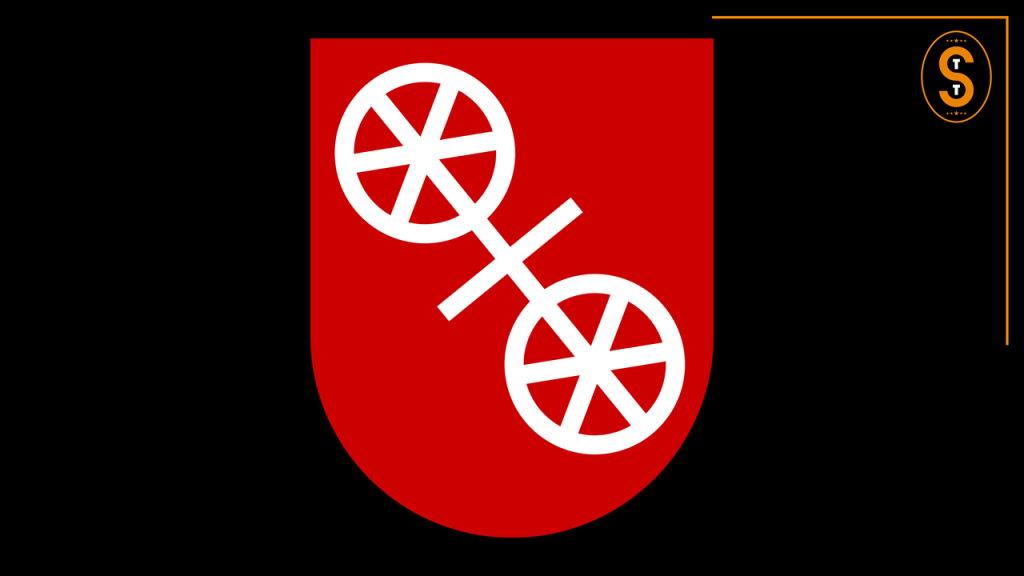
The colors of red & white come from the city of Mainz’s coat of arms, which dates back to the 13th century, possibly even before then.

The club’s full name is written at the bottom of the crest.

The main element of the crest is a stylized M written in a circular shape. The M stands for Mainz and the numbers 05 stand for the club’s founding year of 1905.

City of Mainz Coat of Arms

I haven’t been able to verify this, but the city of Mainz’s coat of arms includes 2 wheels with spokes and the club’s crest kind of looks like it’s trying to create a wheel with spokes. I don’t have anything to verify that, but I wanted to share in case you found it interesting. If anyone has more details, please let us know in the comments section of the video.

1. FSV Mainz 05 Simplified Crest

Nowadays, you’ll likely see this simplified crest of just the M & 05 for the club.

Important Events

The first event I’d like to highlight is a not so happy one. After the 1975-1976 2. Bundesliga Süd season, Mainz decided to self-relegate themselves after finishing mid-table. The club was experiencing serious financial issues and would play in the amateur divisions for more than 10 years. Unfortunately, most of the sources I’ve found merely reference this time period but don’t share more details about what exactly happened. If you have some more information, I’d love to know, so please let us know in the comments section below the video.

The next event I’d like to discuss happened while the club was playing in the amateur divisions. On June 17, 1982, Mainz 05 won the club’s greatest trophy to date. On this day, the club beat Werder Bremen’s amateur side 3-0 in the final of the Deutsche Fußball-Amateurmeisterschaft or German Amateur Championship. It was a great day for the club even though this technically isn’t considered a major trophy.

Jumping forward 10 years to April 1, 1992. On this date, Christian Heidel joined the 05ers as an executive. Some sites list him as sporting director and some list him as manager, but regardless of his title, Heidel is likely the most important person in the club’s history. Heidel supported Mainz 05 as a child and is from the city of Mainz. He provided excellent leadership, revamped the club’s youth academy & scouting network, appointed some of the club’s most important managers who we’ll discuss in more detail soon, and was in charge as the club built a new, modern stadium. Heidel was instrumental in the club reaching and becoming a regular Bundesliga club. He left in 2016 after 24 years and will always be an incredibly important person in Mainz 05’s history.

The next event I’d like to highlight happened on February 27, 2001 which is when Jürgen Klopp was appointed club manager. Klopp was a long-time player for the club and was actually an active player at the time, but was injured. Mainz was in a relegation battle that season and fired its manager. Klopp was asked to take over on an interim basis. This appointment would be incredibly important as we’ll discuss in more detail later in this video.

One of the things under Klopp’s leadership that we can discuss right now happened on May 23, 2004. It was the final day of the 2. Bundesliga season and Mainz beat Eintracht Trier 3-0. The result clinched 3rd place for Mainz and promotion to the Bundesliga for the first time. It was the first time in the club’s nearly 100 year history that it would be playing in the top division. It is arguably the greatest day in the club’s history.

And the final event I’d like to highlight is a year rather than a specific date. In 2011, Mainz 05 finished the Bundesliga season in 5th place – it’s highest ever league finish. That result qualified Mainz for European competition from a sporting perspective for the first time in the club’s history. Mainz had previously qualified for Europe through a fair play award. The incredible year for the club was not done, as that same year, the club opened its new, modern stadium. The club had previously been playing in a makeshift expanded stadium that did not truly meet the requirements of a top division club. The new stadium was a huge accomplishment for the club and has allowed Mainz to maintain its place in the Bundesliga for 10 seasons at time of recording. 2011 was one of the greatest years in club history.

Supporters

The Humba is now a world famous chant, but it all began in the city of Mainz in 1964. At that time, Ernst Neger, who was a local composer, wrote the chant as a Carnival song. It’s a nonsensical call and response chant that goes: “Gebt mir ein H (crowd responds with H!) – gebt mir ein U (crowd responds with U!) – gebt mir ein M (crowd responds with M!) – gebt mir ein B (crowd responds with B!) – gebt mir ein A (crowd responds with A!)” and then everybody goes crazy and they all chant: “Wir singen Humba, Humba, Humba, Täteräääää!!”

It really doesn’t mean anything but it looks like a lot of fun and you can understand how it’s become so popular. The chant as it applies to soccer was first adopted by Mainz 05 supporters in the 1990s. The Humba has spread throughout the Bundesliga and since the German national team adopted it in 2007, it has become world famous. Now, many clubs & supporters perform the chant after victories. It all traces back to the city of Mainz and Mainz 05.

Noteworthy Players

I’d like to discuss 4 players in this section.

Jürgen Klopp signed his first professional contract with the club at the age of 23 in 1990. Klopp described himself as an average player who had 4th-division talent and a 1st-division head. He’d play for the club for 11 seasons, making over 300 appearances before an injury ended his playing career in 2001. Though Klopp likes to downplay his own achievements, he’s currently 3rd on the club’s all- time scoring charts, which is very impressive for someone who played the majority of his career as a defender.

Dimo Wache was a goalkeeper for Mainz from 1995-2010. He’d make more than 400 appearances for the club, mainly in the 2. Bundesliga but have a handful of seasons in the Bundesliga. Mainz would be the only professional club that Wache would make an appearance for in his career. He’s the club’s all-time record appearance holder and was a long time club captain. Wache is an honorary club captain and is a legend for FSV Mainz 05.

Nikolče Noveski was a defender for Mainz for 11 years and captain for 7 of those years from 2004-2015. He made more than 300 appearances for the club including more than 250 Bundesliga appearances. He was a Macedonian international and was named honorary captain of the club after his departure. In September 2017, Mainz held a testimonial match for Noveski and he is an absolute club legend.

Lastly, I’d like to mention arguably the club’s most talented ever player, André Schürrle. Schürrle joined Mainz as a youth player and made his professional debut in the summer of 2009. He’d only play for Mainz for 2 seasons before moving to Leverkusen and then onto other clubs in Germany and abroad. Schürrle’s 2 seasons at Mainz to start his career were probably the best of his career. He’s has gone on to have a moderately successful career that has tailed off in recent seasons. The pinnacle of Schürrle’s career though was an incredibly high point. He provided the match winning assist in the 2014 World Cup Final that won Germany the title. For that reason alone, Schürrle deserves mention here.

Noteworthy Managers

With limited historical success, I’m only going to highlight 2 managers in this section and both managers are relatively recent in the club’s history.

As we already mentioned, Jürgen Klopp took over Mainz 05 in February 2001. Klopp saved the club from relegation to the 3rd division that season and in his next 2 full seasons at the club, he nearly led Mainz into the Bundesliga. In his third full season at the club, Klopp finally did lead the club into the Bundesliga for the first time in 2004. Klopp maintained Mainz in the Bundesliga for 3 seasons before suffering relegation. He remained in charge of the club for 1 more 2. Bundesliga season but couldn’t bring the 05ers back to the Bundesliga and departed for Dortmund in 2008. Klopp would have great success at Dortmund and now Liverpool, where he currently manages. He’s widely considered one of the best managers of his generation and it all started at Mainz 05. Klopp is one of the most important people in the club’s nearly 115 year history.

And the other manager I’d like to highlight is Thomas Tuchel. Tuchel had a short playing career in the lower divisions of Germany and became a youth coach at Stuttgart & Augsburg. He joined Mainz in 2008 as a youth coach and was surprisingly appointed as first team manager in the summer of 2009 after the previous manager had led the club back to the Bundesliga. Tuchel proved to be the right hire though as he led the club for 5 seasons and stabilized Mainz in the Bundesliga. Additionally, Tuchel led Mainz to a 5th placed Bundesliga finish in the 2010-2011 season. As mentioned in our important events section, this is still the club’s highest ever league finish. Tuchel has gone on to manage Borussia Dortmund and Paris Saint Germain and, though not quite at the level of Jürgen Klopp, he has a very impressive managerial resume.

Rivals

Mainz has 2 rivals: Eintracht Frankfurt and 1. FC Kaiserslautern.

The Eintracht Frankfurt rivalry isn’t one of the most intense in Germany. Matches will sometimes be called Rhein-Main-Derby matches in reference to the rivers that the cities of Mainz and Frankfurt lie near. This is a bit of a one-sided rivalry as Frankfurt has a few other clubs that it considers to be primary rivals, while Mainz considers Frankfurt and more recently Kaiserslautern as its main rivals. Frankfurt and Mainz are located less than 25 miles apart, which helps any rivalry, but most fans won’t consider these matches to be full-blown derbies with intense passion. The rivalry deserves mention, but it’s not enormous.

Mainz’s other main rival is 1. FC Kaiserslautern. Based on an article from Der Spiegel, this seems to be a newer rivalry. Kaiserslautern has a longer history as a Bundesliga club, but in recent years, Mainz has overtaken Kaiserslautern in the German soccer pyramid. That has likely helped fuel this budding rivalry between clubs from the German state of Rheinland-Pfalz. Again, this isn’t considered one of the most intense rivalries in German soccer, but is a rivalry and should continue to grow in the future.

Stats & Records

The stats and records we’re about to discuss are as of December 2019, which is when we are recording this video.

Mainz 05 has played 14 seasons in the top flight in its history.

The club has no major trophies and its greatest title was winning the 1982 German Amateur Championship.

The 05ers’ record first team appearance holder is Dimo Wache with 406 first team appearances.

The club’s record goal scorer is Michael Thurk with 64 first team goals.

Mainz’s record transfer purchase was Jeremiah St. Juste from Feyenoord in the Netherlands on August 7, 2019 for ~€9M.

And the club’s record transfer sale was Abdou Diallo to Borussia Dortmund on July 1, 2018 for ~€28M.

And 1 last interesting fact about the club:

I believe Mainz has the 2nd largest standing supporters stand in Germany behind Borussia Dortmund’s stadium. There are other grounds with greater standing supporter capacity, but Mainz’s stadium technically has the 2nd most when comparing just 1 stand or section of the stadium. I do want to add in a disclaimer that this was accurate as of 2016, but I wasn’t able to fully verify that it is still accurate. If you have any more details, please let us know in the comments section.

So there you have it… a bit of history on 1. Fußball- und Sportverein Mainz 05. Let’s continue the discussion in the comments section below the video.

Thanks for stopping by the Soccer Tavern. Hope to see you again soon. Prost!
Fortuna Düsseldorf | Club History

Fortuna Düsseldorf | Club History

Welcome to the Soccer Tavern, where we’re discussing the history, philosophy, and culture of the beautiful game. My name is Dave and in this video, we’re talking about the history of Düsseldorfer Turn- und Sportverein Fortuna 1895 e.V., better known as Fortuna Düsseldorf. Pull up a seat and let’s start the discussion.

Fortuna is located in the northern, slightly western part of the city of Düsseldorf.  Düsseldorf is located in the western part of Germany. The club currently play in the Bundesliga and its home ground is called the MERKUR SPIEL-ARENA (formerly ESPRIT) Arena. The stadium opened in 2004 and holds a little less than 55,00 people.

Origin

The club was officially founded as a gymnastics only club on May 5, 1895 in a town called Flingern, which is now a part of the city of Düsseldorf. The club’s original name was Turnverein Flingern 1895.

Completely separate from this club, 2 other clubs were formed in the Düsseldorf area in the early part of the 1900s. Düsseldorfer Fußballklub Spielverein was created on May 1, 1908 and Fußballclub Alemania 1911 was created in May 1911. Fußballclub Alemania 1911 would rename itself to Fußballklub Fortuna 1911 in 1912. The name Fortuna came from a local bakery in the neighborhood of Flingern.

These 2 soccer clubs would merge in 1913 to become Düsseldorfer Fußballclub Fortuna 1911.

Finally, on November 15, 1919, the Turnverein Flingern 1895 merged with the Düsseldorfer Fußballclub Fortuna 1911 and became the club’s current name of Düsseldorfer Turn- und Sportverein Fortuna 1895.

Though Fortuna can rightly claim it has existed since 1895 as a club, the soccer portion of the club has “only” been playing since 1908.

Nicknames

The club has 2 straightforward nicknames.

The first is F95. It’s an abbreviation for the club with the F standing for Fortuna and 95 standing for the club’s founding year.

The other nickname of Die Flingeraner means people from Flingern, which, we’ve already discussed, is the neighborhood where the club was founded. Though its home stadium is no longer located in this neighborhood, the club still maintains this nickname.

Crest

Like most German soccer crests, Düsseldorf’s crest is very simple but it has evolved a bit over the years.

Düsseldorfer Turn- und Sportverein Fortuna crest from 1920

The first time a logo resembling the current logo was used was noted to be December 11, 1920. This logo had the letters “DTFSV” for Düsseldorfer Turn- und Sportverein Fortuna with the F large & in the middle and the club’s founding year of 1895. The colors of red & white for the club can be traced back to the two original soccer clubs of “FK Spielverein” and “FK Alemania” who both played in red & white striped kits.

Fortuna’s crest for the 1924-1925 season

No one knows exactly who changed it or when the logo was updated but for the 1924-1925 season, the club was using this logo. You can see the large white F representing the Fortuna part of the club’s name. The 95 comes from the club being founded in 1895.

Fortuna’s modern crest

This is the same basic design as the current logo which has simply been updated with modern technology.

Important Events

I’d like to discuss 5 events here.

On June 11, 1933, Fortuna Düsseldorf played FC Schalke in the German National Championship Final. At the time, there was no Bundesliga and the German league champion was decided by a knockout tournament. Fortuna went unbeaten in 21 matches that season and on this date defeated FC Schalke 3-0 in the final in Cologne in front of 60,000 people. It was the club’s first and so far only league title.

The next event I’d like to discuss happened more than 45 years later. On May 16, 1979, Fortuna played FC Barcelona in the final of the European Cup Winner’s Cup in Basel, Switzerland. At the time, FC Barcelona weren’t the dominant FC Barcelona that we think of today, but the club was still one of the most famous clubs in the world. Fortuna went behind 1-0 5 minutes into the match. Fortuna levelled before Barca took the lead again. Fortuna equalized and the match went to extra time 2-2. Barca scored 2 goals in extra time to go up 4-2. Fortuna fought back to make it 4-3 but couldn’t get a late tying goal. Even though Fortuna lost the match, this is considered one of the best performances in the club’s history.

These next 2 events are happier from a Düsseldorf perspective. The first happened about a month after that loss to Barca that we just discussed. On June 23, 1979, Fortuna Düsseldorf beat Hertha Berlin 1-0 in the final of the DFB Pokal to win its first German cup in the club’s 6th appearance in the final. Up until that point, Fortuna had a reputation for being a great cup team until it got to the final. In this match, the club finally got over the hump and won the DFB Pokal for the first time. The club followed it up by winning their second consecutive Pokal final 1 year later on June 4, 1980. Fortuna beat FC Cologne 2-1 in the final. This is the club’s last major trophy victory.

And the last event I want to mention happened on April 28, 2018. The club beat Dynamo Dresden 2-1 in the 3rd to last match of that season. The victory secured the club’s promotion back to the Bundesliga for the 5th time in its history.

Supporters

The club hasn’t had much top flight success or even experience playing in the top flight, but the city of Düsseldorf is one of the largest in Germany. That enables the club to nowadays regularly fill its almost 55,000 seater stadium, even whilst it played in the lower divisions. That wasn’t always the case and support for the club ironically greatly increased when it dropped to the 4th division in 2002.

That motivated local fans to support the team and around the same time a famous local band named Die Toten Hosen sponsored the team’s kits. That sponsorship made Fortuna a cool team to follow for people outside of Dusseldorf.

So, since the early 2000s, the club has had fantastic support, which creates an amazing gameday atmosphere and has earned the Fortuna supporters a great reputation.

Noteworthy Players

Paul Janes played for Fortuna Düsseldorf from 1930 to 1951 with a break from 1941-1947 due to WWII. He was a standout defender for both Fortuna and the German National Team during his career. He won the 1933 German National Championship with Fortuna and was the record appearance holder for West Germany for almost 30 years until his record of 71 appearances was broken in 1970. Düsseldorf’s 2nd team stadium is named after Paul Janes.

Klaus Allofs was a talented striker who played for Fortuna from 1975 to 1981. He was the Bundesliga’s top scorer in 1979 while playing for Fortuna and is one of the best strikers in the club’s history. He was a key member of the Fortuna sides that won the only 2 DFB Pokals in the clubs history. Those came in 1979 & 1980, which we’ve already mentioned. Allofs would have a very successful career playing for other Bundesliga clubs and 2 clubs in France. He is still among the top 10 all-time scorers in Bundesliga history with 177 Bundesliga goals in 424 matches.

And the last player I’d like to discuss is Gerd Zewe. Zewe was a teammate of Allofs, but unlike Allofs he spent his entire professional career with Fortuna. He is the club’s all-time appearance leader and was a key member as the club made 3 straight DFB Pokal finals from 1978-1980, winning 2 of them. In the summer of 2016, Zewe became the 2nd ever player in the club’s more than 100 year history to be named honorary club captain.

Noteworthy Managers

Heinz Körner was the first noted manager in the clubs history, starting in June 1924. He managed until May 1928, then came back in 1931 and managed until 1934. Körner was the manager in charge of the club for its first and only national championship, which came in 1933. He’d have a couple other short stints with the club in the late 30s, early 40s, and early 50s, but his greatest achievement was the 1933 championship.

It’s tough to find other great managers in the club’s history. Hans-Dieter Tippenhauer deserves mention as he was in charge of the club for the 1979 European Cup Winner’s Cup Final loss to Barca and then the 1979 DFB Pokal victory over Hertha that we’ve already discussed.

But he left the club after a short stint and Otto Rehhagel was in charge of Fortuna when they won the 1980 DFB Pokal. Both deserve mention but aren’t exactly legendary managers at the club.

The last 2 managers I’d like to quickly mention are Kuno Klötzer and Aleksandar Ristic. Each had 2 separate stints with the club and each managed the club for about 8 years in total. Neither won anything exceptionally notable, but based on simply length of time in charge of the club, they deserve mention.

Rivals

Fortuna’s main historic rival is likely Rot Weiß Essen and the club’s main current rival is FC Köln (Cologne).

The Fortuna vs Rot Weiß Essen rivalry stretches back to the 1970s, when the two clubs regularly met in the Bundesliga. The two clubs are located about 20 miles apart and this rivalry really stems from geographic location. Rot Weiß Essen has fallen down the divisions in German soccer, so matches between the sides don’t happen as frequently. That has led to a cooling of this rivalry and why I highlighted it as a historic rival.

Fortuna’s main current rival is FC Köln. The cities of Cologne and Düsseldorf have a natural rivalry and are two of the biggest cities in Germany. They are located about a 30-minute train ride from one-another on the Rhine River. In the 1970s and early 1980s, Fortuna became a Bundesliga mainstay and competed for trophies along with places at the top of the Bundesliga table. Köln was also a successful club at this time, which helped develop this rivalry. Unfortunately, Köln’s main rival is Borussia Mönchengladbach, which dissipates this rivalry a bit, but Köln is Fortuna’s main rival from the Fortuna perspective.

Stats & Records

The stats and records we’re about to discuss are as of October 2019, which is when we are recording this video.

Fortuna Düsseldorf has played 25 seasons in the top flight in its history.

The club has 3 major trophies including:

  • 1 German national championship (1933)
  • 2 DFB-Pokals (German Cups) (1979 & 1980)

Fortuna’s record first team appearance holder is Gerd Zewe with 529 first team appearances in competitive matches. He made an additional 31 appearances in a tournament called the Intertoto Cup, which was a summer club tournament and some people don’t consider these to be official appearances. He made 560 appearances for Fortuna if you include these Intertoto games. I’ll leave it up to you what you consider Zewe’s appearance record to be.

The club’s record goal scorer is Peter Meyer with 98 first team goals.

Fortuna’s record transfer purchase was Dawid Kownacki from Sampdoria in Italy for a fee of €7.5M. Kownacki was on loan at Fortuna Düsseldorf and as part of the loan agreement, if he made 4 appearances, he would be permanently transferred. This happened on September 22, 2019. The deal will officially become permanent on January 1, 2020

And the club’s record transfer sale was Benito Raman to FC Schalke on July 5, 2019 for ~€6.5M.

And 1 last interesting fact about the club: Fortuna consecutively lost its first six cup final appearances across the DFB Pokal & European Cup Winners’ Cup. Five of those six matches were defeats by only a single goal. Though Fortuna is in the club’s name, it hasn’t always had the greatest luck. Hopefully things change as the club looks to re-establish itself in the Bundesliga.

So there you have it… a bit of history on Fortuna Düsseldorf. Let’s continue the discussion in the comments section below the video.

Thanks for stopping by the Soccer Tavern. Hope to see you again soon. Prost!
FC Schalke | Club History

FC Schalke | Club History

Welcome to the Soccer Tavern, where we’re discussing the history, philosophy, and culture of the beautiful game. My name is Dave and in this video, we’re talking about the history of Fußballclub Gelsenkirchen-Schalke 04 e. V., better known as FC Schalke. Pull up a seat and let’s start the discussion.

FC Schalke is located in the northern part of the city of Gelsenkirchen. Gelsenkirchen is located in the western part of Germany. The club currently play in the Bundesliga and its home ground is called the VELTINS-Arena. The stadium opened in 2001 and holds about 62,000 people.

Origin

On May 4, 1904, a group of boys, led by Willy Gies, formed Westphalia Schalke as a soccer club. Schalke is a neighborhood in the city of Gelsenkirchen. The club’s original colors were red & yellow.

In Germany in the early 1900s, gymnastics was the bigger sport and soccer clubs found it tough to exist on their own. For this reason, Westphalia Schalke merged with the gymnastics club Turnverein Schalke 1877 in 1912. As a result of the merger, the new club’s colors became blue and white in 1913. Those are the current colors still used by the club today.

The club would go through a handful of other mergers and splits before its final split from the gymnastics club in 1924. On January 5, 1924, the club officially became Fußballclub Schalke 04. The 04 was a reference to the club’s original founding year of 1904.

The final update to the club’s name came in 1927, when the club decided to build its own stadium. The city of Gelsenkirchen helped the club with friendly land and loan terms. As a thank you, the club added the city’s name to its official name to become Fußballclub Gelsenkirchen-Schalke 04.

Nicknames

The club has 2 main nicknames: Die Königsblauen, meaning The Royal Blues, & Die Knappen, meaning The Miners. Both nicknames have straightforward explanations.

The Königsblauen nickname comes from the club’s main shirt color of royal blue.

And the Knappen nickname comes from the fact that many of the clubs fans and players in its early days were workers at the local mines in Gelsenkirchen.

Crest

Schalke has a very simple crest.

FC Schalke 04’s crest

The crest is merely the club’s main colors of royal blue and white, featuring the letters of S for Schalke and 04 for the club’s founding year. These two items are encircled by a large white G, which is a reference to Gelsenkirchen – the club’s home city.

Important Events

The first event I’d like to highlight happened in 1920. During this year, Hans and Fred Ballmann, whose parents had emigrated to England from Germany before WWI, were deported from England back to Germany. They settled in Gelsenkirchen where they were reacquainted with Fred Kühne, who had been a captive during WWI in England. Kühne convinced the players to join his club, Schalke. Because the brothers had grown up in England, they taught their teammates a new style of play modeled on the short Scottish passing game that had become popular in parts of England. The style of play was called the Schalker Kreisel, which translates to ‘Spinning Top’ in English. The club became one of the most attractive and successful clubs in the 1930s and early 1940s and it all started with Ballmann brothers’ deportation. Schalke won 7 major domestic titles during this time.

The second event I’d like to discuss happened when Schalke finished in last place in the 1964-1965 Bundesliga season. Fortunately for Schalke, another Bundesliga club, Hertha Berlin, was caught bribing players. The league automatically forced Hertha into relegation. The Bundesliga wanted a team from Berlin in the league for political reasons and made the decision to add Tasmania Berlin in Hertha’s place. Schalke and the other relegated team, Karlsruhe, protested that they had more of a right to be in the Bundesliga. So, sometime in the late spring or early summer of 1965, the Bundesliga expanded from 16 teams to 18 teams to allow Karlsuhe and Schalke to remain in the Bundesliga. That is how Schalke avoided its first ever relegation.

The third event happened on April 17, 1971 when Schalke played Arminia Bielefeld. Schalke’s first team players accepted a bribe from Arminia of 40,000 Deutsch Marks to lose the match. During the match, the club’s goalkeeper was injured and reserve keeper Dieter Burdenski entered the match. He didn’t know about the fix and played ridiculously well. His own players were telling him to let the balls in, but he didn’t understand why and kept playing well. Eventually Arminia broke through and won the match 1-0. Later in the year, Schalke players lied under oath that the match had not been fixed. Eventually, the truth came out and some Schalke rivals still refer to the club as FC Meineid, meaning FC Perjury. Schalke wasn’t the only club involved in fixed matches that season, but it was one of the most high profile with 13 players receiving some punishment. Many viewed Schalke as getting off light because of their status at the time and some still hold this against the club today.

The 4th event happened on May 2, 1984. Schalke were a second division side at the time and were playing Bayern Munich in the semi-final of the DFB Pokal. Only a day earlier, the other semifinal matched ended 5-4 after extra time and no one possibly thought this game could be more dramatic. They were wrong. Regulation ended 4-4 and it was a back and forth affair throughout normal time. In the 112th minute, Bayern took the lead to make it 5-4, but Schalke equalized in the 116th minute. Ninety seconds later, Bayern took the lead again only for Schalke to score in the 123rd minute through Olaf Thon. Thon, who had turned 18 years old the previous day, had possibly his greatest individual performance of his career as he scored a hattrick in the game. The match ended 6-6 and Bayern ended up winning the replay 3-2, but this semi-final is considered one of the greatest semi-finals in DFB Pokal history.

And the final date I’d like to mention is May 21, 1997. Schalke played Inter Milan in the final of the UEFA Cup (now known as the Europa League). It was Schalke’s first European final and the second leg took place in Milan on May 21. The first leg ended 1-0 to Schalke in Gelsenkirchen. This match also ended 1-0, but in favor of Inter Milan, so it went to penalties.  Schalke prevailed 4-1 in the shootout to win its first and only major European title to date.

Supporters

Before every home match, the VELTINS-Arena goes dark and the fans loudly sing Das Steigerlied. It is an old coal-mining song where the miners hope to see the light at the end of their shift. As already mentioned, Schalke is located in the heart of Germany where coal-mining used to take place, so the song connects deeply with the club and its supporters. It’s a really cool tradition.

Noteworthy Players

The club has had many noteworthy players in its history.

Klaus Fichtel was a defender who made his debut for Schalke in 1965 and played for the club for 15 years before moving to Werder Bremen in 1980. He’d play at Werder for 4 years before returning to Schalke in 1984 to play for another 4 years. When Fichtel retired in May of 1988, he had played more than 550 Bundesliga matches in his career and is the oldest player ever to make an appearance in the Bundesliga. He was 43 years 6 months and 2 days old in his last appearance. That is more than a year older than the next closest player.

The next player I’d like to highlight is Klaus Fischer. Fischer is Schalke’s all-time leading goal scorer and is 2nd on the Bundesliga all-time scoring list with 268 Bundesliga goals. He joined the club in the summer of 1970 and left 11 years later, winning a DFB Pokal in 1972. While playing for West Germany in 1977, Fischer scored a bicycle kick against Switzerland. It was voted goal of the century by Sportschau, which is a German sports magazine & broadcaster.

The third player I’d like to discuss is Olaf Thon, who we already mentioned in the Important Events section. Thon began his career in 1983 with Schalke. He moved to Bayern in 1988, but returned to Schalke in 1994 where he’d end his career in 2002. He played as a center midfielder and a sweeper/defender during his career. He won the World Cup with West Germany in 1990 and won the 1997 UEFA Cup with Schalke.

The 4th player I’d like to mention also began his career at Schalke, Jens Lehmann. Lehmann was a goalkeeper for Schalke from 1988-1998. He was the goalkeeper as Schalke won their penalty shootout in the 1997 UEFA Cup Final with Jens making a crucial save on Inter Milan’s first shot. After leaving Schalke in 1998, Lehmann eventually joined Arsenal in England in 2003. He played every match during that club’s Invincibles season in 2003-2004 when the club went unbeaten in the league and won the Premier League. Jens is a legendary keeper for Schalke.

The final player I want to discuss in detail is Gerald Asamoah. Asamoah was born in Ghana but grew up in Germany. He joined Schalke in 1999 with 3 years of professional experience. He’d play the majority of his career with Schalke – 11 years in total – becoming a fan favorite for his tireless work rate. He won 2 DFB Pokals with Schalke and became the first ever African born player to represent the German national team.

And 2 modern players I want to briefly mention are Manuel Neuer & Mesut Özil. Both began their professional careers with Schalke before moving on to other clubs where they’ve had greater success.

Noteworthy Managers

I’d like to highlight 2 managers in detail in this section.

Edi Frühwirth managed Schalke for 5 seasons from 1954 to 1959. He led the club to the 1955 DFB Pokal Final where they ultimately lost. Frühwirth also led the club to the 1958 German National Championship, which is the last time the club was crowned league champion. It was a great accomplishment for Edi and the club and he is worthy of mention here. He unfortunately died in a car accident in 1973.

And the other manager I’d like to discuss here is Huub Stevens. Stevens had 3 different stints with Schalke between 1996 and 2019. Schalke fans voted Stevens the manager of the century for the club in 1999. In his first spell from 1996-2002, he led the club to the UEFA Cup that we’ve already discussed, and Stevens also won back-to-back DFB Pokals in 2001 & 2002. His first period with the club was his most successful and he’d manage more than 300 matches across all competitions for the club.

Additionally, Jupp Heynckes & Udo Lattek were legendary managers for their time elsewhere, but had short stints at Schalke so I wanted to quickly mention them here. They’re 2 of probably the top 5 German managers of all-time.

Rivals

FC Schalke’s most passionate rivalry is with Borussia Dortmund. It is called the Revier Derby or sometimes the Ruhr Derby and is one of the fiercest rivalries in the Bundesliga. Both clubs are two of the biggest clubs based in the epicenter of the coal-mining & steel-forging industries in the Ruhr region of Germany. People from the area are often hard-working, blue-collar citizens that’re obsessed with soccer. So, they’re passionate people already. Add in the fact that the two clubs are about 25 miles apart and have met more than 150 times since first playing in 1925, and you can understand how a rivalry has developed.

Additionally, a match in Dortmund in 1969 saw overcrowded fans rush the pitch after Schalke took an early lead. Police tried to control the fans with German Shepherds, who bit 2 Schalke players in the chaos. That led to increased tensions between the clubs. Recently, Dortmund ended Schalke’s title hopes in 2007. These events along with many others have helped this flourish into one of the best rivalries in the Bundesliga.

Stats & Records

The stats and records we’re about to discuss are as of October 2019, which is when we are recording this video.

Schalke has played 52 seasons in the top flight in its history.

The club has 13 major trophies including:

  • 7 German national championships, which were all won before the Bundesliga was created
  • 5 DFB-Pokals (German Cups)
  • 1 UEFA Cup (now known as the Europa League)

Die Knappen’s record first team appearance holder is Klaus Fichtel with 521 first team appearances.

The club’s record goal scorer is Klaus Fischer with 200 first team goals.

Schalke’s record transfer purchase was Breel Embolo from FC Basel in Switzerland on July 1, 2016 for ~€26.5M

And the club’s record transfer sale was Leroy Sané to Manchester City in England on August 2, 2016 for ~€50.5M.

And 1 last interesting fact about the club: in 1937, Schalke won both the national championship and the cup to become the first German club to win a double – meaning the domestic title and domestic cup competition in the same season.

So there you have it… a bit of history on Fußballclub Gelsenkirchen-Schalke 04. Let’s continue the discussion in the comments section below the video.

Thanks for stopping by the Soccer Tavern. Hope to see you again soon. Prost!
DeKalb County United | Club History

Welcome to the Soccer Tavern, where we’re discussing the history, culture, and philosophy of the beautiful game. My name is Dave and in this video, we’re talking about the history of DeKalb County United. Pull up a seat and let’s start the discussion.

DeKalb County United is located in DeKalb County, Illinois. DeKalb County is located halfway across the state of Illinois between Chicago and Iowa. Illinois is located in the midwestern part of the United States.

The club competes in the Midwest Premier League, which is a member-run soccer league for elite amateur and semi-professional clubs in the Midwestern part of the United States. US Soccer does not have a fully functional pyramid, but the Midwest Premier League is likely the equivalent of a 5th division league if US had a proper pyramid.

DeKalb County United’s home ground is the Northern Illinois University Soccer Complex in DeKalb, IL. It holds about 1800 people.

Origin

DeKalb County United started as a dream that the community of DeKalb could have a local semi-pro club to support. It would also provide a platform for young local players to advance in the game after high school. In January of 2017, John Hall and Colby Newquist began talking about the idea, how to bring it to life, what the mission would be, and how to fund it. With a vision, no money and a whole lot of passion, the work began.

In the summer of 2017 the club launched as a nonprofit, managed by a Board of Directors. Work began to bring in sponsors, meet with local clubs, and tell the story of what the club would represent for the community. The first round of open tryouts saw 126 players attend as the club was preparing for the 2018 season in the UPSL. And like that…the seed was planted.

The club had 254 season ticket holders for its inaugural campaign.

Now heading into the club’s 3rd season, numerous events have been hosted by the club to engage the community including youth goalkeeper and striker camps, futsal tournament and a street soccer tournament. In 2018, The club also hosted a “DKCU Shoots Out Hunger” Foot Darts tournament that raised $5800 for the charity Move for Hunger.

As part of the club’s mission, partnerships exist with several local youth organizations at both the rec level and competitive club level in the area. The club strives not to compete with these youth organizations, but rather to support them as each serves its own purpose within the local soccer landscape.

The club’s origin is a real grassroots success story in American soccer.

Nickname

DKCU’s nickname is The Greens. “The Greens” comes from the green home kits worn by the team. It also helps that local clubs and schools do not wear green, so it’s a unique color for the team in the area.

Crest

The club’s crest was drawn by a local artist.

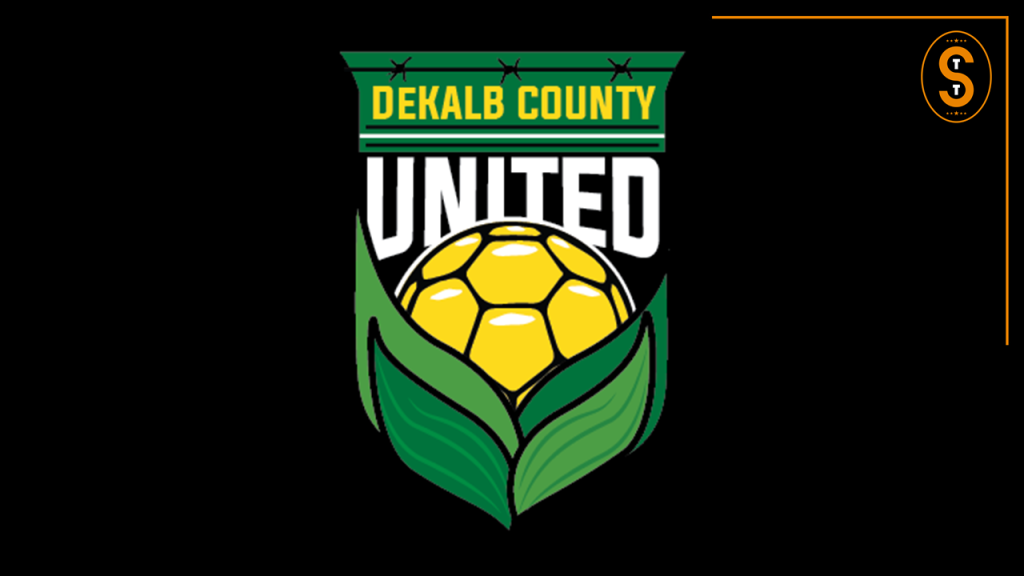
DeKalb County United’s crest

At the very top of the crest is barbed wire. Barbed wire was actually invented in DeKalb, IL in 1873 and the club included it in its crest as a nod to this influential invention.

With the strong agricultural history of the area, the yellow soccer ball and leaves underneath, look like an ear of corn. The ball is growing from nothing…just like the club.

A club like DKCU will never stop growing as long as the community continues to nurture it and that is the main message of the crest.

Important Events

I’d like to highlight 5 important events in the club’s history in this section.

The first came on April 4, 2018, which was the club’s inaugural Season Kickoff Party. For the first time, the team, supporters, sponsors, and community members gathered to celebrate the creation of the new club. Several hundred people attended and the club’s first ever kits were unveiled.

The next event happened 10 days later on April 14, 2018 when the club held its first ever friendly match. Due to the unpredictable midwest weather in April, DeKalb County’s first ever match was hosted indoors. First year side Old Bhoys SC from Indianapolis traveled to DeKalb and the Greens won 6-0 in front of a full house of 283 people. Carlos Gallardo scored the club’s first ever goal.

After an undefeated pre-season, the club was disappointed to drop its first league match away at Elgin Pumas. But a week later, on May 24, 2018, the club got its first league win. DKCU opened its home stadium for league play and defeated Joliet United 3-1 with 340 in attendance on this day.

Late in DeKalb County’s first season, it hosted the closest geographical rival of Aurora Borealis Soccer Club. After losing on the road earlier in the season, there was a strong push to fill the stands for this Friday night fixture on July 13, 2018. Although, DKCU would eventually drop the points at home, had a club record 523 fans in attendance for its first Blackout game.

And the final event I’d like to highlight came on July 22, 2018. After a long first season in the UPSL, United hosted Union Dubuque in the last regular season match of the inaugural campaign. The two first year clubs battled evenly until the 92nd minute when local boy Chad Newquist scored the winner in a scrum in front of goal. 342 fans erupted as DKCU made it a clean sweep against their Iowa rivals. Most importantly, the fans, players, coaches and volunteer staff moved into the off-season with a positive memory.

Supporters

The club’s first supporters group is called the “Silo Supporters.” Despite relatively small numbers, this group created a lot of noise at both home and away matches.

Noteworthy Players

I’d like to highlight 3 players in this section & two of the players have moved on to professional opportunities.

First, I’d like to mention Martin Jimenez. Martin was a big goalkeeper for the club and left United to join the Real Villadolid academy in La Liga in 2018.

The next player I’d like to mention is Leo Lenth. Leo left United in 2019 to join Milwaukee Torrent of the NPSL Members Cup. An upstart professional league in the United States.

The final player I’d like to highlight is Alberto (Beto) Martinez. Beto is the club’s all-time leader in goals scored with 14. He’s chipped in 7 assists in all competitions as well.

Noteworthy Managers

Michael Gecan was brought in as the club’s first head coach in late 2017. With strong ties to the community and a long career at the helm of various programs, Gecan became the club’s first gaffer and helped put together the initial roster. He led the club to a 5th place spot in 2018 and improved to a second place finish in 2019. Gecan remains in charge of the first team heading into 2020.

Rivals

The club has one main rival: Union Dubuque.

The two are like-minded clubs with strong commitments to the communities that they represent. Union and United have met 4 times on the field. Off the field the club’s leadership groups work together to share ideas and strategies to make them stronger. But on the field, this rivalry is quickly becoming one of the best in the Midwest.

Stats & Records

The stats and records we’re about to discuss are as of November 2019, which is when we are recording this video.

DKCU spent two seasons in the UPSL before making the decision to join the upstart Midwest Premier League for 2020. Through those two campaigns the club recorded 7 wins, 8 losses and 3 draws. United are 15-9-5 in all competitions.

The club’s trophy cabinet is currently empty, but the Illinois State Cup and the Midwest Premier League are both targets for the club in 2020.

The club’s record goal scorer is Beto Martinez 14 goals.

And a few last interesting facts about the club:

In 2020, United will run a men’s and women’s u23 team in addition to its first team. Not many lower league clubs in the US operate 3 teams, so it is very impressive from United. Additionally, the club continues to be managed by volunteers. All operational expenses for the club come from sponsors, ticket sales, merchandise and camps or tournaments hosted by the club.

Lastly, the club also has its own beer called “815 Brewnited” through the Forge Brewhouse in DeKalb. A portion of all beer sales go back to the club.

So there you have it… a bit of history on DeKalb County United. Let’s continue the discussion in the comments section below the video.

Thanks for stopping by the Soccer Tavern. Hope to see you again soon. Cheers!

1. FC Köln (Cologne) | Club History

Welcome to the Soccer Tavern, where we’re discussing the history, philosophy, and culture of the beautiful game. My name is Dave and in this video, we’re talking about the history of 1. Fußball-Club Köln 01/07 e. V., better known as FC Köln (FC Cologne). Pull up a seat and let’s start the discussion.

FC Köln is located in the western part of the city of Köln or Cologne in English. Cologne is located in the western part of Germany. The club currently play in the Bundesliga and its home ground is called the RheinEnergieStadion. The stadium opened in 2004 and holds about 50,000 people.

Origin

The club’s official founding date is in 1948, but its history actually begins at the start of the 20th century.

In June of 1901, the Kölner BC club was formed as its founders broke off from FC Borussia 99 Köln.

A few years later, the Sportverein Sülz 07 club was formed in 1907 in the neighborhood of Sülz in Cologne. This club merged with another club named Hertha 08 Sülz around 1920 to become Spielvereinigung Sülz 07.

The 2 clubs of Kölner BC and Spielvereinigung Sülz 07 existed separately until after WWII. The creation of 1. FC Köln is attributed to Franz Bolg and Fritz Plate. These two men led the discussions about merging the two clubs. On February 12, 1948, the members of each club approved the merger after intense discussions.

The following day on February 13, 1948, the members of the new club met at the Roggendorf pub to finalize the merger. They settled on the club’s new name of 1. Fußball Club Köln 01/07. The last part of the club’s name 01 Schrägstrich 07 means 01 slash 07 in English and is a reference to the founding years of the 2 clubs that merged to form 1. FC Köln.

So, the club’s official founding date is February 13, 1948, although the club’s history begins many years before then.

Nicknames

The club’s main nickname is die Geißböcke (meaning The Billy Goats in English). In 1950, a travelling circus donated a goat to the club to celebrate the club’s second birthday. The club and fans immediately took to the animal and the club has had 9 total live goats as mascots since then. All have been named Hennes after the former player and manager Hennes Weisweiler, who we’ll discuss in more detail later in this video. The nickname comes from the club having a billy goat mascot.

The other nickname for the club is Effzeh, which is the local pronunciation of FC. Most other places in Germany put the emphasis on the second syllable, but in Cologne, they put the emphasis on the first syllable. It’s a subtle distinction, but has earned the club this nickname.

Crest

The club’s crest has been used since 1992.

The prominent feature from this unique crest is obviously the billy goat. We’ve already discussed Hennes and where the club’s billy goat nickname comes from.

The club’s colors of red, black, and white are used throughout the crest.

In the red circle, you can see the outline of the Kölner Dom (Cologne Cathedral) in the background. This landmark is iconic in the city of Cologne for its two towers.

And the club’s name of 1. FC Köln is written across the middle of the circle.

Important Events

On May 9, 1964, FC Köln were crowned the first ever champions of the Bundesliga. The 1963-1964 season was the first season in the Bundesliga’s history. Köln had actually clinched the title a few matches prior and were well deserving first-time champions. The club scored in all 30 games that season and led the table after every matchday except for the 4th one. It was an impressive display from FC Köln.

About 15 years later, the club had an even more impressive season but we first need to talk about the Bundesliga Skandal of 1971. In the 1970-1971 season, 10 Bundesliga matches were fixed or contained some sort of illegal activity towards the end of the season. 3 of those matches involved FC Köln with the club’s goalkeeper Manfred Manglitz one of the ringleaders. Manglitz was eventually caught along with other players and in July 1971 he was banned from the sport for life. His actions left a black mark on the club.

Jumping forward a few years to happier times: On April 15, 1978, the Billy Goats faced Fortuna Düsseldorf in the DFB Pokal final. FC Köln won the match 2-0. The club wasn’t done winning trophies that season though. On April 29, 1978 the final matchday of the Bundesliga season took place. Borussia Mönchengladbach & FC Köln were tied at the top of the table with Köln holding a +10 goal difference lead. Gladbach proceeded to win their match 12-0 over Borussia Dortmund, but Köln beat St. Pauli 5-0. The results meant FC Köln were German league champions for the 3rd time. This was also the last time the club was German league champions. With FC Köln winning both the domestic league and domestic cup titles that season, the club became one of only 4 German clubs to accomplish the historic double.

The 4th event I’d like to mention is a not so happy one. On November 24, 2001, the Billy Goats scored a goal in the 31st minute of their Bundesliga match against FC St. Pauli. The club would then go 1,034 minutes or the equivalent of 11 1/2 matches before scoring another Bundesliga goal on March 2, 2002 in the 75th minute of their match against Hertha Berlin. This scoreless streak is the longest in the Bundesliga’s history.

And the final event I’d like to highlight occurred on May 6, 2019. On this date, FC Köln defeated Greuther Fürth 4-0 in the third to last match of the 2.Bundesliga season. The 2.Bundesliga is Germany’s second division. The result meant Köln clinched promotion back to the Bundesliga for the 2019-2020 season and that is their current league at time of recording.

Supporters

The club’s anthem or hymn is called “Mer stonn zo dir, FC Kölle” which translates from the local dialect of Kölsch to English as “We stand by you, FC Cologne”. The song is about 20 years old and was written by local carnival pop band Höhner. It’s more or less a direct copy of the Scottish folk song ‘The Bonnie Banks o’ Loch Lomond’. The song is very catchy and it is quite an experience as the fans belt out this anthem.

Noteworthy Players

Let’s talk about 6 players in this section.

Hans Schäfer joined the club in its inaugural year of 1948 and FC Köln would be the only club he’d play for during his career. Schäfer played in 3 World Cups, winning the 1954 World Cup with West Germany. With Köln, he won the German National Championship in 1962 and the Bundesliga in 1964. Schäfer was named German Footballer of the Year in 1963 and he is the club’s all-time leading goalscorer, with the majority of his goals coming before the Bundesliga existed.

Wolfgang Overath is a club legend who is Effzeh’s all-time record appearance holder. Overath made close to 550 appearances for the club between 1962 and 1977. He won the Bundesliga once and 2 DFB Pokals with the club before he retired. He also won the 1974 World Cup with West Germany.

Johannes Löhr is the club’s all-time top scorer in the Bundesliga era. Löhr was a longtime teammate of Overath and won 1 Bundesliga, as well as 3 DFB Pokals, with FC Köln. He was one of the best goalscorers in the Bundesliga during his career.

Harald Schumacher, more commonly known as Toni Schumacher, was a standout goalkeeper who spent the majority of his career with Köln. Schumacher was the starting goalkeeper as West Germany won the 1980 European championships and he was widely considered one of the best goalkeepers in the world during his career. He won 3 major trophies with FC Köln and was named German Footballer of the Year twice while with the Billy Goats.

Like most of the players we’ve previously mentioned, Dieter Müller spent the majority of his career with FC Köln, though it wasn’t quite as long as those already mentioned. He is arguably the most lethal goalscorer in the club’s history though, as he once scored 7 goals in a Bundesliga match – that is still an all-time single game record. Müller is also the only Effzeh player to be the top scorer in a Bundesliga season on more than 1 occasion.

And the final player I want to mention is Lukas Podolski who began his professional career with the club. Unlike all of the other players mentioned, Podolski only played for FC Köln for a handful of seasons before moving to Bayern Munich. Still, he is a beloved player who actually came back to the club after his time with Bayern for a few more seasons before moving on to Arsenal. He was one of the best German attackers throughout the majority of his career, which is actually still active as he’s playing in Japan at time of recording. He won over 100 caps for the German national team and won the 2014 World Cup.

Noteworthy Managers

I’d like to talk about 4 managers here.

The greatest manager in FC Köln’s history is Hennes Weisweiler. Weisweiler managed the club over 3 different stints from 1948 to 1980. He was in FC Köln’s first ever match as a player and became player manager later in 1948. His first 2 stints with the club did not end with trophies, but Weisweiler led the club to 3 major trophies in his third stint in the late 1970s. Additionally, he won 3 Bundesligas, a DFB Pokal, and a UEFA Cup with Monchengladbach in the early 1970s. Weisweiler was ahead of his time as he developed an extremely effective counter-attacking style and was one of the leaders in a new school of managing. He communicated his tactics with players and involved the players in the discussions/decisions. He is a true legend and he also named the club’s goat mascot after himself, which is just awesome.

The next manager I’d like to discuss is Georg Knöpfle. Knöpfle was the man in charge as the club won the inaugural Bundesliga trophy. For that reason alone, he deserves mention here. Before joining the club, he won the 1961 DFB Pokal with Werder Bremen and in 1966, he left Köln to become the first ever technical director in German soccer, which he did at Hamburg.

The third manager I’d like to discuss is Rinus Michels. Though Michels only won 1 major trophy with FC Köln (the 1983 DFB Pokal), he is widely considered one of the greatest managers in soccer’s history. He was only with the club for 3 years towards the back half of his managerial career, but Michels was one of the key people that helped revolutionize Ajax, the Dutch National team, and FC Barcelona with Total Football in the 1970s. He is a managerial legend and definitely deserves mention here.

And the last manager I want to highlight is Peter Stöger. Stöger took over as manager in 2013 and led the club out of the second division and back into the Bundesliga. Once in the Bundesliga, Stöger helped solidify the club’s position in the league and even led it back to a European competition for the first time since the 1990s. Sadly, the club started poorly in the 2017-2018 season, which caused Stöger to be fired by December 2017. Still, he is remembered fondly by Effzeh supporters and I wanted to discuss him here.

Rivals

Köln’s main rivals are Borussia Mönchengladbach, but I also want to briefly mention Bayer Leverkusen and Fortuna Düsseldorf as minor rivals.

Both the Leverkusen and Düsseldorf rivalries stem from those clubs being located in the same area as the city of Cologne. Matches between Bayer and FC Köln have gotten heated, with hooligan fighting often a problem, so this is definitely a rivalry. And the Fortuna Düsseldorf rivalry stretches back to the 1970s and 1980s when both clubs were competing at the top end of the Bundesliga table. It still has elements of a rivalry and thus deserves mention here.

But FC Köln’s fiercest rival is Borussia Mönchengladbach. The two clubs are each located in the Rheinland region of Germany and matches between the sides are called the Rheinischederby in German or Rhine Derby in English. The two first met in 1962 and Köln was the stronger side in the early days before the Rhine Derby really heated up in the 1970s. Both Köln & Gladbach competed for trophies during this time. One of the most notable incidents came in the final matchday of the 1977-1978 when the two weren’t even playing, which we’ve already discussed. Both clubs have gone through ups and downs since the 1970s, but this derby has remained heated. The proximity of the two clubs has likely been the main contributing factor to that with this rivalry being recognized as one of the most intense in all of Germany.

Stats & Records

The stats and records we’re about to discuss are as of November 2019, which is when we are recording this video.

The Billy Goats have played 48 seasons in the top flight in their history.

The club has 7 major trophies including:

  • 4 DFB-Pokals (German Cups)
  • 2 Bundesliga titles
  • 1 German national championship, which was won before the Bundesliga was created

Effzeh’s record first team appearance holder is Wolfgang Overath with 542 official appearances.

The club’s record goal scorer is Hans Schäfer with 304 goals in officials matches.

FC Köln’s record transfer purchase was Jhon Córdoba from Mainz 05 on July 1, 2017 for ~€17M.

And the club’s record transfer sale was Anthony Modeste to Tianjin Quanjian in China on July 1, 2018 for ~€29M.

And 1 last interesting fact about the club: FC Köln is the 4th largest club in Germany behind Bayern Munich, FC Schalke and Borussia Dortmund. The club has more than 100,000 members.

So there you have it… a bit of history on 1. Fußball-Club Köln 01/07. Let’s continue the discussion in the comments section below the video.

Thanks for stopping by the Soccer Tavern. Hope to see you again soon. Prost!
FC Bayern Munich | Club History

Welcome to the Soccer Tavern, where we’re discussing the history, philosophy, and culture of the beautiful game. My name is Dave and in this video, we’re talking about the history of Fußball-Club Bayern München e.V. better known as Bayern Munich. Pull up a seat and let’s start the discussion.

*Per Peter from the FC Bayern Pack MASS supporters group, the video contains some inaccuracies that I’d like to highlight. They are called out in red italics below each section. I’d like to thank Peter for bringing these to my attention and I encourage you all to read the items in red.

Bayern Munich is located in northern part of the city of Munich. Munich is located in the southeastern part of Germany. The club currently play in the Bundesliga and its home ground is called the Allianz Arena. The stadium opened in 2005 and holds about 75,000 people.

*In terms of accuracy, when referring to the soccer team, the e.V. has been officially removed from the club’s name, not just the logo, as they changed how the club is structured (for merchandise sales purposes and financing of a new stadium), and it is actually FC Bayern München AG that manages the soccer team. FC Bayern Munchen e.V. does still exist and is the parent club, but it’s not the soccer team anymore. There actually have been a few legal battles brought on by other clubs in Germany and some concerned Munich citizens who think the club’s international structure violates the intent of the German laws. So far everything has been upheld without the e.V. Soccer is now administered under AG; Table Tennis, Handball, Chess, and a few other sports under e.V; and the Basketball team under GmbH. In short, it makes sense to just say FC Bayern, or FC Bayern München leaving off the e.V.

*The club is NOT located in the North of Munich. The newly built Allianz Arena is, but the club has their headquarters and practice facility at Sabener Straße, which is directly south of Munich, in between Giesing and Hackerling, and used to play at Grunwalderstadion in Giesing just south of Munich center, but Geising is where 1860 are from, and there are many chants making fun of them for that, so it doesn’t make sense to associate Bayern with Geising. They also played at Olympiastadion before that for many years much closer to Munich center in Schwabing, which does appear in Bayern chants. It’s still best to associate the club with the Säbener Straße headquarters. Many fans feel Allianz Arena is too far from the home of where the fan base is, way on the outskirts of Munich.

Origin

On February 27, 1900, a group of men stormed out of a meeting for the MTV München 1879 Sports Club. There was a dispute between existing members over the sport of soccer’s future at the club. The group of men who stormed out of the meeting, then met at the Gisela restaurant in Munich that night and formed Fußball-Club Bayern München, or FC Bayern Munich in English. Bayern is the German word for Bavaria, the region where the city of Munich is located.

The leader of this rebel group was named Franz John and he was elected Bayern’s first president. In 1906, the club merged with Münchner Sports-Club and adopted the colors of red & white that is still in use by the club today. There would be a few other mergers and splits of the club, but the core of what we know as Bayern Munich was formed and solidified in 1900 and 1906.

*There wasn’t necessarily a dispute as to the future of soccer with MTV, MTV (Munchner Turn Verein, or Munich Gymnastics Club) did not support soccer and said it would not field a team in the newly forming national league, and in order to keep playing those players would go on to form “FC Bayern” (not München, that would become attached later) so they could play soccer at all.

*Actually, and I know this may have been omit for time, but the club separated from MSC (Munchner Sports Club), which was a very key aspect of the club’s history, which allowed them to become professional, and take back the FC Bayern name.

*You also seemed to have brushed over all that work of Kurt Landauer to build the club to prominance, and revive the club and sport in the post-war years in the discussion about its founding. That’s become a huge part of the club’s current history, as they work to combat anti-Semitism.

Nicknames

The club has many nicknames. The first 2 of FCB & Bayern come from the club’s name. FCB is the acronym for Fußball-Club Bayern and Bayern is obviously a word from the club’s name.

Another nickname used for the club is die Roten, which means the reds. It comes from the club’s primary kit color.

Bayern has 2 more nicknames with a bit more of a complicated story.

The first is FC Hollywood. In the 1990s, Bayern players had a reputation for lacking discipline and the club experienced a lot of internal problems. Stories were then leaked to the press who dubbed the team FC Hollywood. This nickname will still sometimes be used today.

And Bayern’s final nickname is Stern des Südens or star of the south. The club is located in southern Germany and is the most successful team in German soccer’s history. Also, the club’s official anthem is Stern des Südens. The song is played before home matches. I’m not sure if the anthem or the nickname came first, so if you have more info, please let us know in the comments section but this is definitely another nickname for the club.

*Bayern is not a word from the club’s name, but the Bavarian word for Bavaria. It’s the region they represent. The real nickname there is “Die Bayern”, or The Bavarians. Just saying FCB and Bayern is repeating the club’s name, not giving them a nickname.

*Stern des Südens is not stars of the south but “Star” of the south, a nickname for the City of München in general (because it’s this spectacularly beautiful and thriving metropolis in the largely wooded and rural South of Germany). Bayern as a club has taken the nickname because it too is a star of the German soccer world. Obviously, the anthem was made after that.

*There are other nicknames for the club, such as “Die Bullen”, or the Bulls/Bullies (the Police), which came from the red jerseys, along with the club’s sponsor in the 1970s (who made a famous truck/tractor named Die Bullen, which was even printed “Die Bullen” on the center of their jerseys for a few seasons), and notorious physical playing style, guided by defensive midfielder Franz “Bulle” Roth. Similarly, as well as the reds, it often would get “Red Devils” attached to it, which seems just a common red team nickname (which I can understand passing over, as Manchester United are the more famous Red Devils, but there are many other who use that nickname). I guess it would be nice to note that the nicknames you chose are not the only, just the only you chose to point out?

Crest

Bayern’s crest has more or less been the same since 1970, with only minor design changes since then. It’s a relatively simple design with the club’s name around the outside of the circle and a portion of the Bavarian flag in the middle.

FC Bayern Munich’s crest

The flag of Bavaria is light blue and white with a diamond pattern design. The colors and design come from the coat of arms of the Wittelsbach family. The Wittelsbach family ruled Bavaria from the 13th century into the 20th century and is deeply ingrained in the history of Bavaria.

*While the design in the center of the logo is based off the Bavarian Flag, German law strictly forbids the use of Government symbols to be used by another purpose than official government business. So, you will note, the angle of the lozenge pattern is opposite that of the Bavarian Flag, and the design is actually intentionally 2 rows of white diamonds on a blue background, not an actual alternating lozenge pattern. This was more noticeable on prior iterations of the logo than the most recent, but is definitely noticeable when it is on the jerseys or other merchandise. (This same restriction can be seen on other things, like famously the BMW logo, or Bayerische Motoren Werke, which uses squares and the opposite color pattern as the Bavarian flag)

Important Events

Obviously there are a ton of important events in the club’s history. It was tough to choose, but I selected 4 of them to highlight here. Please feel free to let us know the details of others in the comments section under the video.

First, on June 12, 1932, Bayern Munich faced Eintracht Frankfurt in the Final of the German National Championship in Nuremburg. This was before the Bundesliga was created, so this trophy was recognized as the highest league title in Germany. 55,000 people watched as Bayern won 2-0 to win its first major trophy in the club’s history.

The club would wait more than 25 years to win its second major title. That came on December 29, 1957. Bayern played Fortuna Düsseldorf in the DFB Pokal final on this date. Again, Bayern did not concede a goal and scored the only goal of the match through Rudi Jobst to win 1-0. It was the club’s first Cup title in its history.

The third event I’d like to highlight is a negative event on the surface, but it actually was a huge stroke of luck for Bayern Munich. On April 28, 1963, 1860 Münich clinched the league title for the Oberliga Süd. The league title meant that 1860 would qualify for the Bundesliga which was starting later that year. There was a rule that only 1 team from each city could qualify for the initial Bundesliga and that meant that even though Bayern Munich had more of a sporting right to be in the Bundesliga based on the previous 10 seasons, 1860 would be an initial member of the Bundesliga.

Because Bayern was relegated to the second division, the club needed to change its financial policy and get rid of a lot of their expensive players. That change of philosophy allowed the club to play youngsters like Franz Beckenbauer, Sepp Maier and Gerd Müller. The drop down in division also allowed the club to restructure as a professional club and establish an infrastructure that set the club up for long term success. Who knows what would have happened to those players and the club if Bayern was an inaugural member of the Bundesliga in 1963?

Many other important events happened in the clubs history, but I want to flash forward to June 1, 2013. On this date, Bayern beat VfB Stuttgart in the final of the DFB Pokal to win their 16th Pokal title. The reason that this title was so special is that Bayern had already won the Bundesliga title and beaten Borussia Dortmund in the final of the UEFA Champions League that season. By winning their domestic cup title as well, Bayern became the 7th European club, and first German club ever to win a treble. A treble is when a club wins its domestic league, domestic cup, and the Champions League in the same season. It was an historic moment for an historic club.

Also, if you don’t know the story, look up Bayern’s 2001 Bundesliga title. Specifically their last match against Hamburg on May 19, 2001.

Supporters

“Mia san Mia” is FC Bayern’s club motto. It is the Bavarian translation of “Wir sind wir” in German and translates to English as “We are who we are.” It is a saying of regional pride for the Bavarian state of Germany and the phrase has roots that began in the 19th century Austro-Hungarian Empire.

The phrase as it applies to Bayern became popular during the club’s run to the 1987 European Cup final. Hans Pflügler, Hansi Dorfner and Ludwig Kögl incorporated mia san mia into their post-match songs – usually while celebrating on top of a table or bar.

The phrase has become synonymous with FC Bayern and in 2010 the club released a set of 16 principles based on the mia san mia philosphy.

Noteworthy Players

So many amazing players have played for FC Bayern over the years. I’m only going to highlight 6 here with a focus on players from at least 10 years ago, but please leave your comments with additional players and info about them below the video.

Sepp Maier is one of the best goalkeepers in history. He played at Bayern from 1958 until a car accident ended his career in 1979. He made 473 Bundesliga appearances, including 422 consecutive matches, won 4 Bundesliga titles, 4 DFB Pokals, 3 European Cups (now known as the Champions League), and 1 European Cup Winners Cup with Bayern. He also won a World Cup and a European Championship with West Germany.

Franz Beckenbauer was a teammate of Maier. Nicknamed Der Kaiser, he won all of the same major trophies as Maier (14 in total for club & country). Beckenbauer would make just under 400 Bundesliga appearances for Bayern before leaving to finish his career in the United States. He was named German Footballer of the Year 4 different times and is a legend of the game.

The next player I’d like to highlight is Gerd Müller, who was also a teammate of Maier & Beckenbauer. Müller is one of the most lethal goal scorers in soccer’s history. He has the single season Bundesliga scoring record (40 goals) as well as career Bundesliga scoring record (365 goals). No one has really come close to breaking either of those records. Müller also won the same 14 trophies as Maier & Beckenbauer and internationally, he scored a ridiculous 68 goals in only 62 matches for West Germany.

Karl-Heinz Rummenigge joined Bayern at 18 years old in 1974 in the middle of the Maier, Beckenbauer, & Müller years. Rummenigge finished his career as the 2nd highest scorer in the club’s history and he still holds that recognition, though current attackers Robert Lewandowski & Thomas Müller are somewhat close to passing him on the scoring charts. Rummenigge won 7 major trophies with Bayern, collected 3 individual awards, was Bundesliga top scorer on 3 occasions and won a European Championship with West Germany in 1980.

Lothar Matthäus isn’t quite a Bayern legend the way the other players mentioned so far were because he was already an established star before joining Bayern and he actually left the club during his peak. Still, Matthäus is one of the most decorated soccer players in German history. He won 7 Bundesliga titles, 3 DFB Pokals, the UEFA Cup (now known as the Europa league) with Bayern. He also won the Euros in 1980 with West Germany and captained the country to the World Cup title in 1990. Matthäus is the only German to win the World Player of Year award, which he won in 1991, and he is one of 3 players to appear in 5 different World Cups.

The 6th & final player I’d like to highlight is Oliver Kahn. Kahn joined Bayern in 1994 and in his 14 years with the club, he won a record 8 Bundesliga titles, a record 6 DFB Pokals, the Champions League once, and the UEFA Cup once. Kahn was 3 time World Goalkeeper of the Year and along with Sepp Maier, Kahn is considered one of the best goalkeepers in soccer’s history.

*Starting with Sepp Meier and brushing past Der Kaiser is quite a blunder in the ordering. It was really Der Kaiser who set the club apart from others, with his ability to play the unique role of Sweeper, and generate scoring. He also figured heavily on the German National Team with the 1966, 1970 & 1974 teams, but again, when he lead West Germany to the World Cup as a coach (one of only 2 to have done that ever, along with Zagalo of Brazil). He was the long time President of Bayern Munich, and he took over as coach himself for the 1996 UEFA Cup triumph. He really should’ve been given much greater emphasis here.

*Uli Hoeneß was a major part of those squads that won the 3 Euro Cups in a row as a player, and scored the game winner for their first ever one, before his career was shortened by knee injuries, but then went on to become a board member right away, and was club President through many successful title runs.

*Someone skipped over here who should not have been was a famed youth product and long time Bayern captain, and World Cup Winner in 1990, Klaus Augenthaler. He made a very significant contribution to the club on the field throughout the 1980s into the early 1990s, serving as captain from 1984 to 1991 (the longest tenured captain in club history), and still puts his time in with the youth academy and travels around the world scouting and coaching up talent for Bayern.

*Lothar Matthäus (is actually pronounced “mah-tay-us”, often phonetically spelled Matthaeus in English), may have left the club in his peak, but also returned to play for them for another 7 seasons. He is pushed down the list mainly because he never did win the Euro Cup/Champions League, and often makes rather controversial statements and has a very notably scandalous personal life, which leave him very unpopular with the German people.

*Philipp Lahm… I know you said players from further than 10 years ago, but, Lahm captained the club to the treble in 2013, and Germany to the World Cup in 2014, the club’s 3rd World Cup winning captain, a feat not matched by other clubs. In the pantheon of the club’s great players, he’s more worthy of mention than quite a few that got listed (and certainly as worthy as Beckenbauer & Matthäus). Technically, his debut came in 2004, so he was from longer than 10 years ago… js. Also you’re going to mention Lahm, you might as well mention Bastian Schweinsteger, as well.

*… that doesn’t even consider guys like Paul Breitner, Hans-Georg Schwarzenbeck, Franz “Bulle” Roth, Roland Wohlfarth, Stephan Effenberg, Mehmet Schol, Giovanni Elber, Roy Makaay, etc. many of which are in the club’s own Hall of Fame, or lead the season as top goal scorers for 4 seasons or more.

*In short, highlighting just 6 players from a team with 5 CL titles, 30 domestic league titles, and 20 domestic cup titles is probably on the way too narrow side of things. Maybe you should’ve gone over the Club’s all-time XI as selected by the fans in 2005, and done that instead?

*The same could be said of why you chose the coaches you did, and why instead of sticking to more than 10 years ago with coaches, you chose two of the more recent ones.

Noteworthy Managers

I want to highlight 4 managers here.

Udo Lattek is the most successful Bundesliga manager of all time. He won 6 Bundesliga titles with Bayern Munich in 2 separate stints and 2 titles with Borussia Mönchengladbach. His 8 titles are still a Bundesliga record. Lattek led Bayern in the early to mid-1970s as the club became a German powerhouse and won its first European Cup (now known as the Champions League). Lattek managed mainly in Germany, but had a stint at FC Barcelona where he won the European Cup Winners Cup. He was the first and only manager to win the 3 major European Cups each with a different club. In 2000, the Cup Winners Cup was eliminated, so Lattek will be the only manager in history to hold this record. He is one of the greatest German managers in history and won 15 major titles, the majority of which came at Bayern.

Jupp Heynckes is another one of the greatest German managers in history. He began his managerial career with Borussia Mönchengladbach in 1979. He couldn’t win any trophies in his 8 years as a manager, so it was slightly surprising when Bayern appointed him as manager in 1987. In his first of 4 different stints with the club, he won 2 Bundesliga titles. Heynckes would move on to manage many other clubs in Spain, Germany, and Portugal, before returning to Bayern for a brief period in 2009. His time at Bayern from 2011-2013 is when he sealed legendary status as he won a treble in the 2012-2013 season. As we already said, a treble is winning the domestic league, domestic cup, and Champions League in the same season. He is the only German manager in history to accomplish that feat.

The next manager I’d like to highlight is Ottmar Hitzfeld. Before joining Bayern Munich in 1998, Hitzfeld won 2 Bundesliga titles and a Champions League with Bayern rivals Borussia Dortmund. He was also named World Coach of the Year in 1997. Upon arriving at Bayern, Hitzfeld quickly won many trophies. By the time he left Bayern for the 2nd time in June of 2008, he had won 5 Bundesliga titles, 3 DFB Pokals and a Champions League with Bayern.

And the final manager I’d like to discuss is Pep Guardiola. Pep only managed Bayern Munich for 3 seasons from 2013 to 2016 but he was very successful. He won the Bundesliga title every season and won the DFB Pokal 2 out of the 3 seasons. Unfortunately, he couldn’t lead Bayern to a Champions League title as his Bayern sides were eliminated in the semifinals of that tournament all 3 years. Still, Guardiola is widely considered the greatest active manager in the world and has had massive success in Spain and England in addition to Germany. At only 48 years old, he’s already won 17 major titles and is on track to be the most decorated manager in soccer history.

Rivals

As Bayern is the largest & most successful German club in history, it has many rivals. I’m only going to discuss 3 in detail here.

Bayern’s city rival is 1860 Munich with matches between the teams called Munich (München) Derbies and stretching all the way back to their first meeting in 1902. It may be tough to believe since 1860 has slipped down the German soccer pyramid, but 1860 was actually the bigger and more successful club in the early days of the Bundesliga. 1860 was an inaugural member of the Bundesliga while Bayern had to start in the second division. That helped increase the animosity in this existing rivalry. Since the 1970s, Bayern have been the dominant side in this matchup, but whenever the two sides meet these days, it is an intense rivalry match for players and supporters.

Bayern’s main historical rival is FC Nuremburg. Though the two cities are currently in Bavaria, the cities of Munich and Nuremberg historically represented different regions in Germany, old Bavaria and Franconia respectively. As such this rivalry is either called the Bayerische Derby (Bayern Derby) or the Fränkisch-Bayerisches Derby (Franconian-Bavarian derby). The two clubs have played more than 180 times and Nuremberg was the most successful German side until Bayern knocked them from their throne in 1987. The rivalry has lost of bit of luster over the last 2 or more decades as Bayern have become an absolute powerhouse while Nuremberg have fluctuated between the divisions and not really challenged for trophies. This is still a major rival for Bayern that is worth highlighting.

Lastly, Bayern’s main current rival is Borussia Dortmund. It is a relatively recent rivalry as Dortmund only became a Bundesliga power in the 1990s. The clubs first met in 1965 and have played over 100 matches with Bayern historically dominating this matchup. The cities are more than 350 miles apart, but as Dortmund has risen to become the usual second best club in the Bundesliga, this rivalry has grown. The most recent memorable match came in the 2013 Champions League Final, which Bayern won 2-1. Matches between these two clubs are called Der Klassiker, which loosely translates as the classico. This rivalry should continue to grow as Dortmund builds its case as the second biggest club in Germany.

Stats & Records

The stats and records we’re about to discuss are as of October 2019, which is when we are recording this video.

Bayern has played 55 seasons in the top flight in its history.

The club is by far, the most decorated German club team. FCB have 56 major trophies including:

  • 28 Bundesliga titles
  • 19 DFB-Pokals (German Cups)
  • 5 UEFA Champions Leagues or European Cups
  • 1 UEFA Cup (now known as Europa League)
  • 1 German National Championship before the Bundesliga was created
  • 1 UEFA Cup Winners’ Cup
  • 1 FIFA Club World Cup

Bayern’s record first team appearance holder is a bit disputed. On the usually reliable website Transfermarkt, Oliver Kahn is listed with the most first team appearances at 632. I did find some other less reliable sources that listed Sepp Maier as having as many as 700 Bayern appearances, but officially according to Transfermarkt, Maier “only” had 631 first team appearances. I’ll let you judge who you view as the club’s all-time appearance record holder.

The club’s record goal scorer is Gerd Müller with a ridiculous 565 first team goals.

Bayern Munich’s record transfer purchase was Lucas Hernandez from Atlético Madrid in Spain on March 27, 2019 for ~€80M. The transfer officially processed on July 1, 2019 when the transfer window opened

And the club’s record transfer sale was Douglas Costa to Juventus in Italy on July 1, 2018 for ~€40M.

*Along with the Club World Cup, Bayern won the predecessor cup to that, the Intercontinental Cup twice in 1976 & 2001, but boycott the competition twice, not accepting the format which the South Americans wished to hold the cup under. Still it makes sense to note the two Intercontinental Cups, which many equate as on par with the Club World Cup, if not more prestigious.

And 1 last interesting fact about the club: during WWII, the club’s captain Conny Heidkamp worked with his wife Magdalena, to save the club’s trophies from air raids on Munich, which began in the summer 1942. The couple sent the trophies to a farmer in Ascholding where Magdalena had vacationed as a child.

They were safe until about 3 years later, when the Americans came closer in the spring of 1945. Americans had a reputation for taking souvenirs, so the Heidkamps buried the boxes on the Ascholding farm. That’s how any trophies and memorabilia from before 1945 were saved by the club.

So there you have it… a bit of history on Fußball-Club Bayern München. Let’s continue the discussion in the comments section below the video.

Thanks for stopping by the Soccer Tavern. Hope to see you again soon. Prost!
FC Augsburg | Club History

Welcome to the Soccer Tavern, where we’re discussing the history, philosophy, and culture of the beautiful game. My name is Dave and in this video, we’re talking about the history of Fußball-Club Augsburg 1907 e. V., better known as FC Augsburg. Pull up a seat and let’s start the discussion.

FC Augsburg is located in the southern part of the city of Augsburg. Augsburg is located in the southern, central part of Germany. The club currently play in the Bundesliga and its home ground is called the WWK Arena. The stadium opened in 2009 and holds about 31K people.

Origin

Sometime around 1906 or early 1907, a group of men began playing soccer periodically on the Großer Exerzierplatz in Augsburg. The Großer Exerzierplatz basically translates as large field. Over the course of the year, more and more men kept showing up to play, so on August 8, 1907, a club was officially formed named FC Alemmania. Alemmania is the ancient name for an area, which is in present day Germany that includes the city of Augsburg.

The club’s first president was Fritz Käferlein.

In 1909, the club merged with another local club named TV 1871 Augsburg and moved its home ground.

By 1914, the club joined the German Football Association.

The club had another name change in 1919, before merging with another club in 1969. As a result of this final merger, the club officially became its current name of Fußball-Club Augsburg 1907 e. V.

Nickname

The club’s nickname is die Fuggerstädter. That translates as the residents of the Fugger city. It’s also a general nickname for people from the city of Augsburg. The Fugger family was a prominent business and mercantile family from Augsburg during the Renaissance time period. The family helped build and develop many things in the city hence the nickname.

Crest

Let’s take a look at Augsburg’s crest now.

Augsburg city coat of arms

Most of its elements are derived from the city’s coat of arms. The red & white shield, along with the pine cone comprise the city’s coat of arms. The red & white colors go back as far as the 14th century and are attributed to the Bishop of Augsburg & the Duke of Swabia.

The pine cone is a symbol of the Holy Roman Empire. The city of Augsburg was founded in 15 BC by emperor Caesar Augustus of the Holy Roman Empire. That’s also where the city gets its name. Augustus=Augsburg. The city was then a part of the Holy Roman Empire for many years, thus the Holy Roman Empire symbol of the pine cone being included.

FC Augsburg crest

Circling back to the FC Augsburg crest, the other elements should be straightforward.

The FCA at the top stand for Fußball-Club Augsburg.

The red, green, & white rectangles are the club’s official colors and are the colors of the city’s coat of arms.

And finally the year of 1907 is written at the bottom as that is when the club was officially founded.

Important Events

1 – Unfortunately, I couldn’t find the exact date, but in May or June of 1973, FC Augsburg played Herzogenaurach FC in the final match of the Bayernliga season. FC Augsburg was in a tight title race with ESV Ingolstadt who were playing on the road that day. FC Augsburg prevailed 3-1 in their match, while Ingolstadt lost 2-0. The result meant Augsburg were Bayernliga Champions and were promoted back to professional soccer for the first time since the club’s merger in 1969. 15,000 supporters flooded the pitch to celebrate the promotion. If you have more details about the exact date, please let us know in the comments section.

The next event I want to highlight happened in the summer of 2000. FC Augsburg had just completed the Regionalliga Süd season in 8th place, securing their place in the division from a sporting perspective. Unfortunately, the club was in a bad financial position and was negotiating with the DFB for its playing license to remain in the division. The DFB ultimately denied Augsburg their playing license after the club’s main investor couldn’t guarantee 3M Deutsch Marks. The club was then relegated to the 4th tier for the first time in its history. Fortunately, the club quickly found a savior in an investor group fronted by Walther Seinsch that set them on their current path, but the summer of 2000 was one of the darkest times in the club’s history.

3 – And the final event I want to discuss happened on May 8, 2011. On this date, FC Augsburg hosted FSV Frankfurt in the second to last match of the 2. Bundesliga season (2nd division). The match was tied 1-1 late in the game. Michael Thurk took a corner for Augsburg that sailed to the back post for Stephan Hain to finish in the 85th minute. That gave FCA a 2-1 victory and secured promotion to the Bundesliga for the first time in the clubs’ history.

Supporters

Since 2007, the Supporters-Club 1907 has represented the supporters of Augsburg. The organization has created Tifos and coordinated chants/songs amongst the fans. The supporters club also serves as representation for the supporters when communicating with the club, media, police, and league.

Noteworthy Players

There aren’t many legendary careers with FC Augsburg but there are prominent players that have played for Augsburg over the years.

Helmut Haller, nicknamed der “Blonde Engel” (or the Blonde Angel), began his professional career in 1957 with BC Augsburg (which was one of the 2 clubs that merged to form FCA in 1969). Haller played with Augsburg for 5 years before being transferred to FC Bologna in Italy where he became the first ever German player to play in Italy.  In Italy, he became the first foreigner to be named Footballer of the Year in Italy and had a very successful club and international career before returning to FCA in 1973 where he basically ended his career.

Bernd Schuster began his youth soccer career with SV Hammerschmiede Augsburg in 1971 and joined FC Augsburg’s youth academy in 1976. Before Schuster could make a first team appearance with FCA, Schuster was signed by FC Köln, the reigning Bundesliga champions. He’d break into the starting lineup at 18 years old and would play with Köln for 2 seasons before transferring to FC Barcelona in 1980. He’d go on to have a fantastic club career in Spain at Barcelona, Real Madrid, and Atletico Madrid. During his career, Schuster won the 1980 Euros with West Germany and won 10 major club titles all in Spain.

And the final player I’d like to highlight here is Karl-Heinz Riedle. Riedle started his professional career with Augsburg in 1983. He had good performances for the club in the lower leagues and broke out in the 1985-1986 season when he scored 22 goals and earned a call up to the German U-21 team. That led to his transfer to Blau-Weiss Berlin in the Bundesliga. Riedle would go on to play for Werder Bremen, Lazio, Borussia Dortmund, Liverpool, and Fulham before he retired in 2001. He won the World Cup in 1990 with West Germany and won 3 Bundesliga titles and a Champions League in his career, which began at FC Augsburg.

Noteworthy Managers

The first manager I’d like to highlight is Armin Veh. Veh actually played for the club on 2 separate stints in his playing career before becoming manager of FCA in 1990. It was his first managerial job and he led the club for 6 seasons while it operated in the third tier of German soccer. In the 1993-1994 season, Veh led Augsburg to the Bayernliga title, but the club couldn’t advance through the promotion playoffs to the second tier. Veh would leave FCA in 1995 and return for a 1 year stint from 2003-2004. Similar to the players we discussed, Veh is more well-known for his time spent elsewhere as he won the Bundesliga title in 2007 with VfB Stuttgart. Veh managed more than 300 Bundesliga matches and more than 700 matches in total with a variety of clubs. Veh’s last managerial job ended in 2016 and he is currently Sporting Director at FC Köln.

The other manager I’d like to discuss here is Jos Luhukay. Luhukay joined Augsburg in 2009 and led the club to a promotion playoff in his first full season. Though FCA lost that playoff, the club rebounded the following year and won automatic promotion to the Bundesliga in the 2010-2011 season, which we’ve already discussed. Simply for taking the club to the first division for the first time in its history is worthy of mentioning Luhukay here. He left the club at the end of the 2011-2012 season after he helped FCA avoid relegation. He will always be remembered by Augsburg fans.

Rivals

FC Augsburg’s two main rivals are fellow Bavarian based clubs 1860 Munich and FC Ingolstadt.

The 1860 rivalry really began in 1973 when the two sides met in a second division match in Munich. Augsburg brought a much larger than expected number of travelling fans that saw an estimated 80-90,000 people watch the match. As the two cities are located relatively close together and both clubs fluctuated between the lower divisions between the 1970s and 2000s, the rivalry continued to develop. Unfortunately, 1860 has gone through some serious struggles in recent years and slid down the divisions, while Augsburg has stabilized in the Bundesliga. That has led to this rivalry slipping a bit.

Augsburg’s other main rival is FC Ingolstadt. There is a natural rivalry between the cities of Ingolstadt and Augsburg in addition to competing against each other in soccer over the course of more than 100 years. The rivalry really isn’t that intense as there haven’t been too many hostile matches to solidify this as a full blown rivalry. The matches have a slight increase in intensity between fans and players, but Augsburg’s main rival remains 1860.

Stats & Records

The stats and records we’re about to discuss are as of October 2019, which is when we are recording this video.

Augsburg has played 9 seasons in the top flight in its history.

The club has no major trophies.

FCA’s record first team appearance holder is Daniel Baier with 335 first team appearances at time of recording & he is still an active player, so he is likely to add to that tally.

The club’s record goal scorer is Michael Thurk with 56 first team goals.

Augsburg’s record transfer purchase was Martin Hinteregger from RB Salzburg in Austria on August 31, 2016 for ~€10.5M.

And the club’s record transfer sale was Abdul Rahman Baba to Chelsea FC in England on August 16, 2015 for ~€20M.

And 1 last interesting fact about the club:

In 1951, BC Augsburg opened the Rosenaustadion which was the first major sports arena built in Germany after World War II. The stadium was constructed using rubble from the war and housed the club for 58 years before it moved into its current Arena in 2009.

So there you have it… a bit of history on Fußball-Club Augsburg 1907. Let’s continue the discussion in the comments section below the video.

Thanks for stopping by the Soccer Tavern. Hope to see you again soon. Prost!
Eintracht Frankfurt | Club History

Welcome to the Soccer Tavern, where we’re discussing the history, philosophy, and culture of the beautiful game. My name is Dave and in this video, we’re talking about the history of Eintracht Frankfurt e.V. Pull up a seat and let’s start the discussion.

Eintracht Frankfurt is located in the southwestern part of the city of Frankfurt. Frankfurt is located in the central, slightly western part of Germany. The club currently play in the Bundesliga and its home ground is called the Commerzbank-Arena. The stadium opened in 2005 and holds around 52K people.

Origin

Eintracht Frankfurt’s official founding date is considered March 8, 1899. On this day, Frankfurter Fußball-Club Victoria was formed. In the same year, another club called Frankfurter Fußball-Club 1899 Kickers was formed. The two would operate as separate clubs until merging on May 13, 1911 to become Frankfurter Fußballverein (Kickers-Victoria).

In 1920, the club merged with Turn- und Sportgemeinde Eintracht Frankfurt von 1861, which included a bunch of other sports beyond just soccer. This merger was the first time the name Eintracht was connected to the club. “Eintracht” basically means “United” in English.

By 1927, the two clubs that merged in 1920 split into a gymnastics club and a sports club with each keeping Eintracht as a part of its official name.

Finally, in 1969, the two clubs that split in 1927 merged yet again to form the current club of Eintracht Frankfurt e.V.

Nicknames

The club has 3 nicknames: Die Adler (The Eagles), S.G.E. (SGE), and Launische Diva (Moody Diva).

The Eagles nickname is straightforward as it comes from the club’s crest which has an eagle on it. We’ll talk more about the crest in the next section. This is the club’s main nickname.

Two less used nicknames are (Ess-Ga-Aye) or S.G.E. and Launische Diva, which means moody diva.

S.G.E. is the acronymn associated with the club’s old name before the merger in 1969. It stands for Sportgemeinde Eintracht.

And the moody diva nickname came about in the 1970s and 80s as the club earned a reputation for playing well in big time matches, but then underperforming against weaker opposition.

Crest

Eintracht Frankfurt’s crest draws most of its inspiration from the city of Frankfurt’s coat of arms.

Frankfurt city coat of arms

The eagle features prominently on the Frankfurt city coat of arms. Frankfurt was crowned an Imperial City of the Holy Roman Empire in 1245 and the eagle was a symbol of the empire. The city’s colors were not originally white and red, but red & white were adopted sometime around 1400. Around this time as well, the crown was added to the top of the eagle’s head. Since then, the city’s coat of arms has remained relatively unchanged.

Eintracht Frankfurt’s crest

Versions of the Eintracht Frankfurt crest have more or less looked the same throughout the club’s history with the Eagle being a main feature of every crest and a combination of red, white and black utilized. These are the official colors of the club and come from a combination of the city’s official colors of red & white and the official Prussian colors of black and white.

The club’s most recent crest modifications came in 1999 as the club celebrated its 100th year of existence. We’ve already talked about the eagle and the E in the middle of the eagle refers to the Eintracht part of the club’s name.

Important Events

On June 28, 1959, Eintracht Frankfurt faced local rivals Kickers Offenbach in the German National Championship before the Bundesliga was created. The match was a back and forth affair, ending 2-2 after regulation. Frankfurt took the lead in extra time through a disputed penalty before going up 4-2. The Kickers brought it back to 4-3 with 10 minutes to go, but Eintracht scored the title clinching  goal in the 119th minute to finish the match 5-3. It is the club’s only league title in its history and was the club’s first major trophy.

The next event I’d like to discuss happened on May 21, 1980. On this date, Eintracht Frankfurt faced Borussia Mönchengladbach in the second leg of the UEFA Cup Final. This competition is now known as the Europa league and this was the first time a European Competition had 2 German clubs in the final. Gladbach won the first leg 3-2 at home. On May 21, Fred Schaub scored the only goal of the match around the 80th minute as Frankfurt won 1-0, winning the Final on away goals. It is the club’s first and only major European title. It’s also likely the club’s greatest victory.

The third event I’d like to discuss is one of the most disappointing days in the club’s history. On May 16, 1992, Frankfurt played FC Hansa Rostock on the last match day of the season. Frankfurt was in a close title race with Stuttgart and Dortmund, while Rostock were fighting relegation. With the match tied 1-1 in the 76th minute, Frankfurt player Ralf Weber was clearly taken down in the penalty area. The referee did not call a penalty and admitted after the match that he made a mistake. Rostock would score and Frankfurt would lose 2-1, losing the title to VfB Stuttgart. This game is still talked about as one of the most disappointing in the club’s history.

The 4th event I want to discuss happened on July 17, 2002. Frankfurt had been relegated to the 2nd division a season earlier and lost some key owners and sponsors as a result. In June of 2002, after the team secured new owners, it made a mistake with filing its licensing paperwork to the DFL. The DFL is the German organization responsible for professional soccer. The DFL denied Eintracht their license and another club, SpVgg Unterhaching, who had been relegated, attempted to take Frankfurt’s place in the upcoming season. That would have meant Frankfurt would be relegated to amateur levels of soccer and would have been incredibly difficult for the club to recover from. Fortunately, on July 17, 2002, the court’s officially ruled in Frankfurt’s favor, meaning it retained its place as a fully professional 2nd division club.

And the final event I’d like to highlight came on May 20, 2018 Eintracht Frankfurt played Bayern Munich in the DFB Pokal final. Frankfurt prevailed in the match 3-1 with a brace by Ante Rebić and another goal by Mijat Gaćinović. This was Frankfurt’s first major trophy since May 28, 1988 – almost exactly 30 years to the day.

Supporters

Since 2006, Attila the golden eagle has been at every Eintracht Frankfurt home match. In 2006, the club was looking for a good luck charm and found Norbert Lawitschka who is a falconer who owns Attila. The bird is one of only 2 live animal mascots in the Bundesliga.

Noteworthy Players

Alfred ‘Don Alfredo’ Pfaff was one of the greatest players in Frankfurt’s early post WWII years. He led the club to their first and only national championship in 1959, which we’ve already discussed. Don Alfredo was an attacker and became world famous after a great display in the 1960 European Cup Final (now known as the Champions League). Though Frankfurt lost that match 7-3, it is considered one of the greatest European Finals ever.

The next player I’d like to highlight is Jürgen Grabowski. Grabowski is widely considered the best player in Eintracht’s history. He joined the club in 1965 and it would be the only club Grabowski would play for in his senior, professional career. Grabowski made 441 Bundesliga appearances for the club, never being substituted, and scored more than 100 goals. He led the club to 2 DFB Pokal titles and the 1980 UEFA Cup (though an injury ended his career shortly before and he wasn’t able to play in that 1980 UEFA Cup Final). For West Germany, Grabowski also won a World Cup and a European Championship. He is an Eintracht Frankfurt legend.

The next player I’d like to highlight is Bernd Hölzenbein. Hölzenbein was with the club for its most successful period in the 1970s and early 1980s. He joined the club in 1966 and would play for the Eagles for 15 years. Hölzenbein is the club’s all-time top scorer and won 3 DFB Pokals and 1 UEFA Cup with the club.

The 4th player I’d like to highlight is Karl-Heinz (Charly) Körbel. Charly is the club’s all-time record appearance holder and made the most appearances of any player in the history of the Bundesliga. He made 602 Bundesliga appearances over nearly 20 years, all of which came while playing for Eintracht Frankfurt, his only senior professional club. Körbel won 4 DFB Pokals and the UEFA Cup with Eintracht.

The 5th and second to last player I want to discuss is Anthony (Tony) Yeboah. Tony joined the Eagles in 1990 and though he was only with the club for 5 years, he was incredibly influential in the club’s history. Yeboah was the first black player the team had ever signed and he would become the first African player to captain a Bundesliga club. Yeboah was part of the 1991-1992 Eintracht side that nearly won the Bundesliga and that side is considered one of the greatest Frankfurt team’s ever. He would leave in 1995 for Leeds United, but he is a legend for the club and his name is still sometimes sung at Frankfurt matches.

And the final player I want to  mention is Augustine Azuka Okocha, better known as “Jay-Jay” Okocha. Jay-Jay is widely considered one of the most skillful and talented dribblers in soccer history. He gained international recognition for his performances with Eintracht Frankfurt in the early stages of his professional career. Jay-Jay joined the club in the middle of the 1991-1992 season and nearly won the Bundesliga. He would make more than 90 appearances and score 18 goals before moving to Turkish club Fenerbahçe in 1996. While with Frankfurt, he won an African Cup of Nations title with Nigeria in 1994. And shortly after leaving Frankfurt, Okocha won a Gold Medal with Nigeria at the 1996 Olympics.

Noteworthy Managers

For a club that has had a decent amount of success, Eintracht surprisingly doesn’t really have a legendary manager in its history.

The closest manager to a legend would be Paul Oßwald.  Oßwald was the longest tenured manager across 3 separate stints with the club beginning in 1929 and ending in 1964. He was manager as the club won its first and only National Championship in 1959. Oßwald was also in charge for the 1960 European Cup Final against Real Madrid in Hampden Park, Glasgow. As we already mentioned this is recognized as one of the greatest European Finals in history.

2 other managers I briefly want to mention are Dietrich Weise & Jupp Heynckes

Weise won 2 DFB Pokals with Eintracht Frankfurt in his first 2 seasons at the club in the 1970s. He left the club as manager in 1976, but returned in 1983. He’d leave again in 1986 and managed more than 230 matches across his 2 stints at Eintracht.

And Jupp Heynckes is widely considered one of the greatest German managers in history. He is more famous for his time at other clubs and many in Frankfurt see him as the reason why the club took a huge downturn in form in the mid-1990s. Heynckes took over in the summer of 1994. After the team underperformed throughout the season and Heynckes made numerous errors in dealing with the press and his players, he left the club on April 2, 1995. Eintracht finished mid-table that season, but were relegated the following season and many blame Heynckes for derailing the club and setting them up for relegation. Even though Heynckes was a total failure at Eintracht Frankfurt, he is worthy of a mention here because he is one of the most accomplished German managers in history.

Rivals

Eintracht’s primary rival is without question Kickers Offenbach. The clubs play in stadiums about 10 miles apart and matches are called Main Derbies in reference to the river that flows near both cities. The rivalry stretches back to the early 20th century, but it really took the next step in 1959. Offenbach and Frankfurt made the final of the German championship, which was the national competition that preceded the Bundesliga. An epic back and forth match followed with Frankfurt ultimately prevailing. A few years later, when the Bundesliga began play in 1963, Frankfurt was selected ahead of Offenbach to be initial participants. Offenbach had been the more successful side since WWII, but the Bundesliga weighed recent success more heavily in their selection criteria, which allowed Frankfurt initial entry. These critical events, coupled with the sides playing so close to each other sealed this as a fierce rivalry that continues to today.

Other, less-intense rivals are SV Darmstadt 98 and FSV Frankfurt.

SV Darmstadt 98 is a rival of Eintracht mainly due to the club’s location. The clubs are located about 20 miles from each other and both clubs are located in the Hesse state in Germany. For this reason, matches between the sides are called Hessen Derbies. Though Frankfurt is a much larger club, these two fanbases do not like each other. In 2015, fans in Frankfurt burned Darmstadt scarves and flags, which resulted in stadium bans for the Frankfurt fans. The rivalry sees increased police presence in both cities when these two sides meet.

And finally, matches between Eintracht Frankfurt and FSV Frankfurt are creatively named Frankfurt Derbies. There’s not much to this rivalry beyond the 2 clubs sharing the same city. Eintracht has historically been a much larger & successful club while FSV Frankfurt hasn’t enjoyed nearly the same success. The two haven’t played in official competitions much against each other since the Bundesliga began in 1963. It’s not much of a rivalry, but deserves mention here.

Stats & Records

The stats and records we’re about to discuss are as of October 2019, which is when we are recording this video.

The Eagles have played 51 seasons in the top flight in their history.

The club has 7 major trophies including:

  • 5 DFB-Pokals or German Cups
  • 1 UEFA Cup (now known as Europa League)
  • 1 German national titles before the Bundesliga was created

Eintracht’s record first team appearance holder is Charly Körbel with 685 first team appearances.

The club’s record goal scorer is Bernd Hölzenbein with 191 first team goals.

Frankfurt’s record transfer purchase was Martin Hinteregger from FC Augsburg on August 1, 2019 for ~€9M.

And the club’s record transfer sale was Luka Jovic to Real Madrid in Spain on June 4, 2019 for ~€60M. The transfer officially processed on July 1, 2019 when the transfer window opened

And 2 last interesting facts about the club:

1 – Eintracht Frankfurt was the first German club to reach a European Cup Final. It came in 1960, when the club lost 7-3 to Real Madrid in Glasgow.

2 – The first 3 World Cup victories for Germany (1954, 1974, & 1990) all featured an Eintracht Frankfurt player on the roster.

So there you have it… a bit of history on Eintracht Frankfurt. Let’s continue the discussion in the comments section below the video.

Thanks for stopping by the Soccer Tavern. Hope to see you again soon. Prost!
Borussia Mönchengladbach | Club History

Welcome to the Soccer Tavern, where we’re discussing the history, philosophy, and culture of the beautiful game. My name is Dave and in this video, we’re talking about the history of Borussia Verein für Leibesübungen 1900 Mönchengladbach e.V., better known as Borussia Mönchengladbach. Pull up a seat and let’s start the discussion.

Borussia Mönchengladbach is located in the western part of city of Mönchengladbach. Mönchengladbach is located in the western part of Germany. The club currently play in the Bundesliga and its home ground is called Borussia Park. The stadium opened in 2004 and currently has a capacity of about 54K people.

Origin

On November 17, 1899, a group of players met at the Anton Schmitz pub in Mönchengladbach to break away from the Germania sports club and form their own club. The players called their new club FC Borussia. Borussia is the latin word for Prussia and Mönchengladbach was located in the area that was known as Prussia at that time.

Less than a year later, the club officially joined a league under the name of Borussia 1900. This is considered the club’s founding date, which was August 1, 1900, but the club’s history begins shortly before then as we just discussed.

The club would go through a couple minor name changes and mergers before finally becoming its current name of Borussia 1900 Mönchengladbach e.V. in 1921. Just a quick note, the official name of the city was München Gladbach until 1960. In 1960, the city’s name was changed to Mönchengladbach to avoid confusion with the city of Munich (which is pronounced München in german). The club officially changed their name to coincide with the city name change in 1960.

Also, the club basically follows the same naming convention as Bayern Munich with the region first, city name second.

Nicknames

The club has 2 main nicknames: Die Fohlen (The Foals) & ‘Gladbach. You might also see the nickname of Die Borussen, but that isn’t used as often.

In the 1960s and 70s, the club was well-known for having young, energetic, attacking players. This led to the nickname of Die Fohlen, which translates as the foals or young horses. Foals are known to have a ton of energy and the nickname was first written by Wilhelm August Hurtmanns. Hurtmanns was the team’s main reporter at that time. Other reporters began using this nickname and it has stuck over the years.

The clubs other main nickname of ‘Gladbach, is just the shortened version of the city’s name where the club plays. Pretty straightforward.

And the final nickname of Die Borussen, just means the Prussians and comes from the first word of the club’s official name.

Crest

Mönchengladbach has a very simple crest.

Borussia Mönchengladbach’s crest

Versions of this crest have been used dating back to 1906, but really 1961 is when the club officially adopted its current design of a diamond crest with horizontal stripes & a B in the middle of it. Unfortunately, I wasn’t able to find why the diamond shape and horizontal lines were used in the design. If you know, please let us know in the comments section of the video.

The large B is a reference to the word Borussia in the club’s name. The black and white crest used today was the original color scheme for ‘Gladbach crests. The club used another version of the diamond crest with the colors of green & white in the 1960s, which came from Rhineland’s flag & crest. Mönchengladbach is located in the Rhineland region of Germany.

The current crest has been used since 1999.

Important Events

I want to highlight 4 important events in the club’s history in this secion.

The first event happened on October 5, 1960. Gladbach met Karlsruher SC in the final of the DFB Pokal. It was a back and forth match with Gladbach taking a 1-0 lead before Karlsruher equalized. Again, Gladbach took a lead, at 2-1 but Karlsruher equalized to make it 2-2. Finally, Albert Brülls scored the decisive goal for Gladbach and they held on for the 3-2 victory. The title was the club’s first ever major national title and it qualified the club for the European Cup Winner’s Cup, which would be the club’s first European competition.

The next event I’d like to highlight happened on June 5, 1971. On this date, Gladbach beat Eintracht Frankfurt 4-1 while Bayern Munich lost 2-0 to MSV Duisburg. The results meant Gladbach were Bundesliga champions for the 2nd consecutive year, making the club the first ever team to become back to back Bundesliga champions.

The 3rd event I’d like to mention happened on May 21, 1975. This was the second leg of the UEFA Cup Final (now known as the Europa League). At the time, the finals were played over 2 legs and 2 weeks earlier, Gladbach had drawn their opponent FC Twente from the Netherlands at home. So, on May 21, the Gladbach travelled to the Netherlands where it demolished the home side 5-1. Jupp Heynckes who was injured and forced to miss the first leg, returned in the second leg and put in a man of the match performance. Heynckes scored 3 goals and won Gladbach its first European title. It was also the first time a German team won the UEFA Cup/Europa League.

And the final event I’d like to highlight came on February 14, 2011. On this date, Borussia Mönchengladbach appointed Lucien Favre as its manager. The club was in the relegation zone, had 16 points from 22 games, and had allowed 56 goals at the time of Favre appointment. As the transfer window was already shut, Favre worked with the players he had to earn 20 points from the final 12 matches and helped the club avoid relegation. Remarkably, the club only allowed 9 goals in the final 12 matches. Favre’s appointment was a huge turning point for the club and definitely worthy of mention here.

Supporters

After a goal, the club plays a Torhymne, which translates as a goal song. The song is a techno song called Maria by Scooter where the fans chant “Doop Doop doop do do doop doop doop.” It happens to be the same song that my hometown club, the Philadelphia Union and its supporters group the Sons of Ben, adopted from Gladbach when the Union began play in MLS in 2010.

Gladbach was the origin of this goal song and it is widely considered the best in all of the Bundesliga, regularly winning online polls for best Torhymne.

Noteworthy Players

I want to discuss 5 players in this section and briefly highlight 1 more player at the end.

The first player I want to highlight is Günter Netzer. Netzer signed his first professional contract with the club in 1963 when he was 19 years old and Gladbach was still playing in the Regional League. Netzer was a creative attacking midfielder that could dominate matches. He is considered one of the greatest passers in soccer’s history. During his time with Gladbach, he helped the club become one of the 2 dominant Bundesliga clubs in the 1970s and he scored more than 80 goals in 230 Bundesliga appearances. Netzer won 3 major titles with Gladbach before departing for Real Madrid in 1973.

The next player I’d like to highlight is Jupp Heynckes. Heynckes was born in Mönchengladbach and began his professional career in 1964 with Gladbach when it was still in Germany’s second tier. He led the club to promotion that season and was a huge part of the Foals team that dominated German soccer in the 1970s. By the end of his career, he scored a then record 220 Bundesliga goals, won 6 major club titles with Gladbach, and had also won a World Cup & a European Championship with West Germany.

The third player I want to discuss is Berti Vogts. Vogts joined the Foals 1 year after Heynckes but unlike Heynckes, Vogts never played a senior match for any other team other than Gladbach. He is the club’s all-time appearance record holder and won 5 Bundesliga titles, 1 DFB Pokal, & 2 UEFA Cups with Gladbach. Like Heynckes, he also won a World Cup & European Championship with West Germany while playing club soccer at Gladbach.

A teammate of Heynckes & Vogts and the 4th player I’d like to highlight is Allan Simonsen. Simonsen joined Gladbach in 1972 and had a tough time adjusting to the Bundesliga as he came from Denmark. By 1974 he was breaking into the lineup and his performances were impressive. He continued to grow in the team and was one of the critical players in the dominant 1970s team before he left for FC Barcelona in 1979. Before he left though, he won the European Footballer of the Year award in 1977 as a Gladbach player. He was the first and so far only player to win the Ballon d’Or award while playing for Borussia Mönchengladbach.

Moving to our 5th player, Lothar Matthäus is one of the greatest German players in history. Matthäus join Gladbach from his boyhood club in 1979 and quickly earned a starting midfield spot at 18-years-old. Though he unfortunately didn’t win any trophies with Gladbach, he made an incredible impression at the club before moving to Bayern in 1984. Matthäus would play in 5 World Cups, including captaining the German national team that won the 1990 World Cup. He holds the record for most World Cup matches played after playing in 25 games. He also is the only German to ever win the FIFA World Player of the Year, which he won in 1991. Though most of these accomplishments came after his time with Gladbach he definitely deserves mention.

And before we wrap up this section, I wanted to briefly mention Marco Reus who is currently a standout player in the Bundesliga for Borussia Dortmund and the German national team. Reus had his career breakout while playing with Borussia Mönchengladbach in 2012 before he was transferred to Dortmund. Just wanted to note that.

Noteworthy Managers

I want to highlight 4 managers in this section and the first 3 managers were actually consecutive managers for the club.

First, was Hennes Weisweiler. Weisweiler joined Mönchengladbach in 1964 and was an incredibly innovative coach at the time. He developed an extremely effective counter-attacking style and was one of the leaders in a new school of managing. He communicated his tactics with players and involved the players in the discussions/decisions. He won 3 Bundesliga titles, a DFB Pokal and a UEFA Cup before departing for FC Barcelona in 1975. He established the foundations for the club to be dominant in the 1970s.

Udo Lattek then took over for Weiseiler in 1975. Lattek had already made a name for himself at Bayern Munich where he won the DFB Pokal and 3 straight Bundesliga titles. His time at Bayern ended on a negative note in the 1974/75 season, but Gladbach were happy to hire him. In his 4 seasons with the Gladbach, he won 2 Bundesliga’s and a UEFA Cup. He would move on to Dortmund in 1979 and by the time he retired, he was the most successful manager in the Bundesliga’s history. Lattek won 15 major club titles in his managerial career, 13 of which came while he managed Bundesliga clubs.

Once Lattek left in 1979, the recently retired Jupp Heynckes assumed managerial duties at the age of 34. He would manage Mönchengladbach for 8 seasons, but unfortunately couldn’t lead them to any major titles. Why am I mentioning him here then? In 1987, he left Gladbach for Bayern Munich and would have a legendary managerial career. He is one of the greatest managers in the history of the sport and won FIFA World Manager of the year in 2013.

And the last manager I want to highlight is Lucien Favre. We mentioned him in our Important Events section and he has been really critical to Gladbach reestablishing themselves in the upper echelon of the Bundesliga. Though he didn’t win any silverware with Gladbach, he helped them avoid relegation in 2011 and led them to qualify for the Champions League in 2012. He led the club to top half finishes in each of his 3 full seasons before he left in 2015 after a disastrous start. He has gone on to manage Nice in France and Borussia Dortmund  and many view Favre as one of the best 20 managers in the world right now.

Rivals

The Foals have 3 main rivals, which we’ll talk about in increasing levels of modern intensity to the rivalries.

The first rival I’d like to discuss is Bayern Munich. Both clubs began the 1960s outside of the Bundesliga and joined the league together in 1965. The rivalry really heated up in the 1970s as one of the two clubs won the Bundesliga for 9 straight seasons between 1969 and 1977. Mönchengladbach then went through a down period relatively speaking in the 1980s and 90s, while Bayern rose to become the most successful Germany club. The rivalry is nowhere near its peak, but Bayern does deserve mention here as a historic rival.

The next rival I’d like to discuss is Borussia Dortmund. Matches between the two sides are unsurprisingly called the Borussen Derby because both clubs begin their name with Borussia. Quite frankly, there isn’t much to this rivalry beyond the naming convention used by each club. The two aren’t regional rivals and there is a bit of animosity stemming from some historical incidents, but each club has another main rival. I wanted to mention Dortmund here, but let’s talk about Gladbach’s main rival.

FC Köln or FC Cologne in English is Gladbach’s fiercest rival. The two clubs are each located in the Rheinland region of Germany and matches between the sides are called the rheinische Derby in German or Rhine Derby in English. The two first met in 1962 and Cologne was the stronger side in the early days. Like the Bayern rivalry, the Rhine Derby really heated up in the 1970s as both Cologne and Gladbach competed for trophies. One of the most notable incidents came in 1978 when the two weren’t even playing. It was the last day of the Bundesliga season and the two were tied on top of the table, but Cologne held a 10 goal difference lead. Gladbach proceeded to beat Dortmund 12-0, only to find out that Cologne won its match 5-0 and won the title that season. Both clubs have gone through ups and downs since the 1970s, but unlike the Bayern rivalry, this derby has remained heated. The proximity of the two clubs has likely been the main contributing factor to that.

Stats & Records

The stats and records we’re about to discuss are as of October 2019, which is when we are recording this video.

Gladbach has played 52 seasons in the top flight in its history.

The club has 10 major trophies including:

  • 5 Bundesliga titles
  • 3 DFB-Pokals or German Cups
  • 2 UEFA Cups (now called Europa League)

The Foals record first team appearance holder is Berti Vogts with 528 first team appearances.

The club’s record goal scorer is Jupp Heynckes with 292 first team goals.

Gladbach’s record transfer purchase was Alassane Pléa from OGC Nice in France on July 13, 2018 for ~€23M.

And the club’s record transfer sale was Granit Xhaka to Arsenal FC in England on July 1, 2016 for ~€45M.

And 2 last interesting facts about the club:

1 – Gladbach were the victors in each of the 3 largest winning margin Bundesliga matches in history. The club beat Dortmund 12-0 in 1978, Schalke 11-0 in 1967, and is tied with 2 other clubs for a 10 goal margin of victory after Gladbach beat Eintracht Braunschweig 10-0 in 1984.

2 – On matchday 27 of the 1970-1971 season, Gladbach striker Herbert Laumen ran into the net as he tried to get on the end of a free kick. He hit the net so hard that it forced the left-hand post to break. At the time, wooden goalposts were used and the match had to be abandoned. From then on, wooden goalposts were no longer allowed to be used in the professional game. Nowadays, the broken post is on display at the Borussia Mönchengladbach club museum.

So there you have it… a bit of history on Borussia Verein für Leibesübungen 1900 Mönchengladbach e.V.. Let’s continue the discussion in the comments section below the video.

Thanks for stopping by the Soccer Tavern. Hope to see you again soon. Prost!