Borussia Dortmund | Club History

Welcome to the Soccer Tavern, where we’re discussing the history, philosophy, and culture of the beautiful game. My name is Dave and in this video, we’re talking about the history of Ballspielverein Borussia 09 e.V. Dortmund, better known as Borussia Dortmund. Pull up a seat and let’s start the discussion.

Borussia Dortmund is located in the central, slightly southern part of city of Dortmund. Dortmund is located in the western part of Germany. The club currently play in the Bundesliga and its home ground is called the Signal Iduna Park. It was previously known as Westfalenstadion. The stadium opened in 1974 and currently has a capacity of more than 81,000 people.

Origin

On December 19, 1909 more than 40 people met at the Zum Wildschutz restaurant with the intention of forming a soccer club. These people were youth members of the Catholic Holy Trinity church and felt that they had been persecuted by other members of the church for being soccer players.

The leader of the church, Father Hubert Dewald, showed up at the meeting and was able to convince more than 20 members not to leave. But 18 members founded Ballspielverein Borussia null neun on that night.

Ballspielverein means ball game club. It was a designation that the club would mainly play sports involving a ball (mainly soccer) rather than gymnastics, which was a staple of many other German clubs at that time. Borussia was a reference to the local Borussia brewery. The founders of the brewery took their name from the Latin name for Prussia, which was more or less the region in Europe that became Germany. And null neun are the numbers 09 to refer to the club’s founding year. Eventually the club would add Dortmund to the end of its official name in reference to the city the club plays in.

The club originally played in blue & white striped kits with a red sash on top and black shorts. In the summer of 1912, three other local clubs dissolved and merged into Borussia Dortmund. One of the clubs, named Britannia, had lemon yellow tops and it was decided that color would be worn going forward. The club has maintained the black and yellow color scheme ever since.

Nicknames

The club has 2 main nicknames: Bay-fow-bay and Die Schwarzgelben. You might also sometimes see the nickname of Die Borussen, but that isn’t as common.

The Bay-fow-bay nickname are the letters BVB pronounced in German. It comes from the first part of the club’s official name, Ballspielverein Borussia. Ballspielverein is a compound word of Ballspiel (meaning ball game) and Verein (meaning club), which we’ve already discussed. That’s where the B and the V come from. And you guessed it, the second B comes from the word Borussia, which we’ve already mentioned is latin for Prussia. The BVB nickname is an acronym of the club’s name.

The other main nickname of die Schwarzgelben doesn’t require much of an explanation. It simply refers to the club colors – black (schwarz) and yellow (gelb) – the ‘en’ at the end makes the word plural.

And the nickname of Die Borussen, just means the Prussians and comes from the first word of the club’s official name.

Crest

BVB has a very straightforward crest.
BVB crest

This logo has more or less been the club’s crest since the 1940s with the exception of a few years in the 1970s that included a Samson lion’s head. Samson was a tobacco company and sponsor of Dortmund for a few years, so this change was made to appeal to a corporate sponsor. It was short lived and the crest returned to a version of the iconic crest we all know by 1978.
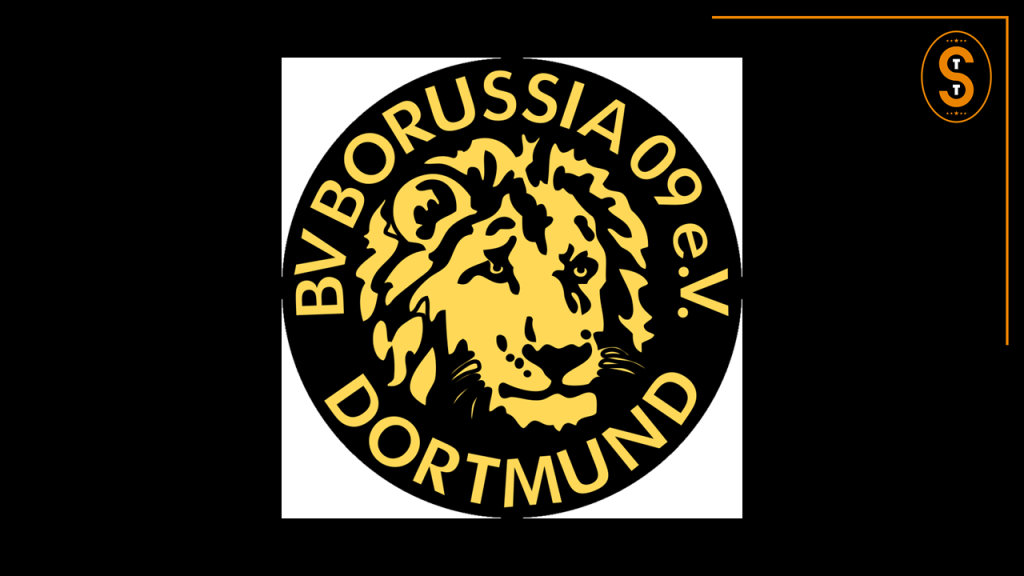
BVB’s crest in the 1970s

The crest is simply the club’s acronym of BVB with the numbers 09 in the club’s colors of black and gold. All of those things should be self-explanatory based on what we’ve already covered in this video.

Important Events

The first event I want to discuss in this section happened on June 24, 1956. Dortmund played Karlsruher SC in the final of the German national championships in Berlin. The national championship was the highest title in Germany at that time because this was before the Bundesliga existed. Dortmund came out 4-2 victors on the day, for their first major title.

Now, the story doesn’t end there, as the following day, the team rode a train back to Dortmund with their wives. There was some weird politicking going on between the players and the board at the club during the 1950s and the board wanted to present the players to their fans without the players’ wives. So, the board planned to separate the wives and players by having the players on a car towards the front of the train, while the wives would be on a car further back. They then planned to unhook, the wives’ car and arrive with just the players. I swear I’m not making this up as this story comes from the official Dortmund website. The players got wind of this and decided to intermingle amongst all the wives, so the board couldn’t execute their plan. It’s quite an interesting story from the club’s past.

The next event I want to highlight happened on May 6, 1966. On this date, Dortmund played Liverpool in the final of the UEFA Cup Winner’s Cup in Glasgow, Scotland. Dortmund were the underdogs in the match, but won 2-1 with a wonderfully chipped goal by Reinhard Libuda in the 106th minute. Dortmund became the first German club to win a European title with this victory.

The club went through some rough periods in the 1970s and 1980s, so let’s flash forward to the mid-1990s. On June 17, 1995, Dortmund won 2-0 over Hamburger SV to clinch its first ever Bundesliga title, which they defended the following season. An even more historic event happened the following year. On May 28, 1997 BVB played Juventus in the final of the UEFA Champions League. Just like in its first European title against Liverpool, Dortmund were the underdogs, but pulled off the upset with a 3-1 victory. It is one of the most glorious days in the club’s history.

Before we move on, I do want to highlight that the club was in a dire financial position in 2003. Bitter rivals FC Bayern loaned Dortmund €2m to pay player salaries. Dortmund paid the loan back in less than a year, but without this assistance, who knows where the club might be today.

Supporters

Within Dortmund’s magnificent stadium is the Südtribüne or South Bank. This is Europe’s largest single-tier standing terrace and also has another nickname, which is the Yellow Wall. More than 24,000 people are packed into the Yellow Wall on matchdays and it creates an absolutely stunning visual, as well as auditory, experience.

Dortmund also has the highest average attendance per match of any Bundesliga club and is regularly among the top 5 in average attendance per match for any club in the world.

Noteworthy Players

A club with a storied history like Dortmund has had many amazing players. I’m going to highlight 6 of them here, but if you have other players that deserve mention, please let us know in the comments section.

Alfred “Aki” Schmidt played at the club in the 1950s and 60s. Dortmund was the only club he played for in his career, making more than 250 appearances over a 12 year period for the black & yellows. The club won 4 major trophies during his time with BVB as Schmidt provided outstanding leadership.

Manfred Burgsmüller deserves mention because although he played during a rough period in the 1970s for Dortmund, he scored 158 goals in only 251 games. His goalscoring might be a record at the club, depending on who you ask, which we’ll discuss later in the video. Burgsmüller was captain during his last 4 seasons at the club before leaving in 1983 and is one of the greatest midfielders in BVB’s history.

Michael Zorc is widely considered the greatest legend in Borussia Dortmund’s history. Zorc made his pro debut in 1981 and would appear in 571 matches for the black & yellows during his career. He was a one club man who led both on and off the field. He captained Dortmund for 8 seasons, winning 2 Bundesligas, a DFB Pokal, and a Champions League. Zorc is another player who might be considered the club’s all-time record scorer depending on who you ask. Stay tuned for more info on that situation.

Matthias Sammer is one of the greatest ever Bundesliga players. Though Sammer played at a handful of other clubs during his career, he is a BVB legend. Sammer is one of the highest scoring defenders in world soccer’s history. The pinnacle of his career came in 1996 as he helped Dortmund win the Bundesliga title and Germany win the Euros. That led to him winning the 1996 Ballon d’Or, given to the best player in Europe (widely considered the best player in the world). Sammer is the only Dortmund player to ever win the award.

Roman Weidenfeller & Marco Reus are two modern legends for the club. Weidenfeller was a goalkeeper at the club from 2002 to 2018. In his 17 years at the club, BVB won 2 Bundesliga titles and 2 DFB Pokals. He made more than 450 appearances for the club and is likely the best keeper in the club’s history.

And finally Marco Reus is still an important player for the club, making over 200 appearances and counting. His career has been unfortunately blighted by injury issues, but when he is healthy, he can be one of the best attackers in the Bundesliga. His legend will likely continue to grow at the club for many more years.

Noteworthy Managers

The two greatest managers in BVB’s history are Ottmar Hitzfeld and Jürgen Klopp. Each took over when Dortmund was in a down period and turned the club around to win major titles.

Hitzfeld took over a struggling Dortmund side in 1991. He was an unknown manager arriving from Switzerland, so expectations were relatively low at the time. Over the next 6 years, he built Dortmund into a perennial title contender, including winning the Bundesliga twice and the Champions League in 1997. He is recognized as one of the greatest managers of his generation. He also holds a unique distinction as being the only manager to defeat Sir Alex Ferguson’s Manchester United both home & away in a 2-legged-European tie. After winning the Champions League with Dortmund, he left to join Bayern Munich, where he would go on to win a number of titles and become one of the most decorated German managers in history.

The other great manager in Dortmund’s history is Jürgen Klopp. Klopp joined BVB in 2008 after making a name for himself managing at Mainz. The prior few seasons for Dortmund were middling, but Klopp set the club on a route back to winning titles. He implemented a high-pressing, counter-attacking style named “gegenpressing” which was described as heavy-metal football or soccer. The entertaining brand of soccer led Klopp’s side to the Bundesliga title in the 2010-2011 season. They followed that campaign with Dortmund’s most successful season ever by winning the Bundesliga title with a record number of points at that time and also winning the DFB Pokal.

That is the only time in the club’s history that the club has won a domestic double. BVB would also make a Champions League final under Klopp, although it unfortunately ended in a loss to rivals Bayern. Klopp would leave BVB after the 2014-2015 season. He currently manages Liverpool FC in England and is one of the most entertaining and well-respected managers in the world.

Rivals

Dortmund’s two main rivals are unquestionably FC Schalke 04 and FC Bayern München (Munich).

Matches between BVB and Schalke are called the Revierderby and this matchup is widely considered one of the fiercest rivalries in all of the Bundesliga. Both clubs are located in the Ruhr region of Germany that is famous for hard-working, blue-collar citizens. This hard-working spirit comes from the region being an epicenter of the coal-mining & steel-forging industries. The region is also obsessed with soccer and these two clubs are arguably the biggest clubs in that region. They’re separated by less than 25 miles and have met more than 150 times since first playing in 1925.

Additionally, a match in Dortmund in 1969 saw overcrowded fans rush the pitch after Schalke took an early lead. Police tried to control the fans with German Shepards, who unfortunately bit 2 Schalke players in the chaos. That certainly led to increased tensions between the clubs and the rivalry has grown from there. Dortmund also helped extinguish Schalke’s title hopes in 2007, which continued to amplify this already full-fledged rivalry.

BVB’s other main rivals are FC Bayern Munich. The clubs didn’t first meet until 1965, but have played over 100 matches against each other since that inaugural game, which Dortmund won 2-0 on the road. Bayern has had the upper hand since then in terms of winning trophies, as well as matches in this matchup. Quite frankly, this wasn’t much of a rivalry until recently.

The cities are more than 350 miles apart and Dortmund only started becoming a perennial trophy contender in the 1990s. The most recent memorable match came in the 2013 Champions League Final, which Bayern won 2-1. Matches between these two clubs are called Der Klassiker, which loosely translates as the classico. The rivalry will only continue to grow as Dortmund continues to build its case as the second biggest club in Germany behind Bayern.

Stats & Records

The stats and records we’re about to discuss are as of October 2019, which is when we are recording this video.

Dortmund has played 53 seasons in the top flight in its history.

The club has 14 major trophies including:

  • 3 German national titles before the Bundesliga was created
  • 5 Bundesliga titles
  • 4 DFB-Pokals or German Cups
  • 1 UEFA Champions League
  • 1 UEFA Cup Winners Cup

BVB’s record first team appearance holder is Michael Zorc with 571 first team appearances.

Technically, the black & yellows’ all-time top scorer is Alfred Preissler with 175 goals. These goals came before the Bundesliga and a national league existed, so the top scorers in the Bundesliga era are:

Michael Zorc and Manfred Burgsmüller. The reason I highlight 2 players is that Michael Zorc had 159 first team goals, but 3 of his goals came in relegation playoff matches and 1 other came in a now defunct competition called the Intercontinental Cup. So, some people only recognize him as having 155 or 158 goals.

Manfred Burgsmüller had 158 first team goals. I’ll let you decide who you want to view as the club’s all-time top scorer.

Dortmund’s record transfer purchase was Mats Hummels from Bayern Munich on June 19, 2019 for a little more than €30M. The transfer officially processed on July 1, 2019 when the transfer window opened.

And the club’s record transfer sale was Ousmane Dembélé to FC Barcelona in Spain on August 28, 2017 for an initial fee of ~€105M that could rise as high as €147M.

And 1 last interesting fact about the club: in October of 2000, Borussia Dortmund became the first and I believe still only German soccer club to be publicly traded on a stock exchange. The club was listed on the Frankfurt Stock Exchange, which is the largest German Stock Exchange. The club is still publicly traded at time of recording.

So there you have it… a bit of history on Ballspielverein Borussia Null Neun (09) Dortmund. Let’s continue the discussion in the comments section below the video.

Thanks for stopping by the Soccer Tavern. Hope to see you again soon. Prost!

Bayer 04 Leverkusen | Club History

Welcome to the Soccer Tavern, where we’re discussing the history, philosophy, and culture of the beautiful game. My name is Dave and in this video, we’re talking about the history of Bayer Null Vier (04) Leverkusen Fußball Gesellschaft mit beschränkter Haftung better known as Bayer Leverkusen. Pull up a seat and let’s start the discussion.

Bayer Leverkusen is located in the Central, slightly southwestern part of city of Leverkusen. Leverkusen is located in the western part of Germany. The club currently play in the Bundesliga and its home ground is called the BayArena. The BayArena opened in 1958 and currently holds about 30,000 people.

Origin

The process of creating the club began in February of 1903 when Wilhelm Hausschild and August Kuhlmann collected signatures in support of starting a Gymnastics club in the area that would become the city of Leverkusen. The two men sent the petition of support to leaders of the Bayer works. The leaders of the company supported the idea and the club was officially founded on July 1, 1904 as a Gymnastics club for employees of the company.

Flash forward a few years to Friday May 31, 1907. On this date, a group of men met at the Wiesdorfer Hof restaurant and called for the creation of a soccer squad at the club. The club leaders accepted under the condition that the soccer players attend the weekly gymnastics events and on June 1, 1907, the soccer component of the club was officially created.

In the 1920s, the soccer portion of the club, separated to form its own distinct club. It then went through a couple name changes and a couple different mergers with other clubs over the decades including re-merging with the sporting club it first left in the 1920s.

The final changes came on April 1, 1999 when the soccer portion of the club, split off again to become its current name of Bayer 04 Leverkusen Fußball GmbH. The GmbH just means that it’s a private limited liability company. Also, it’s important to note here that the club’s official name does not end in e.V. like most other German clubs. Because of the club’s history of always being owned by the Bayer company, the club was given a pass on some of the Bundesliga requirements for ownership.

Nickname

The club is nicknamed Die Werkself. The nickname literally translates as the 11 workers, but can be more loosely translated as the Factory Workers’ team. This nickname comes from the club being created for employees at the Bayer AG pharmaceutcal company’s factory.

Crest

The club’s crest takes most of its inspiration from the Bayer company logo that started the club.

Bayer Leverkusen’s crest

The center of the crest is a circle with the word Bayer written in capital letters vertically and horizontally to form a cross shape. It’s virtually the same logo used by the Bayer company today and is known as the Bayer cross. The Bayer cross was first patented in 1904 and its creation is a mystery with 2 separate Bayer employees claiming to have invented it in the late 19th and early 20th century.

On either side of the Bayer Cross are 2 red lions. I couldn’t find specifics on these lions, but the original Bayer company logo included a 2 tailed lion which came from the coat of arms of Elberfeld, where the company was headquartered at the time. Though the lions in the Leverkusen club crest aren’t two-tailed, I assume this is where they come from. If you have other information about the lions, please let us know in the comments section below the video.

And lastly, the scrolls with writing at the top and bottom of the crest should be self-explanatory. 1904 is the year the club was founded and Leverkusen is the city name where the club plays in addition to it being a part of the club’s official name.

Important Events

I’d like to highlight 3 great days in the club’s history plus touch on something not so great in this section.

First, on May 12, 1979, Bayer Leverkusen played Bayer 05 Uerdingen (now known as KFC Uerdingen 05). Leverkusen were leading the second division at the time and Uerdingen were in 2nd place. A win or draw for Leverkusen on the day meant that they’d be promoted to the Bundesliga for the first time since the league was created in 1963. Leverkusen trailed 3-0 at home after 62 minutes, but fought back to level the match. In the 85th minute, Matthias Brücken scored the equalizer that sent 15,000 fans into delirium. It was one of the greatest days in club history and the club has not been relegated from the Bundesliga since it joined in 1979.

The next event I’d like to highlight happened on May 18, 1988. Bayer had reached the final of the UEFA Cup, which is now known as the Europa League. At the time, it was a two legged final, and Bayer had already lost the first leg 3-0 on the road to Espanyol. May 18 was the return leg at Leverkusen’s home ground. After a scoreless first half, Leverkusen leveled the match through goals by Tita, Falko Götz, and Bum Kun Cha. The match went to penalties with Bayer prevailing in a dramatic shootout. It was the club’s first major title and the club’s only major European triumph to date.

The last positive event I’d like to highlight happened on June 12, 1993. On this date, die Werkself played the second team from Hertha Berlin in the final of the DFB Pokal otherwise known as the German Cup. Just to provide a little clarity, it wasn’t like Hertha just decided to play their second team against Leverkusen in the match. In Germany, often times clubs have second teams that function within the German pyramid, similar to the minor league system in American baseball if the minor league teams could compete against teams in the MLB. Back to the match on this day. Leverkusen were obvious favorites in the match. Although the match only finished 1-0 with a goal from Leverkusen striker Ulf Kirsten, Leverkusen dominated throughout. The club won its second major title and so far only, major domestic trophy on this date.

I do also want to mention the 2001-2002 season for Leverkusen. The club led the Bundesliga late in the season before a collapse saw them end up finishing in second place. This was the 4th time in 5 seasons, that the club finished second. This disappointment was compounded by die Werkself losing the DFB Pokal Final to Schalke after taking the lead early in the match. The pain wasn’t over yet for Leverkusen fans as the club met Real Madrid in the Champions League final on May 15, 2002. Yet again, the club failed to win, falling 2-1 to Madrid. Three heartbreaking 2nd place finishes for the club in the span of 11 days confirmed a cruel nickname: Neverkusen.

Supporters

Before every Leverkusen home match, songs from the Leverkusen band “Mavericks” are played in the stadium. The main club anthem is called “Leverkusen”. Some fans feel other songs are the official club anthem, but this song is the one played in the stadium before matches, so I wanted to highlight it here.

Noteworthy Players

Cha Bum Kun was one of the greatest Asian soccer players of his generation. He joined Bayer Leverkusen in 1983 and was one of the best forwards in the Bundesliga throughout his time with the club. He led Bayer to the 1988 UEFA Cup, scoring a clutch equalizing goal in the 81st minute to force extra time before Bayer won on penalties. Cha retired the next season and in 1999, he was voted Asian Player of the 20th Century. He is a Leverkusen and Bundesliga legend.

The next player I’d like to discuss is Ulf Kirsten. Kirsten is the club’s all-time record goalscorer and joined the club in 1990 after the reunification of East & West Germany. Kirsten had spent the early part of his career in the East German league. He played his entire Bundesliga career with Leverkusen, scoring 182 goals in the Bundesliga alone. His only title with the club was the 1993 DFB-Pokal, but he was a fantastic forward for the club until he retired in 2003.

Rüdiger Vollborn is Leverkusen’s all-time appearance leader and spent his entire 17-year career with the club. Vollborn was a keeper and was instrumental in Leverkusen’s penalty shootout victory in the 1988 UEFA Cup. His career spanned long enough that he was a long-time teammate of both Cha Bum Kun and Ulf Kirsten, who we just discussed.

The last player I want to mention here is Stefan Kießling. Kießling began his career at Nürnberg, but joined Leverkusen in 2006. That would be the only move in his professional career as he would make more than 440 appearances and score more than 160 goals for die Werkself. Along with Ulf Kirsten, Kießling is the only Leverkusen player to be the Bundesliga’s top scorer, which he achieved in the 2012-2013 season. Kießling is undoubtedly one of the best Leverkusen players ever.

Noteworthy Managers

The club really hasn’t had many legendary managers in its existence. No manager has lasted more than 7 years at the club and unfortunately, the club doesn’t have many trophies in its cabinet.

Rinus Michels is the most famous manager from the club’s history, but he was only with Leverkusen for 1 season. Michels is famous for his role in developing Total Football and building Ajax, as well as FC Barcelona, into two of the best clubs in the world in the 1970s. His time with Leverkusen was not very noteworthy beyond it being the last club side he ever managed.

I want to quickly mention Erich Ribbeck who managed the club on 2 occasions, once from 1985 to 1988 and once from 1995-1996. He was the manager as the club won its first major trophy, the 1988 UEFA Cup (which we now know as the Europa league).

And the final manager I’d like to highlight here is Christoph Daum. Daum took over a struggling Leverkusen side in 1996. He led die Werkself to 3 second place finishes in 4 years including a tragic collapse in the 1999-2000 season. That year, the club entered the final day 3 points ahead in the table, but still lost the title to Bayern Munich. Daum likely would have continued building his side and would have unquestionably been Leverkusen’s greatest manager, but a cocaine scandal in the summer of 2000 forced the club to terminate his contract. It was a disappointing ending to a very promising managerial career at the club.

Rivals

Leverkusen considers FC Köln (Cologne) its main rival. The city of Cologne is very near to the city of Leverkusen and the rivalry pretty much stems from geographical proximity. Cologne doesn’t really reciprocate the rivalry as Cologne’s main rivals are Borussia Mönchengladbach. Still, derby matches between Cologne and Leverkusen can get heated, with hooligan fighting often a problem.

Mönchengladbach and Fortuna Düsseldorf are also located in the Rheinland area of Germany and can could be considered loose rivals of Leverkusen.

The reality is Leverkusen is not really liked throughout German soccer. This comes from the club being backed by the company Bayer and not 50% owned by members of the club like most other German soccer clubs. Many opposition fans don’t like the club because of the ownership situation.

Stats & Records

The stats and records we’re about to discuss are as of October 2019, which is when we are recording this video.

Leverkusen has played 41 seasons in the top flight in its history.

The club has 2 major titles:

  • UEFA Cup (Europa League) 1988
  • DFB Pokal (German Cup) 1993

Die Werkself’s record first team appearance holder is Rüdiger Vollborn with 472 first team appearances.

The club’s record goal scorer is Ulf Kirsten with 237 first team goals.

Leverkusen’s record transfer purchase is Kerem Demirbay from Hoffenheim on May 9, 2019 for about €32M. The transfer officially processed on July 1, 2019 when the transfer window opened..

And the club’s record transfer sale was Son Heung-min to Tottenham Hotspur in England on August 28, 2015 for ~€30M.

And 1 last interesting fact about the club: in 1999, the Lindner Hotel BayArena opened in Leverkusen’s stadium. It became the first hotel in Germany to be built within a soccer stadium.

So there you have it… a bit of history on Bayer Null Vier (04) Leverkusen. Let’s continue the discussion in the comments section below the video.

Thanks for stopping by the Soccer Tavern. Hope to see you again soon. Prost!
Caversham United FC | Club History

Welcome to the Soccer Tavern, where we’re discussing the history, culture, and philosophy of the beautiful game. My name is Dave and in this video, we’re talking about the history of Caversham United Football Club. Pull up a seat and let’s start the discussion.

Caversham United is located in Caversham, which is a suburb of the borough of Reading. Reading is located in the southern central part of England in the United Kingdom. It is about 40 miles directly west of London.

The club currently play in the Reading and District Sunday League Division Two. Sunday League does not have a proper pyramid but likely the equivalent of a division 10 league in England. Caversham’ home ground for this season is the Ibis Club on Scours Lane. The club moved there in the summer of 2019 because their previous home ground of the Mapledurham Playing Fields was under refurbishment. Since the home ground is an open field, seating capacity is however many people can fit in a field.

Origin

Caversham United was founded by the current chairman and manager, Paul Gutteridge in the summer of 2015. Caversham had previously been a club in existence in many different iterations but it was most recently AFC Palmer before becoming Cav. The club was poorly run and needed a makeover, hence a new name, kit and badge followed the birth of Caversham United.

The club was saved from the brink of collapse in 2015 and has a very different identity in 2019, which is when we are recording this video.

Nickname

The club is nicknamed the Billy Goats. The nickname came as a result of a Twitter poll with the club’s followers. The nickname refers to the Billy Goats Gruff tale, which is a children’s story about billy goats crossing a bridge with a troll underneath it. The story is linked to the town of Caversham’s infamous bridges, hence, the nickname of Billy Goats.

Crest

Let’s take a look at the club’s crest now.

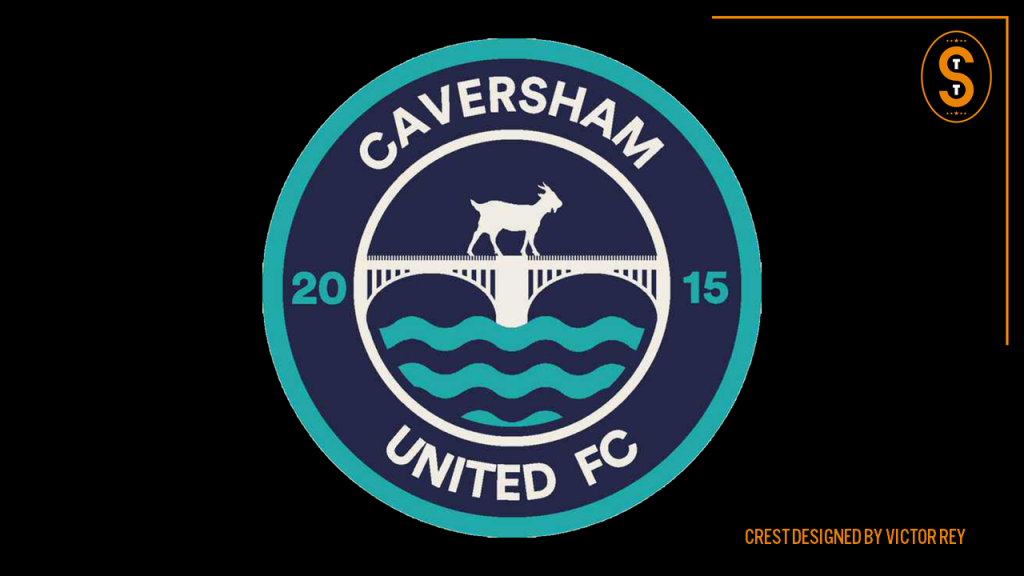
Caversham United FC’s crest

The crest was designed by Victor Rey following a Twitter competition and vote. The poll received over 2,000 votes.

The goat symbolizes the club’s nickname and the goat is walking across the famous Caversham bridge.

The water under the bridge represents the River Thames, which runs through Caversham.

The club’s founding or rebranding year of 2015 is listed along with the club’s name in the outer ring of the circle.

And the colors mark the club’s new identity as the modern Caversham United. They are similar to the club’s first badge which was navy.

Important Events

I’d like to discuss 5 important events in the club’s history in this section.

First, in the summer of 2015, the current management seized the reigns of the club after the previous management duo of Kevin and Perry accumulated just 4 points in the 2014-2015 season. They were sacked with immediate effect and Paul Gutteridge took over.

Moving forward to October 2018. The club decided to become more active on Twitter, in an attempt to gain engagement and a social media following. They have since accumulated more than 5,500 followers, which is amazing for a small Sunday League team in England.

One month later, in November 2018, Caversham United began a partnership with Football Kitbox which resulted in a rebranding of the club. In addition to the rebrand, Football Kitbox sent Caversham United kits all over the world. It was a fantastic marketing move by the club and greatly increased the club’s social following.

In April 2019, the club won a double promotion to Division 2 at the expense of Borussia Teeth. This was the club’s first silverware.

And lastly in July of 2019, the inaugural #CavershamCup was held. This was a tournament organized by Caversham United amongst other clubs active on social media. The tournament raised over £2000 for a charity called Balls to Cancer.

Supporters

Since October 2018, the club has become active on social media, gaining over 6,500 followers between Twitter & Instagram. These followers designed and voted on the clubs badge, kit and nickname. Caversham United is the people’s club!

Noteworthy Players

Joe Hales is a club legend. Hales scored 23 goals in the 2018-2019 season and is the club’s all-time record goal scorer. He is already off the mark in the 2019-2020 season and will continue to add to his goal scoring tally.

Tommie Tank is the club’s clean sheet record holder. He occasionally turns up very hungover to games, but is still able to keep the ball out of the net for the opposition.

Michael Morrison left the club during the 2017-18 season. Morrison was uniquely talented. He had the ability to get injured in every single game that he played. This is how his career ended too, having a game abandoned under what seemed to be a pretty dubious injury.

Chris Kurton lacked match fitness but had an amazing ability to score stunning goals from anywhere on the pitch, particularly against Burghfield FC. Like Morrison, Kurton left during the 2017-18 season.                

Lastly, Neville Swift is an absolute journeyman of Sunday League football in Reading. He is 50 years young and still going. Swift knows every single club and player there is. If Nev doesn’t know it, it’s not worth knowing.

Noteworthy Managers

Paul Gutteridge is the current first team manager and has been since the club’s formation. Stats aren’t available, but his record is mixed. The first three seasons of his tenure, Caversham struggled in the lower half of the table including a bottom place finish in 2017-18.

However, the 2018-2019 season was a turning point for the club. Paul guided the club to runners up in the league, plus a league cup semifinal appearance. This was followed by a Burghfield tournament win and a GoatMilkCup win at the Caversham Cup tournament. His style is a 4-3-3 model with a holding midfielder. Paul wants to play the proper way with the ball on the ground!

Rivals

The Billy Goats have 2 main rivals: Borussia Teeth & Burghfield FC

Borussia Teeth are big rivals after the culmination of the 2018-2019 season. With two games to play, Caversham were 3 points clear with a worse goal difference in the race for promotion. In the penultimate game the two clubs met. Borussia Teeth won the game with a last minute goal to make it 3-2. However, the goal was scored by an unregistered player. Borussia Teeth admitted cheating and the league reversed the result meaning Caversham were promoted. The rivalry has resparked as Teeth are a bit salty about being a division below Caversham this season but this is a relatively friendly rivalry.

Caversham stated they felt like they have played Burghfield FC about 85 times in recent years. Burghfield barely beat Caversham to the title in the 2018-2019 season. The Billy Goats did end Burghfield’s unbeaten season attempt and then beat them on penalties at their own tournament. So the 2018-2019 season added fuel to this growing rivalry.

Stats & Records

The stats and records we’re about to discuss are as of October/November 2019, which is when we are recording this video.

The Billy Goats have only recently made it out of the bottom flight of the Reading Sunday League, being promoted two divisions to division 2 after the 2018-2019 season. Division 2 is the fourth division in the Sunday league structure and as we already mentioned is likely the equivalent of the 10th division in the English football/soccer pyramid.

The club has 2 trophies:

  • 2019 Burghfield Tournament
  • 2019 Goat Milk Cup

Caversham United’s longest serving current player is Brandon D’Souza but he has been plagued with injuries over those years. Paul Gutteridge has probably made the most appearances since the incarnation of Caversham United in 2015. He is the manager so that might be why.

Talisman Joe Hales is the top scorer in the club history. He was golden boot winner in the 2018-19 season with 23 goal and already has at least 1 goal in the 2019-2020 season.

The legend that is Tommie Tank is the club’s all-time clean sheet record holder! He must have had at least 4 last season, which is a record for Caversham!

The club paid a £10 admin fee to the league for Alex Coleman in the summer of 2019. That is the club’s record signing.

And the club doesn’t have any record transfer sales yet.

And one last interesting fact about the club: Caversham United can boast that its shirt has been sold on at least 3 continents. That is mind blowing for a little Sunday League team run from a mobile phone, which is how they provided me all of these details. It’s truly impressive stuff.

So there you have it… a bit of history on Caversham United Football Club. Let’s continue the discussion in the comments section below the video. Thanks for stopping by the Soccer Tavern. Hope to see you again soon. And remember: we’re all goats, aren’t we!? Cheers!

FC Roast | Club History

Welcome to the Soccer Tavern, where we’re discussing the history, culture, and philosophy of the beautiful game. My name is Dave and in this video, we’re talking about the history of Futbol Club de Roast. Pull up a seat and let’s start the discussion.

FC Roast is a soccer club based in London, with Irish Roots. For the 2019 season, it will begin playing in West London though it played in north London previously. London is located in the southern-central part of England in the United Kingdom.

The club currently play in the Middlesex County Football League Division One, which is the 12th division in the English football pyramid. FC Roast’s home ground is called Holland Park and holds about 500 spectators.

Origin

The club started as a five a side team back in 2015, made up of seven players all coming from the West of Ireland. After some successful performances and title wins on the 5 a side pitch, and very successful post game pints, the players decided to step it up and enter a competitive 11 a side league.

Once the now famous club crest was conceptualized and designed, they knew they had no choice but to enter a team.  Helped by the worrying amount of West Ireland immigrants into London, the club got together a squad of 16 players, which included an Italian, Nigerian and a couple of English born players. The one prerequisite to joining the club was that, they all had to drink like Irishmen.

The Roasts had a clear playing philosphy, modelled on the Pep Guardiola approach, with their initial management style inspired by Socrates and his democratic ideals of managing a football team at Corinthians.

As expected, the performances on the pitch were mixed in the 2018-2019 season, with it being its first season as a true club. But it provided some great moments, as FC Roast got to play in front of 1,500 fans, gathered 2,500 instagram followers, 100s of thousands of tweet impressions and sold close to 100 jerseys on the back of our unique club crest.

Nickname

The club’s nickname is the Roasts. A Roast is an Irish slang word, used as a pejorative against people from the countryside. It’s basically like a “redneck” in American lingo. As the club’s original players all came from the countryside in Ireland, the club’s name & nickname is meant as self-deprecating humor.

Crest

The crest idea was inspired by AS Roma which represents the myth of the founding of Rome. Similarly, the Roast crest represents the ideas and culture of the founding of FC Roast, except it’s anything but a myth.

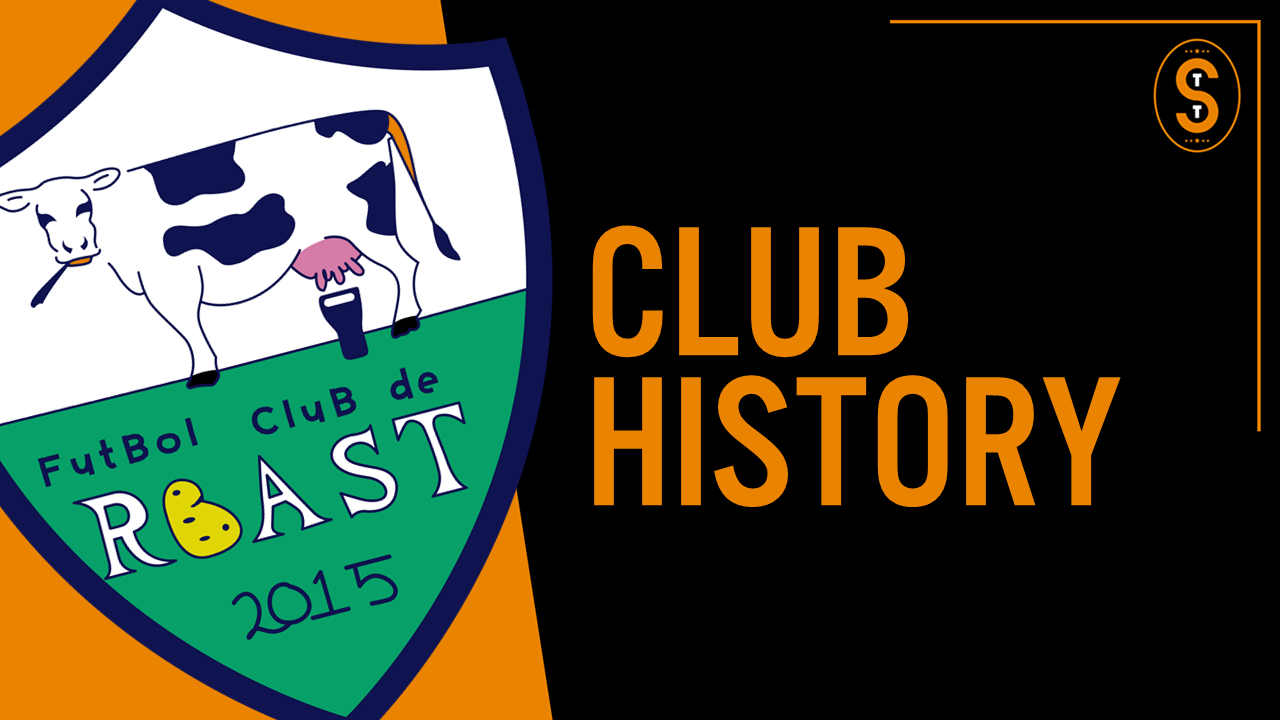
FC Roast’s crest

The Cow is a symbol of the club’s Irish roots, more so their countryside background. And the cow produces Guinness, instead of milk, which the club assures me is a dream of many Irish men.

The ‘O’ in Roast is a Roast potato, with obvious connotations to the Irish stereotype of potato lovers.

And the final element of intrigue is the long narrow thing coming out of the cows mouth, Some say it’s a spliff, but for legal reasons the Roasts insists it’s a piece of straw ;).

Important Events

With the club being relatively new, I only want to highlight 1 event in the club’s history.

On May 11, 2019, FC Roast was scheduled to play Clapton CFC in the second to last match of the season. The match was scheduled as an FC Roast home fixture and Clapton needed to win to secure the league title. Due to Clapton’s massive fanbase, FC Roast actually decided to give up home field advantage in return for a split of the gate receipts.

Over 1,200 supporters showed up for the match, which was the most people many of the players had ever played in front of.

Though FC Roast lost the match 3-0, the money received greatly boosted the club’s then bare bank balance. The injection of funds helped FC Roast get a new jersey designed and manufactured, which I am sporting right here. Icarus FC did a great job manufacturing the kit and you can purchase one of these beauties on the FC Roast website, which we have linked in the video description.

The funds, coupled with the reception of the jersey on social media has given FC Roast a massive platform for the 2019-2020 season. A lot of the credit for all of this can be traced back to the decision to play the May 11 match on the road.

Supporters

One of FC Roast’s hardcore fans named “Hanza” has come up with a huge catalogue of famous club chants. The best and most sung is about a player called Stephen “Boo” Hargadon. The chant is sung to the tune of “Who let the dogs out”, the timeless classic by the Baha Men – special side note, I actually own the Baha Men’s CD with this song.

The chant goes “Who put the ball out…Boo boo boo boo…Who put the ball out…etc etc”

Noteworthy Players

If every club need a hero, then the Roasts need an anti-hero. And in the cult club figure Stephen “Boo” Hargadon, the Roasts have just that. Boo came to prominence in the 2018-2019 season through his social media antics, and frankly nihilistic and abusive behavior towards himself and the opposition, Boo has become that man people love to hate. He averages a yellow card every other game, and his disdain for referees shows no sign of slowing down with his old age.

Rivals

Strangely enough, FC Roast’s biggest rivals are a club based in the West of Ireland, the club’s spiritual homeland. The rivals are called Boyle Celtic, and FC Roast travels back West to play them once a year. The once friendly rivalry was turned sour by the unceremonious depature of FC Roast club founder Ciaran Harrington. With little warning, Harrington left the Roasts only to be seen wearing the green and white hoops of Boyle Celtic in that same season. The rivalry match is played around Christmas time, and for one night only, all rivalry is put aside and the both sides get together in Lavins Pub in Boyle to drink the best Guinness in the West!

Stats & Records

The stats and records we’re about to discuss are as of September 2019, which is when we are recording this video.

The Roasts have had 2 seasons as an FA affiliated club, so it is entering its second season in the 12th division.

The club has no titles yet but hopes to add silverware soon.

The Roast’s record first team appearance holder is Stephen “Boo” Hargadon. Boo somehow managed to avoid any bans last season and played every single game.

The club’s record goal scorer is Bradley Barraclough, who is a journeyman English striker and scored 30 goals from only 25 games.

The club’s attacking, pass it from the back philosophy doesn’t tend to lead to too many clean sheets, so no clean sheet record holder to highlight here.

The club doesn’t really have record transfers in or out, but FC Roast’s first ever foreign import, “Maxi”, was signed after impressing at a trial 7-a-side match. Maxi bought the club members a round of Guinness on signing, so the club actually made a profit on his signing.

And one last interesting fact about the club: the founders of FC Roast come from two small towns in the west of Ireland. The towns are Boyle and Sligo, with a combined population of 25,000, 5,000 of which are in Boyle. At time of recording, there have been over 20 players who have played for the Roasts that have come just from that small corner of Ireland. It’s Probably not the best sign from an Irish perspective, but The Roasts have taken full advantage of this connection!

So there you have it… a bit of history on Futbol Club de Roast. Let’s continue the discussion in the comments section below the video.

Thanks for stopping by the Soccer Tavern. Hope to see you again soon. Cheers!

Louisiana Krewe FC | Club History

Welcome to the Soccer Tavern, where we’re discussing the history, culture, and philosophy of the beautiful game. My name is Dave and in this video, we’re talking about the history of Louisiana Krewe Football Club. Pull up a seat and let’s start the discussion.

Louisiana Krewe is located in Lafayette, Louisiana. Lafayette is located about 150 miles west of New Orleans. Louisiana is in the southern part of the United States.

The club competes in the Gulf Coast Premier League, which is an elite amateur league featuring teams from Alabama, Florida, Louisiana, Mississippi and Texas. US Soccer doesn’t have a fully functional pyramid, but the GCPL is likely the equivalent of a 5th division league if US had a proper pyramid.

Louisiana Krewe’s home ground is the Ragin’ Cajuns Soccer/Track Facility on the campus of University of Louisiana at Lafayette. The stadium was built in 1976 and holds about 5,000 people.

Additionally, the Krewe play their U.S. Open Cup matches at the St. Thomas More Catholic High School Stadium.

Origin

Krewe FC were formed to provide an opportunity for local soccer players to play beyond high school and college level and offer youth players an additional stepping stone towards playing professional soccer.

The decision to form the club came from Kevin Mooney & Joan Oliva in the late Fall of 2018. Kevin is Club director of Southside youth soccer recreation league and Dynamo Juniors Lafayette Club/select soccer. Joan is a coach at Kevin Mooney’s soccer club and was staffed at FC Barcelona youth systems/academies. Both wanted a closer alternative to sending youth prospects to try out for the Houston Dynamo youth academies 3 hours away.

That combined with the help of key volunteers such as Brian Martinez, the Wallace and Lejeune families, as well as others from with the soccer community in Lafayette helped form the Krewe.

Nickname

The club’s nickname is simply The Krewe.

That nickname is obviously a shorter rendition of the club’s full name, but the name Krewe stems from Mardi Gras Krewes/crews. These Krewes/crews are the organizations that raise funds through Balls, Formals, and Dinners to buy bigger floats, decorations, and beads for Mardi Gras parades through the city.

Mardi Gras is a huge part of Louisiana culture and the club wanted to connect with this tradition by choosing Krewe as its name.

Crest

Louisiana Krewe’s crest is pretty straightforward.

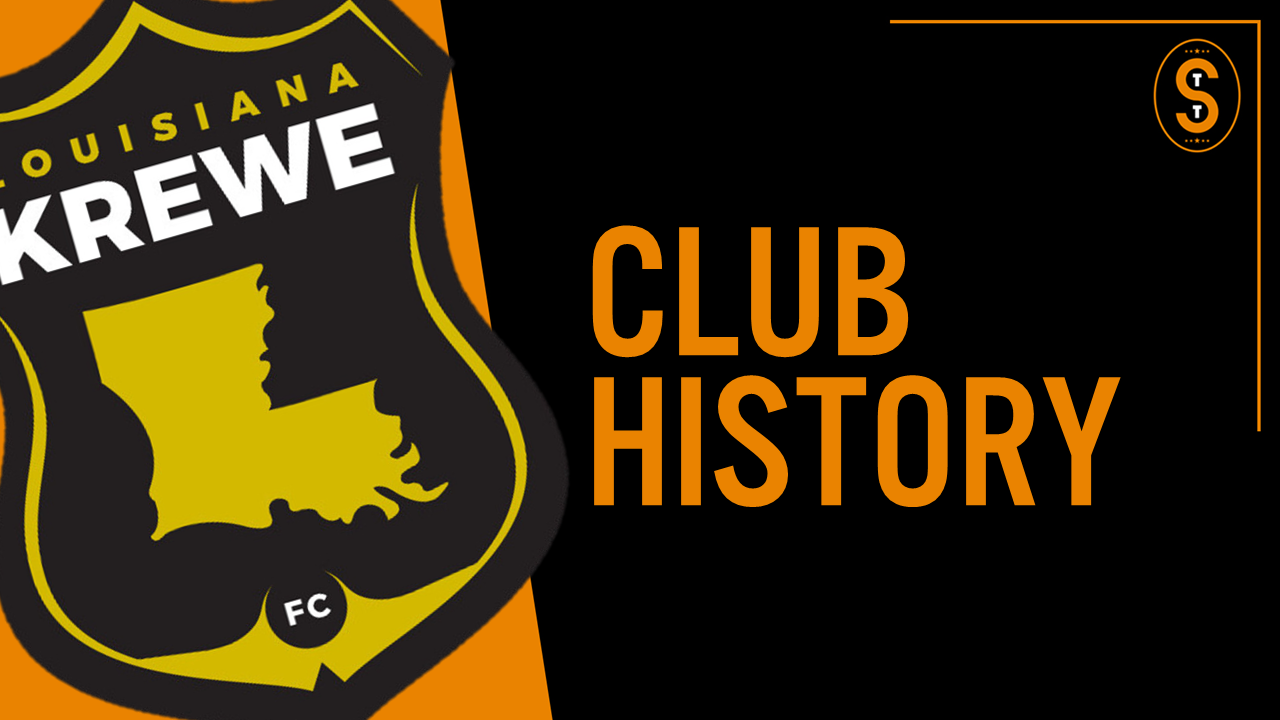
Louisiana Krewe FC’s crest

The state of Louisiana is featured prominently in the middle of the crest.

Louisiana is home to the New Orleans Saints NFL franchise, so the Saints’ colors of black & gold were chosen as the club’s main colors. American football is hugely popular in Louisiana and the Saints are the professional football franchise that the majority of the state cheers for.

Overall, the crest was designed to represent the state as a whole with its color selections and images.

Important Events

The Krewe’s first big showcase game was an intercity cup match vs Cajun Soccer Club. During league play, the two sides met twice, so the results from those 2 matches were considered an aggregate scoreline for the Lafayette Mayor’s Cup. The two league matches ended 1-0, with each team winning once, so the aggregate score was 1-1 after the second match on July 13, 2019. The team’s went to penalties and the Krewe prevailed 5-3 to win its first ever trophy.

The club’s next milestone came on July 24, 2019 when the Krewe met Northshore United FC in the semifinal of the GCPL Cup. It was a tight, back and forth match, but Northshore scored the only goal of the match to win 1-0. Though the Krewe lost the match, it was impressive that the club reached a semifinal in its first year.

And the final events I’d like to highlight are a part of the team’s ongoing U.S. Open Cup run at time of recording. The Krewe is making its first appearance in the qualifying rounds of the U.S. Open Cup in 2019. On September 21, the team got revenge on Northshore United, beating them 5-2 in the first round of qualifying.

Then, on October 19, the Krewe beat Athletic Katy FC 3-2 in the 2nd round. On November 23, the club will face Livonia City FC from Michigan in the 3rd round of qualifying. The winner of that match will officially participate in the first round of the U.S. Open Cup, so it is a big opportunity for Louisiana Krewe FC.

Noteworthy Players

With the club only being 1 year old, I’d like to quickly mention 5 players in this section. The four Krewe players that made the GCPL western conference best Xl were Adrian Olivares (who scored more than 10 goals for the Krewe), Munir Poca, Reed Gravolet, and Cristian Cubedo. Cubedo was the MVP of the western conference.

Additionally, Dillion Gallet is a local product that put impressive numbers for the Krewe in its debut season.

Noteworthy Managers

Louisiana Krewe has only had one manager or head coach in its history, Joan Oliva. Oliva has set a great foundation for the Krewe to build upon. He has a keen eye of not only knowing what players to pick, but also how to play the players to their advantage while exposing the opponent’s weaknesses. Oliva was named Coach of the year in the GCPL in his first season. The man has a great reputation as he used to coach at the FC Barcelona academy.

Oliva has been a key reason why the Krewe have been so successful for a new club.

Rivals

The club has 2 rivals: Cajun Soccer Club (or CSC) and Northshore United FC.

CSC is a cross-town rival and there is already tension between the clubs as the Krewe won the first ever Lafayette Mayor’s Cup, which we mentioned in the important events section. Additionally, many years ago, the CSC and Krewe Club Directors worked together, so there is a pre-existing relationship that adds a bit of drama to this rivalry.

The Northshore United rivalry is a bit more straightforward. The clubs have met in 2 knockout competitions with each side winning 1 match. Northshore beat the Krewe in the GCPL semi-final, but the Krewe got revenge in the US Open Cup qualifying rounds. If the 2 meet in future competitions, this rivalry should continue to grow.

Stats & Records

The stats and records we’re about to discuss are as of November 2019, which is when we are recording this video.

Louisiana Krewe has spent 1 season in the Gulf Coast Premier League.

The has 1 club trophy, the 2019 Lafayette Mayor’s Cup.

The hasn’t kept track of individual stats like appearances, goals scored, or clean sheets, so let’s jump to our 1 last interesting fact about the club.

The Krewe is still young and fresh, but has had a lot of success and positive momentum for not have a main club owner. It is fully self-funded. The staff are all volunteers and they all work together to give the coach and players a professional environment as they prepare the locker rooms and clean up after matches. The volunteers make the club run smoothly so that players and coaches can focus on the game. It’s truly a grassroots effort and incredibly impressive from everyone involved with Louisiana Krewe FC.

So there you have it… a bit of history on Louisiana Krewe FC. Let’s continue the discussion in the comments section below the video.

Thanks for stopping by the Soccer Tavern. Hope to see you again soon. Cheers!

Old Bhoys SC | Club History

Welcome to the Soccer Tavern, where we’re discussing the history, culture, and philosophy of the beautiful game. My name is Dave and in this video, we’re talking about the history of Old Bhoys Soccer Club. Pull up a seat and let’s start the discussion.

Old Bhoys SC is located primarily on the west side of the city of Indianapolis, Indiana. Indianapolis is located in central Indiana and Indiana is located in the midwestern part of the United States.

The club competed in the United Premier Soccer League (UPSL) for the 2018 & 2019 season. This league would be considered 5th tier in the United States. The club is still deciding where it will play in 2020.

Old Bhoys’ home ground is Cardinal Ritter Stadium. It’s been the club’s home ground since the club’s inception and was built in 2012. It is owned by Cardinal Ritter High School in western Indianapolis and seats about 1,000 people.

Origin

The history of the club dates back to an idea in 2014 to connect the youth club environment in Indianapolis to the professional pathway. The youth soccer environment at that time capped out at high school, or possibly college, for a vast majority of players. So, the club’s founder (Andy Hayes) had an idea to bridge that gap and provide a platform for the local player to continue pursuing their soccer dream.

The initial concept was to form a true senior side for the local Indy-based youth club at which Hayes coached. In order to delineate the youth from the adult team, the name United Soccer Alliance of Indiana (or USAi) Old Bhoys was chosen. That established the first iteration of the soccer club. The Club’s original mission was to provide a platform for the youth players on a professional-track and to develop players in Central Indiana. It sought to enhance the soccer opportunities for players after their youth club careers. Through this original vision and mission, the Bhoys took their first steps.

As the 2018 campaign unfolded, it became clear that co-existing with the associated youth club could no longer continue. In an effort to build upon the first season of Old Bhoys wherein the group secured only 2 points in UPSL league play and to fully realize the club’s potential, the Bhoys established themselves as an independent, un-affiliated club. It rebranded to Old Bhoys Soccer Club. This rebrand effort started in August, 2018 and provided the impetus for the club to launch full steam into the 2019 UPSL campaign and pursue a cup competition as well.

Behind the club has been Hayes working in close collaboration with head coach Steve Bushre. The results have significantly improved in two seasons, with the Bhoys claiming 15 points in year 2 from 10 matches, and a semifinal appearance in the USASA Region 2 Amateur Cup.

Nickname

The club’s nickname is simply Bhoys. That should be pretty self-explanatory as it comes from the club’s official name.

Crest

The club’s crest comes mainly from tying into a local youth club, which we’ve already discussed.

Old Bhoys SC’s crest

Additionally the city flag and colors of Indianapolis proper are red, blue and white, which are clearly featured on the crest.

Lastly, the clubs feels the professional team of Indy Eleven do a wonderful job representing the city and the Bhoys are trying to do their part to connect the amateur game with the community they represent. They feel that this crest does that.

Important Events

I’d like to highlight 4 important events in the club’s history in this section.

On May 5, 2018, Old Bhoys made its league debut against Carpathia FC. It was the first league match in the club’s history and it was also the first time a team from Indiana competed in the UPSL. The historic day did not end in victory as the club lost 2-0, but is a day that will always be remembered in Old Bhoys history.

The second event I’d like to highlight happened on June 23, 2018. The club hosted Ann Arbor FC on this date. Trailing 2-1 late in the match, Old Bhoys got a goal in the 93rd minute from their center back to earn the first point in the club’s history.

The third event I’d like to mention happened on May 8, 2019. On this day, Old Boys SC faced Michigan Stars FC in the quarterfinals of the USASA Region 2 Amateur Cup. The Bhoys won 3-0 over the Michigan Stars, who are now a professional team in NISA, to advance to the semifinals of the Cup. It was one of the biggest victories in club history to date.

And the final event I’d like to highlight happened on May 18, 2019. The Bhoys played St. Louis Maritsa in the 3rd match of the 2019 UPSL Spring season. The club won emphatically 4-0, which was the club’s first UPSL victory in its history. The club would go on to win 5 matches in the Spring season & finish respectably mid-table in its division.

Supporters

‘Come on you Old Bhoys’ or COYOB is a common refrain from the club and its supporters on social media and at matches.

Additionally, the club is always looking to grow. They wanted me to let you know that if you want to be a part of the club, or purchase some merchandise, you can reach out to them on social media or visit their store link.

Noteworthy Players

The most famous player in club history differs depending on who you might ask.

Up first would be Christian Lomeli. Lomeli, who is currently an assistant coach at his alma mater, Indiana University, played for the Old Bhoys in their inaugural season. Making less than a handful of appearances, he was the one player with professional club experience after a short time with the Indy Eleven where he learned from goalkeeping legend John Busch. Lomeli is a native Hoosier and was man of the match in the club’s final league match of 2018. He made with key saves that preserved a 0-0 draw against Muskegon Risers SC.

If you belong to the lower-tier American amateur soccer fandom group, Javier (Javi) Steinwascher is probably the most famous player in Old Bhoys’ history. Steinwascher stars collegiately for the University of Indianapolis and played for the Old Bhoys in year one of the club. His abilities were noticed at Cardinal Ritter High School and beyond, as recently he played for Flint City Bucks. Steinwascher joined the Bucks late in their season and contributed to them winning the USL League 2 Championship – which is the 4th division of US soccer.

Last but certainly not least, is the Bhoys’ fan favorite over the club’s first two seasons. He has been club captain and was the first signing in club history, Tim Shackleton. Shackleton starred collegiately at Grove City College before joining West Chester United in the NPSL – another 4th division league. Upon moving to Indianapolis for a teaching career, Captain Tim joined the Bhoys for their inagurual season.

Captaining a side through a winless debut season wasn’t easy, despite leading the club in goals and appearances that year. Some of year 1 highlights included his “Power Knee” goal in a loss to Toledo Villa and being deployed in a defensive position against Muskegon to earn the club’s first away result. Back for year two, Shackleton moved from the #9 to Center Back, captaining the club again. His leadership and ability to connect with the supporters was top flight stuff. Besides the “Power Knee”, Tim’s impact on the club is wrapped up in the following quote: “Shooters shoot, coach.”

Noteworthy Managers

At time of recording, the club has only had one first team head coach: Steve Bushre. In the UPSL, Steve led the club to its first win, and first points. Along with club president/GM Andy Hayes, Steve had a hand in building the club from scratch. From open tryouts to connecting with players in his collegiate and club coaching network, Steve was heavily involved in getting the club started. Steve managed a total of 31 matches for the Bhoys.

Highlights for him include a semifinal run in the Region 2 USASA Amateur Cup in 2019 and a mid-table finish in the Midwest Conference in the 2019 UPSL season. While no trophies were captured during Steve’s tenure, his imprint in how the club competed and how the squad improved year-on-year were embodied as core values at the club.

Bushre was joined in 2019 by assistant coach Sam Fisher, who helped the club make great strides in year two. Both coaches have progressed in their careers and are currently coaching in the collegiate ranks.

Rivals

The club has three main rivals I’d like to highlight here.

FC Indiana is the closest club in terms of geography that Old Bhoys has faced in its two years. It also competes at a similar league level. That adds to the rivalry, and the most recent rendition of this match was a heated affair. The Bhoys aim to be the top amateur club in the Hoosier state. While that official title went to Fort Wayne Sport Club, the Bhoys and Lions of FC Indiana drew each other in a preseason friendly back in April and the rivalry should continue to grow between these clubs.

The next rival for Old Bhoys is St. Louis Maritsa. There is something about a St. Louis vs Indianapolis city rivalry that is both friendly and intense. The clubs first played each other on May 18th, 2019 and held their league return leg on June 29th, 2019. They split results, and finished right next to each other in the table. There is a mutual respect from both clubs, and it starts at the management / ownership level. Alex Todorov runs a good club, and that is evident from St. Louis Maritsa’s deep US Open Qualifying Rounds run in 2018. The Bhoys’ first league win was against Maritsa, and both clubs were the lone UPSL representatives from their respective states.

The last rival is DeKalb County United. While no on-field rivalry exists with a club you’ve only played once in a friendly, DeKalb County is the model for Old Bhoys SC. DCU puts the club and community over everything else; and that’s something that needs to be remembered at all levels of US Soccer. This rivalry is definitely about mutual respect.

Stats & Records

The stats and records we’re about to discuss are as of October 2019, which is when we are recording this video.

Old Bhoys have spent two seasons have been spent in UPSL, which is unoffically the 5th tier of the US Soccer “Pyramid”.

The club has no trophies to date.

Old Bhoys’ record first team appearance holder is Nick Littrell, a local soccer product playing for SCSA in southern Indianapolis in the youth ranks. By the club’s very amateur record tracking, Littrell has made 25 appearances (in all comps) for the club.

The club’s record goal scorer is Tim Shackleton with 10 career club goals.

And in a close competition, Luke Williams holds the club record for clean sheets with… 2.

And one last interesting fact about the club: the May 18th, 2019 match v. St. Louis Maritsa was attended by Non-League America, which is a website dedicated to covering lower division soccer culture in the United States. The post-match interview from that game can be watched here.

So there you have it… a bit of history on Old Bhoys Soccer Club. Let’s continue the discussion in the comments section below the video.

Thanks for stopping by the Soccer Tavern. Hope to see you again soon. Cheers!

Inter Detroit | Club History

Welcome to the Soccer Tavern, where we’re discussing the history, culture, and philosophy of the beautiful game. My name is Dave and in this video, we’re talking about the history of Club Internacional de Futbol Detroit, better known as Inter Detroit. Pull up a seat and let’s start the discussion.

Inter Detroit is located in Pontiac, Michigan. Pontiac is about 25 miles northwest of the city of Detroit, Michigan. Michigan is located in the central, northern part of the United States.

The club currently play in the Open Division of the Michigan Premier Soccer League or MPSL. The MPSL is Michigan’s top amateur league and is likely the 5th tier of the US soccer pyramid. I say likely because the United States doesn’t have a true soccer pyramid and there are technically no divisions below the 3 fully professional divisions. The Open Division is the 3rd tier of the MPSL, so Inter likely play in the 7th tier of US Soccer.

Inter splits its home matches between Oakland University Track & Field Stadium, which seats roughly 500 spectators, & Auburn Hills Civic Center, which seats close to 150 spectators.

Origin

The club was formed in 2017 as Coahuila FC by Edwin Jimenez. The name Coahuila was chosen because it paid homage to Edwin’s family roots in Coahuila, Mexico. The club was originally created as a way for Edwin to play indoors with his family & close friends. He soon realized that the club had potential as it provided young urban adults an opportunity to play under an organized club.

After success with Coahuila FC, Edwin decided to partner with Omar Trevizo. With the partnership, the club rebranded as Club Internacional de Futbol Detroit and created the ultimate platform to take the club to the next level.

Nicknames

The club’s three nicknames are very straightforward. They are Inter Detroit, ID, and simply Inter.

Inter is the shortened version of the Internacional portion of the club’s name. It is a commonly used nickname in world soccer for clubs with Internacional or International in their official name. Obviously Detroit comes from the club’s proximity to the city of Detroit and is included in the club’s official name.

ID is simply the initials for Inter Detroit.

And Inter is simply the first part of the first nickname we’ve already discussed.

See, very straightforward.

Crest

Let’s take a look at the club’s crest now.

Inter Detroit crest

The colors of green and black represent the club owner’s Mexican Roots.

The buildings represent the cities of Metro Detroit.

The fist symbolizes the Joe Louis Monument. The monument is a representation of strength and unity of the Metro Detroit area.

And the club’s name is around the outside of the crest. Internacional is Spanish for International, with Inter fielding players from all over the world.

Important Events

I’d like to mention 5 important events in the club’s history in this section.

On February 23, 2019, Inter Detroit held its first ever try out with more than 75 trialists attending. That set a record for an amateur club in the region.

About 3 months later, Inter opened its inaugural season on May 5, 2019 against Sporting Detroit SC. Though Inter lost on the day, over 100 fans attended the match, creating an outstanding atmosphere for an MPSL club.

One week later, on May 12, 2019, Inter played LK St. Clair in the MPSL League Cup. LK St. Clair was two divisions ahead of Inter at the time. The match ended 0-0 with Inter prevailing 5-4  in penalties to advance in the competition.

The next event I want to highlight is the weekend of May 18 & 19, 2019. On May 18, Inter visited Oakland County FC, a power house Semi Pro team from the Midwest. Inter held the match tied 1-1 until the 80th when Oakland County snagged 2 goals to pull away. Inter had over 70 away supporters travel to the match, who supported throughout the full 90 minutes, which was impressive to the Oakland County FC players & supporters.

The following day, Inter faced Force FC, a rival one division ahead, in the Michigan State Cup. After a torrential downpour caused a delay of 35 minutes, Inter scored a goal with minutes left in regulation to advance 2-1 in the cup. It was a GREAT weekend for the new club.

And the final event I’d like to mention happened on June 15, 2019. Inter played Detroit United in the round of 16 of the MPSL League Cup. Inter again pulled off a huge upset over a rival club 2 divisions ahead to win the match 4-3. Inter advanced to the quarterfinals of the cup with that win, which was huge for the young club.

Supporters

Supporters of Inter Detroit are mainly family and friends, as well as many followers from the club’s active social media platforms.

Noteworthy Players

I’d like to highlight 3 players in this section.

Juan Jimenez – Center back who was on the original Coahuila FC and had never missed a game in over two years until a knee injury in the summer of 2019. Juan has 8 Goals & 30 Appearances for the club.

Rene Montanez- Outside back who was also on the original team. Rene has played every single game in club history, making over 40 appearances for Coahuila & Inter combined, scoring 10 Goals.

And lastly, Eduardo Cardenas is a center back who joined the club and has never missed a game. Eduardo made a graceful transition from striker to center back and has more than 40+ appearances for the club.

Noteworthy Managers

The club has only had one manger under both its names. The manager is Luis Jimenez from Pontiac, Michigan. Luis is the brother of Edwin Jimenez (the club’s Owner). Luis is a player favorite and has gained the respect of his peers across multiple leagues.

Rivals

The club has 3 main rivals. Sporting Detroit, Wayne County Sporting, and LK St. Clair.

Inter has no wins and 2 losses vs Sporting in league play. Owners of both clubs are good friends and the games are always thrillers. It is a friendly rivalry.

Inter has only faced Wayne County Sporting one time and lost the match, but WCS is another Latino based club in the region fighting to see who’s best.

And lastly, the rivalry with LK St Clair comes from facing off in knockout competitions. Inter knocked LSC out of the League Cup, while LSC beat inter in the State Cup. This rivalry should continue to grow in the future if the teams face each other in more knockout competitions.

Stats & Records

The stats and records we’re about to discuss are as of October 2019, which is when we are recording this video.

Inter has played one season in the Open Division of the MPSL and plans to venture out in the years to come.

The club has not won a trophy yet but hopes to win some silverware soon.

Inter’s record first team appearance holders are Rene Montanez & Eduardo Cardenas who each have more than 40 appearances for the club.

The club’s record goal scorer is Irvin Castro with 15 goals. Second place is Dante White with 10 goals.

Oscar Jimenez has the most clean sheets in the club’s history.

And one last interesting fact about the club: Inter gives out free popcorn at all home games. It’s also free admission and the club does other giveaways during matches.

So there you have it… a bit of history on Club Internacional de Futbol Detroit. Let’s continue the discussion in the comments section below the video.

Thanks for stopping by the Soccer Tavern. Hope to see you again soon. Vamos Inter!

Fall River Marksmen FC | Club History

Welcome to the Soccer Tavern, where we’re discussing the history, culture, and philosophy of the beautiful game. My name is Dave and in this video, we’re talking about the history of Fall River Marksmen Football Club. Pull up a seat and let’s start the discussion.

Fall River Marksmen FC, is located in Fall River, Massachusetts. Fall River is about 50 miles south of Boston and about 20 miles east of Providence, RI. Massachusetts is located in the Northeastern part of the United States.

The current iteration of the club does not actually have a league at time of recording. In all likelihood, it will join the 3rd tier of the Boston based Bay State Soccer League, which is a premier adult amateur league. The United States doesn’t have a true soccer pyramid and there are technically no divisions below the 3 professional divisions, but the BSSL first division is likely the equivalent of a 5th or 6th division league if US Soccer had a proper pyramid. So, the Marksmen being in the third division of that league would mean that it will begin play in the 8th or 9th division of US soccer.

The club is a big proponent of promotion & relegation and hopes the US will someday abide by the rules of sporting merit stated in the FIFA rules so that they could work their way up the pyramid.

The Marksmen’s original stadium was Mark’s Stadium in Tiverton, RI which held about 15K people. Mark’s Stadium was built in 1922 and eventually closed and was demolished by the mid 1950’s. The current team plans on playing in Fall River but may shift to Tiverton to honor the club’s roots.

Origin

Fall River Marksmen FC’s origin begins in 1921 when the American Soccer League was formed with a club called Fall River United participating. The club underachieved in its first year and looked to be collapsing when a local entrepreneur named Sam Mark purchased the club. Mark recognized that if he invested in the club, he could turn around its fortunes and ultimately make himself some money.

After purchasing the club, he renamed it Fall River Marksmen. It was quite literally his name plus the fact that the club had male players and were men. Mark also decided to build the club’s stadium across the border in Tiverton, Rhode Island. He did this because Massachusetts was very restrictive of business operations on Sundays at the time and Mark wanted his club to have flexibility to play whenever it wanted.

Mark invested in the club and built it into one of the most powerful and well-known clubs in America throughout the 1920s. The great depression of the 1930s crushed the American Soccer League and Mark moved the club to New York in 1931 due to economic troubles. The club was rebranded under the New York Yankees name and it existed for a few years under that brand. By 1933, Mark had divested out of the club, and the club was rebranded & moved again.

The Fall River Marksmen club and brand would lay dormant for more than 85 years, which brings us to 2018.

The club has been revived by a man named Andre’ Ruette. Andre’ used to run a semi-pro team and league in Florida from 2005-2011. He had to close the league in 2011 and became focused on his non-soccer career.

As time went by, he greatly missed being involved in the game and was becoming even further dismayed with the status of club soccer within the U.S. After doing a lot of research into the then current landscape of U.S. lower league soccer, it became clear that one of the best avenues in getting back into the game was by reviving and honoring the all too often overlooked history of the Fall River Marksmen.

In November of 2018, Andre’ officially purchased the rights to the club and the club’s revival was announced in January of 2019.

Nickname

The club’s nickname is the American Menace. The nickname dates back to the Soccer Wars of the 1920’s. The Marksmen and fellow ASL teams were referred to as the American Menace for their dominance on the pitch and also for grabbing many European players and bringing them stateside.

Crest

Fall River Marksmen FC’s crest

The Marksmen’s colors are red, black, and white. Red represents the Massachusetts Bay Colony and has roots to before the founding of the United States.

Black honors and represents the club’s past and those who helped form the club’s history.

And white represents the future for the club.

At the top of the badge are the Fall River city gates which are located in Fall River and its sister city of Ponta Delgada in Portugal.

The words Fall River at the top of the crest represents where the club is located.

The black, plus looking object in the background of the logo is the Marksmen crest, which is the seal of an official Marksmen.

The old-school soccer ball in the middle of the Marksmen crest is a leather laced soccer ball that would have been used in the 1920s, which was the club’s heyday.

And the club’s original founding date in 1922, as well as acronym of FRMFC which stands for Fall River Marksmen Football Club, is located at the bottom of the crest

Important Events

I’d like to highlight 5 important events in the club’s history

On March 30, 1924, Fall River Marksmen played Vesper Buick in front of 14k people in the final of the National Challenge Cup, now known as the US Open Cup. The match took place in St. Louis and was tied 1-1 at the half before the Marksmen roared to life with 3 goals in the second half to ultimately win 4-2. It was the club’s first Open Cup trophy and completed the club’s first double as it also won the American Soccer League title that season.

Moving forward about 3 years, on May 31, 1926 the Fall River Marksmen drew the New York Giants (which was a soccer team) 1-1. This was the final match of the 1925-1926 American Soccer League season and the Marksmen officially won their third consecutive ASL title on this day though they had clinched the title weeks earlier.

The next date I want to highlight is August 20, 1930. On this date, Fall River Marksmen played Slavia Praha in Prague, Czechoslovakia. The result of the match was 2-2, but the result wasn’t what was noteworthy about this date. This match was the first of a 2-week tour through central Europe for the Marksmen. Though European clubs regularly toured North America at the time, it was extremely rare for an American team to tour Europe. The club would have 3 wins, 1 draw and 2 losses on the Euro tour.

The next date I want to discuss is only a few months later: October 23, 1930. On this day, the Marksmen played Hakoah All-Stars from New York City in the second leg of the Lewis Cup. The Lewis Cup was the American Soccer League’s version of a league cup. The Marksmen had already won the ASL League Title and US Open Cup in 1930 and on October 23, it completed a historic treble. The Marksmen won 3-0 on this date and won the Lewis cup 5-1 on aggregate. The treble win is one of the greatest accomplishments in American club soccer history.

And the last date I want to highlight is August 3, 2019. On this date, the newly reformed Fall River Marksmen FC played Boston Siege FC in its first match under the Fall River Marksmen name in more than 85 years. The match ended 2-2 and was the first in a series of friendlies as part of the 2019 Revival Tour for the Marksmen. It was a rebirth for this club with a glorious history.

Supporters

Right now the club does not have an official supporters group, but will be working on helping to get a supporters group together. Flares, pyro, banners, instruments, voices, and all are welcome and encouraged to stand and support.

Noteworthy Players

The club had many amazing players from the 1920s and early 1930s.

Bert Patenaude – played 114 games and scored 112 goals for the club. He was a member of the 1930 US World Cup team and was the 1st player ever to score hat trick in a World Cup. Although many pundits said he was a streaky scorer, always scoring in bunches, his overall totals were simply impressive. Bert was a hometown guy as well. His parents emigrated to the area from Quebec prior to his birth. To this day, there are a few relatives of Bert who live in the Fall River area.

Adelino “Billy” Gonsalves was possibly the greatest American to ever play soccer. Gonsalves played in 2 World Cups and made 11 Open Cup Finals in a 15 year span. Billy joined the Marksmen in 1929 and was credited with 69 goals in 116 games for the club, but those numbers are a bit hazy since the club moved during his time with the team. By the end of his career, he had played for more than 25 years and won the Open Cup a record 8 times.

The next player I want to highlight is Harold Brittan. Brittan was a professional player in England before coming to the US in 1920. During his career, he won 4 ASL titles and 2 Open Cups. 3 of those ASL titles and both of the Open Cups were won with the Fall River Marksmen. He was a fantastic goalscorer and often led the ASL in goals before he retired in 1927. Brittan is one of the more unsung hero’s from the Marksmen and in US soccer during that era. His numbers with the Marksmen were staggering, especially considering he was a player coach for 4 years of his time with the club. He played 105 Games & scored 102 Goals.

All three of the players I mentioned are members of the United States Soccer Hall of Fame.

The next player I want to highlight here is Johnny Reder. Reder joined the Marksmen in 1929 and was an excellent GK for the club. He would win 2 ASL League titles and an Open Cup with the team before it was relocated. Reder followed the team to New York, but with the collapse of the ASL, he became a member of the Boston Red Sox baseball team.

And the last player I want to mention is James White, also known as Tec White. Sam Mark recruited White from Scotland, where he was playing w/Motherwell at the time. White was a midfielder who would play over 240 matches for the Marksmen and followed the club after it moved to NY and then back to New Bedford. He also had over 100 league goals w/the Marksmen.

Noteworthy Managers

The manager I’d like to highlight here is Harold Brittan. We talked about Brittan as a player, but he has to go down at the best manager in the club’s history as well. His stats on both sides of the touch line speak volumes. After the Marksmen folded and left town in the early 1930s, it was Harold who brought them back to Fall River and wound up renaming the team, Fall River FC.

Rivals

The club has 4 main historical rivals: New Bedford Whalers, Bethlehem Steel, Boston SC & Providence FC.

New Bedford’s proximity to Fall River made for a natural rivalry. Adding to the rivalry of the two club was for all of the success that the Marksmen had, the Whalers to their credit were a very formidable club as well.

Bethlehem Steel were the dominant kings of US soccer prior to the formation of the Marksmen. Although the Steel started to decline in the 1920’s, their prestige was still there and the Marksmen vs Steel was a top tiered match. Unfortunately the split of teams & leagues during the “Soccer Wars” kept these 2 clubs apart on the field during the late 1920’s.

Boston SC, nicknamed The Wonderworkers, were a solid club from the mid to late 1920’s who put a good fight against their regional rivals, the Fall River Marksmen. Boston even managed to pick up silverware and a better place in the standings during the 1926/27 & ’27/28 seasons. That added to this rivalry.

And the last historical rival I want to mention is Providence FC. Providence is listed due to their geographical location and numerous matches against the Marksmen. Sadly, Providence, which changed names on a few occasions, never managed to gain much success against the Marksmen or against the rest of the league.

Finally, I want to mention that the club’s current rival is Fall River FC. The two clubs are both located in Fall River and have created a competition called the Taca de Fall River. The Marksmen lost the first annual series 4-3 on aggregate. This should grow into a true rivalry with many more matches to be played in the future between these 2 clubs.

Stats & Records

The stats and records we’re about to discuss are as of September 2019, which is when we are recording this video.

Technically, the club played 11 seasons in the top flight ASL in the 1920s and early 1930s. But 2 of those seasons were under different club names. So, officially the club has 9 top flight seasons in its history.

The Fall River Marksmen have 11 major titles:

  • 6 ASL League Titles
  • 4 US Open Cups
  • 1 Lewis Cup (which was basically the League’s Cup for the ASL)

The club’s record first team appearance holder is Bill McPherson, who made 331 appearances for the club.

The club’s record goal scorer is Bert Patenaude with 114 goals.

From all of our research, it appears the club’s record transfer purchase was a player named William Fryer, who the Marksmen bought from the New York Giants (soccer team). The club paid $1,500 in 1923, which is about $23K in 2019. There might be a higher total paid out since Fryer but we weren’t able to confirm.

And with the Marksmen being one of the clubs at the top of the food chain during the ASL, we couldn’t find information on record transfer sales for the club. If you have any more info on the club’s record transfer sale, please let us know in the comments section of the video.

And one last interesting fact about the club: the Marksmen started off the 1931 season in Fall River and under their name, Marksmen. It began the stages of the National Challenge Cup (now known as the US Open Cup) under the Marksmen name but moved to New York City during the middle of the season. The club finished the season under its new name of the NY Yankees soccer club.

During that season, the club won the US Open Cup, which would have made it 5 Open Cup titles for the Marksmen, which would have tied Bethlehem Steel as the most Open Cup wins in history. Unfortunately, the Marksmen were not awarded the title and to this day, the Marksmen are only credited with winning the US Open Cup 4 times.

Before we close out, I’d like to include a statement from current club owner Andre’ Ruette: “We’re humbled and honored to act as custodians of the Marksmen history. The revival of this club was due in part to celebrate & honor the success of the past and to ensure its legacy lives on. The accolades of the past aren’t ours to hold, those remain rightfully placed with the original members. However, we vow to always honor & respect the achievements of the past and use them as a reminder of the potential & acuity that lays within the city of Fall River & US Soccer.”

So there you have it… a bit of history on Fall River Marksmen Football Club. Let’s continue the discussion in the comments section below the video.

Thanks for stopping by the Soccer Tavern. Hope to see you again soon. Cheers!

Amish Country United | Club History

Welcome to the Soccer Tavern, where we’re discussing the history, culture, and philosophy of the beautiful game. My name is Dave and in this video, we’re talking about the history of Amish Country United. Pull up a seat and let’s start the discussion.

Amish Country United is located in Berlin, Ohio which is in Holmes County. Berlin is about an hour south of Akron in the northeastern part of the state. Ohio is located in the central, slightly Eastern part of the United States.

The club currently play in the Northern Ohio Soccer League (NOSL). The league is new and is likely the equivalent of a non-league playing level in England. The United States technically has no divisions below the 3 professional divisions, but the NOSL is likely the equivalent of a 6th or 7th division league if US Soccer had a proper pyramid.

Amish Country United’s home ground is Red Rider Stadium in Orrville, Ohio. They’ve played there since 2019 and the stadium holds about 3,500 people.

Origin

Amish Country United, or ACU, was officially founded in 2016, but its roots go back to 2014. In 2014, a group of high school soccer players started an indoor soccer team called Hiland Strikers (named after their high school) to continue playing soccer in the winter.

After two seasons as Hiland Strikers, the name changed to Amish Country United during an impromptu gathering of these friends in club founder, Braden Mast’s basement. They were just hanging out when they began discussing their club.

They wanted to change the club’s name to something more professional and meaningful, so the group decided to base their name off of the area where they lived, which was Holmes County. Holmes County has one of the highest Amish populations in the world, granting its nickname Amish Country.

So, since October 2016, the club has gone by the name Amish Country United.

Nicknames

The club has 3 nicknames.

Their official nickname is the Amish. This nickname gives a nod to the people that populate Holmes County. This is the one used by the club.

Another nickname used by the club is ACU, which is simply the club’s initials.

And the club’s final nickname and one that is unofficial is the Wagon Wheels. This nickname has been used by some fans and it comes from the wagon wheel featuring prominently on the club’s crest.

Crest

Speaking of the club’s crest, let’s take a look at it now.

Amish Country United’s crest

The crest is in the shape of a shield, which signifies defense. ACU defends their name and history on the field.

The plain colors of black, white, and grey provide a classy look for the crest. The colors also represent the Amish people’s simple way of life.

A golden wagon wheel is in the middle of the crest, which symbolizes the Amish way of transportation buggies, or the wheels of the wagons and trailers the Amish use in the fields.

The name of the club and the year the club was founded both feature on the crest as well.

Important Events

I’d like to highlight 2 important events in the club’s history in this section.

The first event happed in 2016. It was the the first year that the club was playing under their new name as Amish Country United. The Amish played crosstown rivals Berlin Soccer Club in a heated indoor game referred to as the Holmes County Derby. This was the third straight year the two sides met and the previous two went to the more-veteran Berlin SC. However, this time around Amish Country United won their first Holmes County Derby, beating their rivals 8-6. Defender Michael Miller famously scored the eighth goal, which clinched victory, with a rocket into the top corner from just over half field.

And the second event I’d like to highlight happened on July 9, 2019. On this date, Amish Country United faced off with number one seeded Inter Ohio FC in the Semi-Finals of the Northern Ohio Soccer League playoffs. Inter had beaten ACU 5-0 and 6-1 during the regular season and were heavily favored to make the final. Amish Country United played their best soccer of the year though, beating the NOSL powerhouse 2-0, and advancing to the Finals. Though ACU lost the final 3-1 to FC Accipiter, the semi-final victory was a very important day in ACU’s short history.

Noteworthy Players

I want to mention 4 players in this section and just a quick heads up that the club only began keeping stats during the club’s first outdoor season in 2018.

Forward and club captain Brandon Kozak has 4 goals and 4 assists in 7 appearances for the Amish. He has played for the club since its formation as Hiland Strikers in 2014.

Midfielder Sam Paul has 7 goals and 7 assists in 7 appearances for ACU. He notably scored the second goal in the 2-0 semi-final game against Inter.

Midfielder Brandon Mount has 7 goals and 3 assists in 8 appearances for the club.

And lastly, midfielder Zach Miller has played for the club since 2014 and is the most capped-player on the team with 14 appearances. He has a goal and three assists since the club’s switch from indoor to outdoor soccer.

Noteworthy Managers

Jon Lotut was hired as first team manager by Amish Country United in May of 2018, and he led the team through their first outdoor season. Jon was instrumental in the formation of the team and brought lots of soccer and coaching knowledge to the club. Prior to ACU’s inaugural season in the Northern Ohio Soccer League in 2019, Lotut stepped down as coach. Though his tenure was short, he remains the most famous manager in the club’s history due to his leadership in the club’s formative years.

Rivals

ACU’s main rival is crosstown club Berlin SC. This was the club’s first rival as they competed against each other in the Hall of Fame Indoor League in Canton, Ohio. Their clashes became known as the Holmes County Derby, with the winner receiving the coveted Lamp, which is a basic lamp-turned-trophy.

Stats & Records

The stats and records we’re about to discuss are as of September 2019, which is when we are recording this video.

Amish Country United has spent one season in the Northern Ohio Soccer League.

The club has not won a trophy yet in its brief history.

ACU’s record first team appearance holders are Defender Braden Mast and midfielder Zach Miller who each have made 14 first team appearances.

The club’s record goal scorers are Sam Paul and Brandon Mount who each have 7 goals for the club.

And one last interesting fact about the club: several of ACU’s players’ parents either grew up Amish or left the Amish at a very early age.

So there you have it… a bit of history on Amish Country United. Let’s continue the discussion in the comments section below the video.

Thanks for stopping by the Soccer Tavern. Hope to see you again soon. Cheers!

Snohomish County FC | Club History

Welcome to the Soccer Tavern, where we’re discussing the history, culture, and philosophy of the beautiful game. My name is Dave and in this video, we’re talking about the history of Snohomish County Football Club. Pull up a seat and let’s start the discussion.

Snohomish County FC, which I’ll shorten to SnoCo FC, is located in the northwestern part of Snohomish County Washington. Specifically, the club plays in the Smoky Point area of the county. Smoky Point is about 40 miles north of the city of Seattle, which is located in the far Northwestern part of the United States.

The club currently play in the Western Washington Premier League (WWPL). The WWPL is a regional elite adult amateur league connected to FIFA via membership with Washington State Adult Soccer, US Adult Soccer and US Soccer. The United States doesn’t have a true soccer pyramid and there are technically no divisions below the 3 professional divisions, but the WWPL is likely the equivalent of a 5th or 6th division league if US Soccer had a proper pyramid.

SnoCo FC’s home ground is the Dick Cardinal Stadium on the campus of Lakewood High School in North Lakewood, WA. As you can see from our photo, the school was recently rebuilt in 2018 and a turf surface was added to the stadium. The stadium was originally erected in 1983 and holds about 2,500 people.

Origin

Snohomish County has a population approaching 900,000 people and, at time of recording, is the most populated county in the United States WITHOUT a 4-year college. So, soccer players must move away to play at the higher levels. So, the club was formed to offer a place for locals to come home and play at a high level.

In January of 2017 a “name the team” vote was held online and “Steelheads” was voted as the top choice in a close vote. Steelheads won 53-47% over the other choice, which was “Cedars.” The club played friendlies in 2017 and 2018, increasing the number of matches and the quality of opponents. It applied to join the WWPL in July of 2018 and were accepted in for the 2019 season.

The Steelheads made their league debut on April 27, 2019 at Wilson High School in Tacoma against Tacoma Narrows FC, claiming a 1-0 away result. The club would go unbeaten in the league and win the championship their first full league season. SnoCo FC was started by players and then a general manager and head coach came on board as the structure was filled in. The Steelheads were assisted by supporters who donated $2,000 to get the club going in its early stages.

Nicknames

We’ve already touched on the club’s nickname of Steelheads. The Steelhead is the state fish of Washington. They run in local Snohomish County rivers. Additionally, the nickname honors the memory of those lost in the Oso Landslide of 2014. The horrific landslide killed 43 people who lived on “Steelhead Drive” in “Steelhead Haven” before the neighborhood was wiped away by the terrible accident.

Other nicknames for the club are the Fish, SnoCo FC, and Snohomish County. All of those nicknames should be pretty self-evident.

Crest

Snohomish County FC crest

The club’s crest is a circle with the club’s name along the outside ring of the circle and a Steelhead fish on the inside of the circle.

The club’s colors of orange, black and tan are featured prominently in the crest. The orange color represents one of the most popular lure colors for catching Steelhead fish. It’s also a color that represents excitement, energy and a bold sense of purpose.

The color black was chosen to balance against the orange color as black warns outsiders that danger may be ahead.

Lastly, the color of tan represents the colors found on stream beds and beaches. It serves as a reminder that Steelhead fish are extremely adaptable and able to survive in both salt and freshwater.

It’s a very unique crest and I particularly like the hexagonal scales on the fish.

Important Events

I’d like to highlight 5 important events in the club’s history

In April 2017, the club debuted in a friendly at South Sound FC. The Steelheads only had a few trained players on hand and no coach for the match. SnoCo FC took a surprise 1-0 lead on a goal by co-founder Andrew Escalante. That was the only positive on the day as the club lost 11-1 and the result solidified that they needed a coach.

They found that coach one month later in May 2017. Daghan Kesim agreed to come on as head coach that month. The club saw an immediate turnaround with their organizational play, but results didn’t come right away.

Flash forward almost a year and the Steelheads began their second season with a 2-1 win away to Grays Harbor Gulls in April of 2018. The result showed that the club can compete AND travel, as the match was 4 hours away from Smoky Point.

The next event I’d like to highlight was in May 2019. SnoCo FC travelled more than 5 hours to Salem to play USL-2 side Portland Timbers U23. The Steelheads had a goal called back in an eventual 2-1 loss. Though the club lost, it was boosted by the team’s performance. It would be the only loss of the team’s 2019 season.

And the final even I’d like to highlight came in July 2019. The Steelheads played away at top of the table Crossfire Redmond. Snohomish won the match 1-0, which put them above Cross Fire and into first place in the table. A few days later the Steelheads won the WWPL when all league matches became final.

Supporters

Steelheads supporters are part of the “Founders Club,” which has members around the Pacific Northwestern part of the United States, all over the US, and even some international members. Founders donated $100 for lifetime passes and inaugural scarves to support the club. The farthest away Founders came from Hong Kong which is more than 6500 miles away from Smoky Point, WA.

Noteworthy Players

The Steelheads feature local players coming up in their careers or coming back from pro careers and college.

The club’s goalkeeper, Dorian Lair, was the starting goalkeeper for the Cascadia National Team’s debut in Washington. The Cascadia National team made its CONIFA debut in 2019.

One other player to highlight is John Troka, nicknamed “Ginger Jesus” for good reason as you can see here. He is a standout defender who also has worked in the summer on an Alaskan Fish trawler.

Noteworthy Managers

At time of recording, the club has only had 1 manager: Daghan Kesim. Kesim was a professional footballer in Turkey, in the Galatasaray system. An injury ended his career but he came to the states and formed “Gala FC,” a youth club which now partners with the Steelheads. He has unique and innovative soccer systems, and his defensive scheme helped the Steelheads only surrender 8 goals over 14 matches in 2019.

Rivals

The club is still too new to have any real rivals. The Steelheads do have clubs that they admire and would someday like to be rivals with, such as Bellingham United, which is a successful outdoor and indoor soccer club located 50 miles north of Snohomish County FC.

Stats & Records

The stats and records we’re about to discuss are as of September 2019, which is when we are recording this video.

The Steelheads have spent one season in the WWPL.

The club has 1 title: the 2019 WWPL League Championship.

The Steelhead’s record first team appearance holder is team co-founder and forward Andrew Escalante, who has about 30 first team appearances.

The club’s record goal scorer is Rio Alcorta who had 8 goals in 2019.

SnoCo FC’s clean sheet record holder is Dorian Lair with 3 clean sheets.

All 3 of the record holders for appearances, goals, and clean sheets are still active members and will likely add to their tallies in the future.

And a few last interesting facts about the club:

Snohomish County FC gave up 11 goals in its first-ever match. 3 years later, the club only gave up 8 goals over an entire 14-match season!

And lastly, the club’s “Hex” 2019 away kit was selected to be sold at ClassicFootballShirts.co.uk which was quite an honor for the club. You can see that the shirt is quite unique and worthy of that selection.

Snohomish County 2019 Away Kit sold on ClassicFootballShirts.co.uk

So there you have it… a bit of history on Snohomish County Football Club. Let’s continue the discussion in the comments section below the video.

Thanks for stopping by the Soccer Tavern. Hope to see you again soon. Cheers!